Topic Food
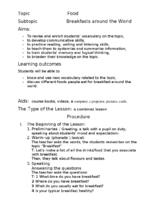
Subtopic Breakfasts around the World
Aims:
To revise and enrich students’ vocabulary on the topic,
to develop communicative skills,
to practice reading, writing and listening skills,
to teach them to systemize and summarize information,
to train students’ memory and logical thinking,
to broaden their knowledge on the topic.
Learning outcomes
Students will be able to
know and use new vocabulary related to the topic,
discuss different foods people eat for breakfast around the world.
Aids: course books, videos, a computer, a projector, pictures, cards.
The Type of the Lesson: a combined lesson
Procedure
The Beginning of the Lesson:
Preliminaries ( Greeting, a talk with a pupil on duty, speaking about students’ mood and expectation).
Warm-up (phonetic \ lexical)
The teacher asks the words, the students remember on the topic “Breakfast”
T: Let’s make a list of all the drinks/food that you associate with breakfast.
Then, they talk about flavours and tastes.
Speaking
Answering the questions
The teacher asks the questions:
T: 1 What time do you have breakfast?
2 Where do you have breakfast?
3 What do you usually eat for breakfast?
4 Is your typical breakfast healthy?
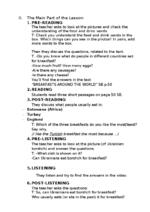
The Main Part of the Lesson:
PRE-READING
The teacher asks to look at the pictures and check the understanding of the food and drink words.
T: Check you understand the food and drink words in the box. Which things can you see in the photos? In pairs, add more words to the box.
Then they discuss the questions, related to the text.
T: -Do you know what do people in different countries eat for breakfast?
-How much fruit? How many eggs?
-Are there any sausages?
-Is there any cheese?
You’ll find the answers in the text
“BREAKFASTS AROUND THE WORLD” SB p.50
READING
Students read three short passages on page 50 SB.
POST-READING
They discuss what people usually eat in:
Botswana (Africa)
Turkey
England
T: Which of the three breakfasts do you like the most/least? Say why.
(I like the Turkish breakfast the most because ...)
PRE-LISTENING
The teacher asks to look at the picture (of Ukrainian borshch) and answer the questions.
T: -What dish is shown on it?
-Can Ukrainians eat borshch for breakfast?
LISTENING
They listen and try to find the answers in the video.
POST-LISTENING
The teacher asks the questions:
T: So, can Ukrainians eat borshch for breakfast?
Who usually eats (or ate in the past) it for breakfast?
What is/was the main reason to eat such a full breakfast?
What regular Ukrainians eat for breakfast?
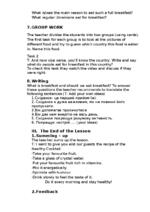
GROUP WORK
The teacher divides the students into two groups (using cards). The first task for each group is to look at the pictures of different food and try to guess which country this food is eaten in. Name this food.
Task 2
T: And now vice versa, you’ll know the country. Write and say what do people eat for breakfast in this country?
To check this task they watch the video and discuss if they were right.
Writing
What is breakfast and should we eat breakfast? To answer these questions the teacher recommends to translate the following sentences (T: Add your own ideas)
1.Сніданок- це перший прийом їжі.
2. Сніданок є дуже важливим, ми не повинні його пропускати.
3.Він допомагає прокинутися.
4.Він дає нам енергію на весь день.
5. Сніданок покращує розумову активність.
6. Покращує настрій …. (your ideas)
III. The End of the Lesson
Summing – up
The teacher sums up the lesson.
T: I want to give you and our guests the recipe of the Healthy Cocktail:
-Take your favourite fruit.
-Take a glass of crystal water.
-Put your favourite fruit rich in vitamins.
-Mix it energetically.
-Sprinkle with humour.
-Drink slowly to feel the taste of it.
Do it every morning and stay healthy!
Feedback
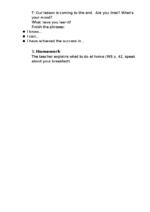
T: Our lesson is coming to the end. Are you tired? What’s your mood?
What have you learnt?
Finish the phrases:
I know...
I can...
I have achieved the success in...
Homework
The teacher explains what to do at home (WB p. 42, speak about your breakfast).