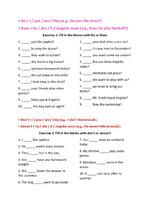
The core goal of these exercises is to help students achieve automaticity in subject-verb agreement. In English, choosing between do/does or don't/doesn't requires matching the verb format to the subject's grammatical person and number.
Key Learning Objectives
Master Subject-Verb Agreement: Training the brain to automatically pair singular subjects with does/doesn't and plural subjects (including I and you) with do/don't.
Build Sentence-Structure Frameworks: Helping students form correct negative statements and questions, which are foundational pillars of English grammar.
Identify Implicit Pronouns: Teaching kids to look at a noun like "the dog" or "my friends" and mentally translate it to "it" or "they" to find the right verb form.
Eliminate Common Oral Errors: Preventing habitual spoken mistakes like "He don't know" or "She do her homework."
Why This Matters for 3rd Graders
At around 8 to 9 years old, children are transitioning from "learning to read" to "reading and writing to learn." Mastering these foundational mechanics ensures that auxiliary verbs become second nature. This frees up their cognitive energy to focus on more complex writing tasks, like vocabulary choice, paragraph structure, and storytelling.