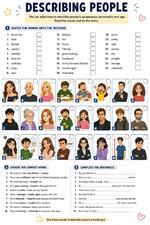
To create effective supplementary materials for teaching Describing People, your materials must target three core areas: appearance, personality, and emotional states.
Here is a comprehensive set of supplementary materials and activities ready for classroom use.
🎯 Lesson Aims & Objectives
Main Aim: To enable students to accurately describe a person's physical appearance and character traits using appropriate adjectives and sentence structures.
Subsidiary Aim: To practice using the correct word order (e.g., opinion + size + age + color) and the distinction between have got (for features) and be (for qualities).
Material 1: The Adjective Bank (Handout)
Divide your vocabulary lists into clear categories so students do not mix up sentence structures.
Age: young, elderly, middle-aged, in their twenties
Build: slim, athletic, stocky, plump, well-built
Height: short, petite, average height, tall
Hair: curly, straight, wavy, bald, shoulder-length
Eyes: hazel, piercing, expressive, almond-shaped
Personality: cheerful, introverted, generous, reliable, witty
Material 2: "Guess Who" Flashcards (Visuals)
Create or print cards featuring diverse characters (cartoons, historical figures, or celebrities). Each card should have distinct, contrasting features.
How to use: One student holds a card. The class asks Yes/No questions.
Target structures: "Does he have a beard?" / "Is she wearing glasses?"
Material 3: The Order of Adjectives Guide
Provide a quick visual formula to help students chain adjectives together correctly.
\(\text{Opinion}\rightarrow \text{Size}\rightarrow \text{Age}\rightarrow \text{Color}\rightarrow \text{Noun}\)
Example: "She has beautiful (opinion), long (size), dark (color) hair."
Example: "He is a friendly (opinion), tall (size), young (age) man."
Material 4: Classroom Activities & Worksheets
1. The Police Sketch Artist (Pair Work)
Setup: Student A receives a hidden picture of a face. Student B is the artist with a blank paper.
Task: Student A describes the face. Student B draws it based only on the description.
Focus: Precision in describing shapes, sizes, and facial features.
2. The "Double Agent" (Personality Match)
Setup: Write short paragraphs describing a person's behavior.
Example: "Tom always shares his lunch and listens to his friends' problems."
Task: Students match the paragraph to the correct personality adjective (generous / supportive).
3. Find Someone Who... (Mingling Bingo)
Create a grid with prompts to get students moving and talking.
Find someone who has wavy hair.
Find someone who is wearing a blue shirt.
Find someone who considers themselves adventurous.