

Цей тест створений на основі тексту про клімат та пори року в Новій Зеландії. Його мета — перевірити, наскільки учні зрозуміли зміст прочитаного тексту, а також навчити їх знаходити ключову інформацію.
- Всеосвіта›
- Бібліотека тестів›
- Англійська мова›
- Reading Comprehension. Climate in New Zealand. 8 NUSH

Тест:
Reading Comprehension. Climate in New Zealand. 8 NUSH
17.05.2026
Опис тесту (учням цей опис не показується):
Вміст тесту:
1
2
3
4
5
6
7
8
9
10
1
1 з 10 балів
Read the text and choose the right answer.
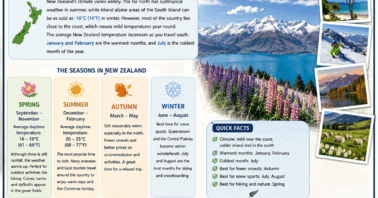
New Zealand’s climate varies wildly. The far north has subtropical weather during summer, while inland alpine areas of the South Island can be as cold as -10°C (14°F) in winter. However, most of the country lies close to the coast, which means mild temperatures year-round.
The average New Zealand temperature decreases as you travel south. January and February are the warmest months, and July is the coldest month of the year. Summer is the most popular time to visit New Zealand. Over December, January and February, the number of visitors increases, as people arrive from overseas to travel while the weather is warm. Summer holidays mean more Kiwis are travelling New Zealand too, making the most of the sunshine and Christmas break. If you would prefer to enjoy sunny days, but with fewer crowds, the best time to go to New Zealand is in autumn.
From March to May the weather is still reasonably warm – particularly in the north – but the crowds have thinned out. As autumn is also the shoulder season, you can enjoy better rates on accommodation and activities. Winter in New Zealand is the best time to visit if you’re enthusiastic about snow sports. With a light dusting of snow, Queenstown and the Central Plateau are transformed into winter wonderlands. If you want to ski or snowboard your way down the slopes of the Southern Alps, the best month to visit New Zealand is either July or August. Spring arrives in September and lasts until November. Although there is still a high chance of rainfall around this time of year, the weather starts to warm up – it’s the perfect time of year to enjoy outdoor activities such as hiking. Spring is also when calves, lambs and daffodils pop up in New Zealand’s green fields, so it’s an incredibly picturesque time. Cool nights and warm days are common, which makes for pleasant travel weather. Spring September - November Average daytime temperature: 16 - 19˚C (61 - 66˚F) Summer December - February Average daytime temperature: 20 - 25˚C (68 - 77˚F).
1. The climate in New Zealand is the same in all parts of the country.
2
1 з 10 балів
Read the text and choose the right answer.
New Zealand’s climate varies wildly. The far north has subtropical weather during summer, while inland alpine areas of the South Island can be as cold as -10°C (14°F) in winter. However, most of the country lies close to the coast, which means mild temperatures year-round.
The average New Zealand temperature decreases as you travel south. January and February are the warmest months, and July is the coldest month of the year. Summer is the most popular time to visit New Zealand. Over December, January and February, the number of visitors increases, as people arrive from overseas to travel while the weather is warm. Summer holidays mean more Kiwis are travelling New Zealand too, making the most of the sunshine and Christmas break. If you would prefer to enjoy sunny days, but with fewer crowds, the best time to go to New Zealand is in autumn.
From March to May the weather is still reasonably warm – particularly in the north – but the crowds have thinned out. As autumn is also the shoulder season, you can enjoy better rates on accommodation and activities. Winter in New Zealand is the best time to visit if you’re enthusiastic about snow sports. With a light dusting of snow, Queenstown and the Central Plateau are transformed into winter wonderlands. If you want to ski or snowboard your way down the slopes of the Southern Alps, the best month to visit New Zealand is either July or August. Spring arrives in September and lasts until November. Although there is still a high chance of rainfall around this time of year, the weather starts to warm up – it’s the perfect time of year to enjoy outdoor activities such as hiking. Spring is also when calves, lambs and daffodils pop up in New Zealand’s green fields, so it’s an incredibly picturesque time. Cool nights and warm days are common, which makes for pleasant travel weather. Spring September - November Average daytime temperature: 16 - 19˚C (61 - 66˚F) Summer December - February Average daytime temperature: 20 - 25˚C (68 - 77˚F).
2. Most of New Zealand is far from the sea.
3
1 з 10 балів
Read the text and choose the right answer.
New Zealand’s climate varies wildly. The far north has subtropical weather during summer, while inland alpine areas of the South Island can be as cold as -10°C (14°F) in winter. However, most of the country lies close to the coast, which means mild temperatures year-round.
The average New Zealand temperature decreases as you travel south. January and February are the warmest months, and July is the coldest month of the year. Summer is the most popular time to visit New Zealand. Over December, January and February, the number of visitors increases, as people arrive from overseas to travel while the weather is warm. Summer holidays mean more Kiwis are travelling New Zealand too, making the most of the sunshine and Christmas break. If you would prefer to enjoy sunny days, but with fewer crowds, the best time to go to New Zealand is in autumn.
From March to May the weather is still reasonably warm – particularly in the north – but the crowds have thinned out. As autumn is also the shoulder season, you can enjoy better rates on accommodation and activities. Winter in New Zealand is the best time to visit if you’re enthusiastic about snow sports. With a light dusting of snow, Queenstown and the Central Plateau are transformed into winter wonderlands. If you want to ski or snowboard your way down the slopes of the Southern Alps, the best month to visit New Zealand is either July or August. Spring arrives in September and lasts until November. Although there is still a high chance of rainfall around this time of year, the weather starts to warm up – it’s the perfect time of year to enjoy outdoor activities such as hiking. Spring is also when calves, lambs and daffodils pop up in New Zealand’s green fields, so it’s an incredibly picturesque time. Cool nights and warm days are common, which makes for pleasant travel weather. Spring September - November Average daytime temperature: 16 - 19˚C (61 - 66˚F) Summer December - February Average daytime temperature: 20 - 25˚C (68 - 77˚F).
3. The temperature becomes lower when you travel south.
Запитання №4 З однією правильною відповіддю
Запитання №5 З однією правильною відповіддю
Запитання №6 З однією правильною відповіддю
Запитання №7 З однією правильною відповіддю
Запитання №8 З полем для вводу відповіді
Запитання №9 З полем для вводу відповіді
Запитання №10 З полем для вводу відповіді
Рефлексія від 9 учнів
Сподобався:
0
Так: 9
Ні: 0
Зрозумілий:
0
Так: 9
Ні: 0
Потрібні роз'яснення:
0
Ні: 9
Так: 0