- Всеосвіта›
- Бібліотека тестів›
- Англійська мова›
- Old HS1 Unit5 #4

Тест:
Old HS1 Unit5 #4

01.09.2021


Вміст тесту:
1
2
3
4
5
6
7
8
9
10
11
12
13
14
Тест містить питання скопійовані з: HS1 2018unit5 #3.
1
12 з 168 балів
Unscramble the words and type them in the blanks. Don’t forget about articles and particle “to”.
1) nvl
2) pm
3) pprbck
4) bgrph
5) mgzn
6) rtcl
7) rprt
8) fctn
9) frtl
10) pblsh
11) hrdcvr
12) tls
2
12 з 168 балів
Match the words with their definitions.
1
an encyclopedia |
А
pictures in the books |
2
a bookworm
Б
a book where you can find the recipe of borsch and other dishes |
3
a dictionary |
В
to take a book home from the library |
4
a cookery book
Г
a story where the author tells his own life story
5
a textbook
Ґ
a person who likes reading very much
6
to borrow a book from the library
Д
a book that lists the words of a language (typically in alphabetical order) and gives their meaning, or gives the equivalent words in a different language, often also providing information about pronunciation, origin, and usage.
7
a bibliography
Е
a book where you can find the information on specific subjects |
8
an authobiography
Є
a book giving information on many subjects and typically arranged alphabetically
9
illustrations
Ж
a book with rules and exercises for every school subject |
10
a reference book
З
the list of books you have used to write a report |
3
12 з 168 балів
Tick all the points which belong to fiction literature.
4
12 з 168 балів
Fill in the gaps with the prepositions in, on, of, since, from, into, by.
1) Do you like the illustrations
this book
fairytales?
2) Who has recently borrowed this book
the library?
3) Where is my favourite encyclopedia? – It’s
the second shelf.
4) Yesterday I found a lot of interesting recipes
the new cookery book.
5) “The Lord of The Rings” is a novel written
J. R. R. Tolkien.
6) Every dictionary is a wonderful source
new words.
7) Could you translate this wonderful poem
English
Ukrainian?
8) I’d be very happy to listen
the author of this drama.
9) He has been reading fantastic fiction
childhood.
10) What are your favourite kinds
books?
5
12 з 168 балів
Match the tense form with its tense indicator.
1
Present Simple
А
lately
2
Present Continuous
Б
while I was reading “The Wolf and Seven Kids”
3
Past Simple
В
last summer
4
Future Simple
Г
by the end of the week
5
Present Perfect
Ґ
for seven months already
6
Past Continuous
Д
sometimes
7
Future Continuous
Е
in a year
8
Past Perfect
Є
by next Friday
9
Future Perfect
Ж
Listen!
10
Present Perfect Continuous
З
at 3 p.m. tomorrow
6
12 з 168 балів
Fill in the blanks with the correct predicate. Choose Present Perfect or Present Perfect Continuous.
Jack (to speak) on the phone for an hour and a half already.
Mary (to look) for the information in my reference book since I gave it to her.
We (not to paint) the illustrations yet.
Who (just to put) this hardcover on my desk?
Thank you for the book with fairytales, Mary. My daughter (to read) it for two hours.
(already to phone) the producer? I want to speak about the release of the film.
I don’t like the mess in my room, that’s why I (to arrange) all the books on my shelf in ABC order recently.
Mag (to dream) of watching this documentary all her life!
These travellers (not to see) all the monuments in this region yet.
We (to choose) a new dictionary for our daughter for two hours already!
7
12 з 168 балів
Choose the correct predicate according to the tense of the sentence.
Jack [has been writing, is writing] his autobiography for 3 years already.
Liza doesn’t like to borrow the books from the library because she always [will forget, forgets] to bring them back.
While they [chose, were choosing]the sound track for the film, we [were speaking, spoke] about the casting.
He [was reading, used to read] many adventure books, when he was a child. Now he doesn’t have enough time for that.
Alice [will bring, will have brought] me the book about an extraordinary boy by next Tuesday.
Mother [had bought, bought]a wonderful dress at a reasonable price by the time I came to the shop.
At this time tomorrow I [will finish, will be finishing] my report about the famous British poet.
The pupils of this school [are choosing, have chosen] all necessary textbooks this week.
Who [will be, is] responsible for the presentation of this book next week?
What newspaper [did, were] you read last week?
What [does, is] Max [do, doing] now? – He [retells, is retelling] the biography of his favourite writer.
8
12 з 168 балів
1. Tim was [so tired, such a tired, such tired, so a tired] when he got home he fell asleep immediately.
2. When Carl phoned he was [in, by, on, with] a ship from France to Holland.
3. The park [we went, where we went, to where we went, to went] was near the river.
4. - Did you know that one of the chairs in the kitchen is broken? – Yes, I did. I [I mend , I mended, I have mended, I’m going to mend] it tomorrow.
5.- What did you think of the Science museum? – It was [the most interesting , as interesting than, more interesting than, interestinger that] I expected.
6. Most people [don’t do, didn’t do, aren’t doing, won’t do] enough exercise so they are quite unfit.
7. I want to go scuba-diving as soon as [I will finish, I will be finishing, I finished, I finish] the training.
8. Do you like [a chocolate, chocolate, many chocolate, few chocolate] ?
9. Don’t forget to [read , listen, write down, tell] any good recipes when you watch the cookery programme on television tonight.
10. We’re really looking forward [to having, to have, having, had] dinner with you tomorrow.
11. I prefer [dance , to dance, dancing, danced] to going to the gym as a way of keeping fit.
12. What did you think of the film? – I thought it was [well, good, better, badly].
13. When is the best time to call you? – Well, [every , the most, along, most] days I get home at 6.00, so any time after that.
14. How about going [on, in, at, with] a cruise to Brazil for our silver wedding anniversary?
15. I’m starting a new job next week. – Good luck! I hope it goes [good, well, the better, were] for you.
16. What was Tim’s reaction when you told him he was going to be a father? – He was happy [of, for, with, about] it, of course.
17. Please, can you stop talking? I need to concentrate [in, into, on, at] my work.
18. Can you swim in the sea here? –Yes, it’s [perfectly safe, perfect safe, perfect safety, more safe] . There are no sharks.
19. On my way home I [ended up, called off, dropped in, got up] to see Helen, as I was passing her house.
20. Are Mark and Sam here or [had they gone, have they been, they have gone, have they gone] to the sports centre?
21. What do you think [for, of, on, with] my new car? – It’s great. How much was it?
22. Police are looking for [the unemployed , an unemployed man, an unemployed, an unemployed woman] in his twenties.
23. Carl was so worried about work he even [dreamt , dreamt of, wished, dreamt about] it in his sleep.
24. I feel [terribly, more terrible, terrible, badly] this morning. I think I have a cold.
25. We were worried because we [could, can, must, should] smell petrol in the car.
26. If you are looking for [informations, an information, many information, information]on where to visit while you are here, please ask our staff at reception.
27. How long [has Emma been teaching, did Emma teach, had Emma taught, does Emma teach] at you school? – Since September. She’s really enjoying it.
28. Tom’s boss is very demanding. I don’t know how Tom [keeps up with , comes up with, puts up with, gets up with] him.
29. Susan’s house is mostly made of [a wood , wood, woods, wooden] .
30. [Did Matt know, Why doesn’t Matt know, Does Matt know, Who knows]a lot about classical music? – Yes. He’s studied it for years.
31. James can swim really [nice , good, better, well] . He’s the captain of the swimming team.
32. This is a very quiet town. Nothing [exciting, excited, excitingly, boringly] ever happens here.
33. I’m going on holiday to Spain next week. [Until, Before, As soon as, After] I go, I need to buy some suntan lotion.
34. Judy telephoned her uncle to thank [him, to him, him for, him that] the lovely necklace he sent for her birthday.
35. There were 20 questions in the test, [neither of which, most of which, any of which, some of any] I answered correctly.
36. The dog [has been barking , is barking, was barking, had barked] since two o’clock.
37. The journalists [are interviewing, had interviewing, will interview, have been interviewing] celebrities for three hours.
38. We [talked, have been talking, had talked, talk] about this documentary for half an hour and haven’t finished yet.
39. The foreign students [improve, improved, have been improving, had improved] their language skills since September.
40. The computers [did, have been doing, do, will do] children and teenagers a lot of harm since they appeared in our everyday life.
41. The Internet [have been replacing, replaced, replace, were replacing] radio and TV since 90s.
42. This factory [are producing , produced, has been producing, produce] … producing cars since October.
43. Public transport [influenced , were influencing, are influencing, has been influencing] the nature for two centuries already.
44. The pupils [have not been practicing , have been not practicing, are not practicing, has been practicing] their musical skills since four o’clock.
45. Mark [had never lived, never lives, will never live, has never lived] away from home before. He’s missing his family now.
9
12 з 168 балів
Listening
Part 1
Questions 1-7
There are seven questions in this part.
For each question there are three pictures and a short recording.
Choose the correct picture and put a tick (v) in the box below it.
Example: How does the woman travel to work?
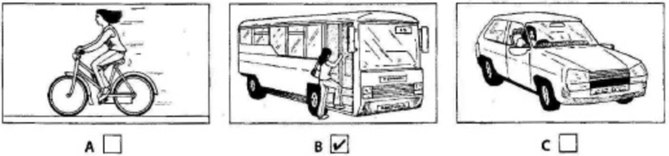
1. What time will the train arrive at the station?
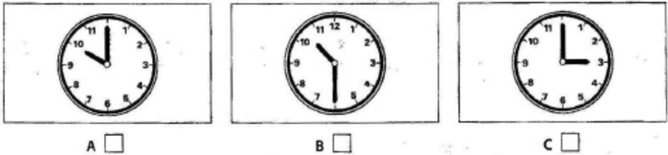
[a, b, c]
2. What is the woman going to do on holiday?
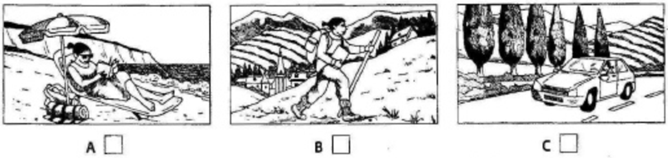
[a, b, c]
3. What is the guest going to talk about?
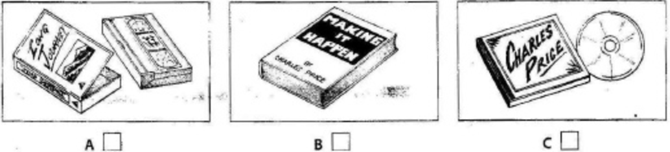
[a, b, c]
4. Where did the man go last night?
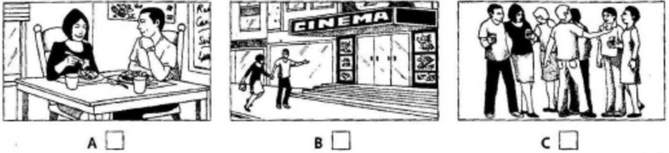
[a, b, c]
5. Where does Anna live now?
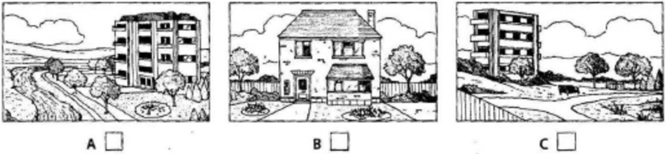
[a, b, c]
6. What does the man’s teacher look like?
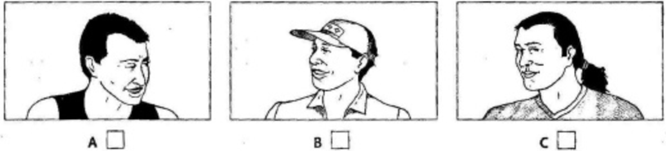
[a, b, c]
7. Where is the letter?
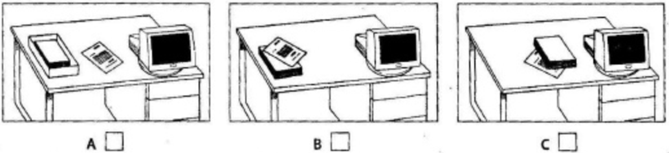
[a, b, c]
10
12 з 168 балів
Part 2
Questions 8-13
You will hear an interview with a writer.
For each question choose the right answer.
8.Jack started writing when he [worked at a school, gave up his job as a teacher, was very young]
9.Jack keeps fit by [exercising every day, running every morning, going for walks]
10.Jack eats his lunch [at the same time every day, away from his computer, while he is writing]
11.Jack likes to write [only in his office, in different places, in the kitchen]
12.How long does it take Jack to completely finish a novel?
[about six months, more than a year, less than twelve months]
13. What does Jack do after he's finished a novel?
[He goes away on his own., He stops writing for a while., He starts writing something else.]
11
12 з 168 балів
Part 3
Questions 14-19
You will hear somebody talking about a fashion show.
For each question, fill in the missing information in the numbered space.
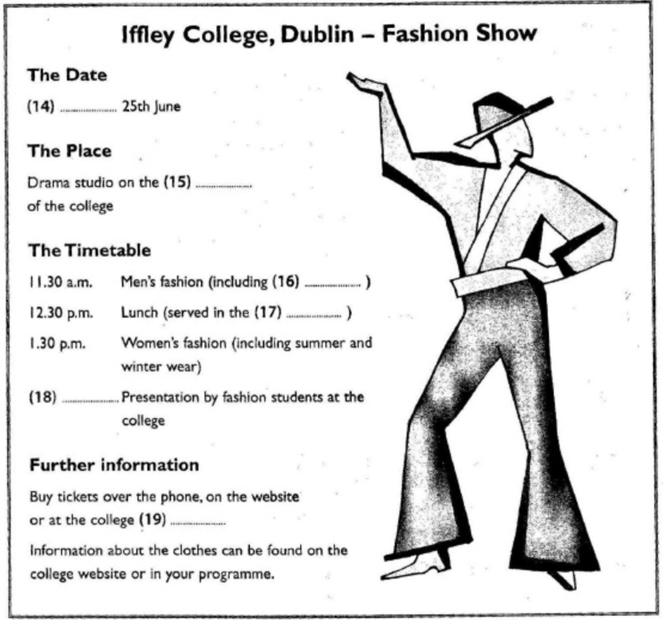
14.
15.
16.
17.
18.
19.
12
12 з 168 балів
Part 4
Questions 20-25
Look at six sentences for this part.
You will hear a conversation between a girl, Sarah, and a boy, Thomas, about moving abroad.
Decide if the sentence is correct or incorrect.
If it is correct, choose YES. If it is not correct, choose NO.
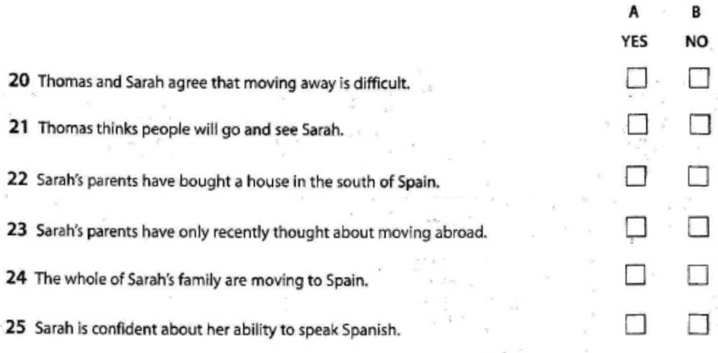
20. [yes, no]
21. [yes, no]
22. [yes, no]
23. [yes, no]
24. [yes, no]
25. [yes, no]
13
12 з 168 балів
Reading
Read and complete the text below. For each of the empty spaces choose the correct answer.
PUNCTUALITY
Most Americans and British people would agree that it is good manners to be punctual (to arrive the right time) for an appointment. Arriving on time for formal [incidents, accidents, events, episodes] such as a business meeting or an interview is considered important. If somebody arrives late for a job interview it may [suggest, offer, recommend, propose]that they are not reliable or not interested in the job. Many people try to arrive a few minutes early for an appointment to [avoid, escape, run, experience] the risk of rushing in at the last minute. Even in less formal situations people are generally expected to think about the person they are meeting and not to [make, hold, stay, keep]them waiting unnecessarily.
People are also expected to arrive on time for social events, especially weddings. Traditionally only the bride is allowed to be late. People are [largely, generally, firstly, principally]more relaxed about the time they arrive for more informal social occasions. When meeting a friend for lunch at a restaurant people try to arrive at the time [agreed, arranged, organized, prepared], or no more than five minutes late. If they are later than this the person they are meeting will start to think they are not going to come at all. However, when invited to dinner in somebody's home it is actually considered polite to arrive a few minutes late. Under no [points, situations, circumstances, states] should guests arrive early. At a party, however, people may arrive an hour or more after the start time written on the invitation.
If somebody does arrive late, they are expected to [excuse, justify, forgive, apologize] . Depending on the circumstances and how late they are, people may say “I'm sorry I'm late” or “Sorry to keep you waiting”. If they are very late they may feel obliged to give an [account, explanation, answer, interpretation]as well, e.g “I'm sorry I'm so late, but the traffic was bad.” People [expect, believe, imagine, trust]concerts, plays etc. to start at the time advertised, and if they are made to wait a long time they may start a slow handclap to show that they are impatient.
14
12 з 168 балів
Read the text below. Choose from (A—H) the one which best fits each space (1—6). There are two choices you do not need to use.
A SALUTE TO SPRING
People in the United States celebrate Easter according to their personal and religious beliefs. Christians commemorate Good Friday as the day that Jesus Christ died and Easter Sunday as the day (1) [A has left them baskets of candies, В to meet at the church service, C that he was resurrected, D who finds the most eggs, E when people meet, F when tourists are allowed, G all over the country, H to roll eggs against the pyramids]. On Easter Sunday children wake up to find that the Easter Bunny (2) [A has left them baskets of candies, В to meet at the church service, C that he was resurrected, D who finds the most eggs, E when people meet, F when tourists are allowed, G all over the country, H to roll eggs against the pyramids]. Children hunt for eggs around the house that they decorated earlier that week. Neighborhoods hold Easter egg hunts. The child (3) [A has left them baskets of candies, В to meet at the church service, C that he was resurrected, D who finds the most eggs, E when people meet, F when tourists are allowed, G all over the country, H to roll eggs against the pyramids] wins a prize.
Traditionally, many celebrants bought new clothes for Easter which they wore to church. After church services, everyone went for a walk around the town. This led to the American custom of Easter parades (4) [A has left them baskets of candies, В to meet at the church service, C that he was resurrected, D who finds the most eggs, E when people meet, F when tourists are allowed, G all over the country, H to roll eggs against the pyramids] . In the early nineteenth century, Dolly Madison, the wife of the fourth American President, organized an Easter egg roll in Washington, D.C. She had been told that Egyptian children used (5) [A has left them baskets of candies, В to meet at the church service, C that he was resurrected, D who finds the most eggs, E when people meet, F when tourists are allowed, G all over the country, H to roll eggs against the pyramids] , so she invited the children of Washington to roll hard-boiled eggs down the lawn of the new Capitol building! The event has grown, and today Easter Monday is the only day of the year (6) [A has left them baskets of candies, В to meet at the church service, C that he was resurrected, D who finds the most eggs, E when people meet, F when tourists are allowed, G all over the country, H to roll eggs against the pyramids] on the White House lawn. The egg-rolling event is open to children twelve years old and under. Adults are allowed only when accompanied by children.
Рефлексія від 5 учнів
Сподобався:
0
Так: 3
Ні: 2
Зрозумілий:
0
Так: 2
Ні: 3
Потрібні роз'яснення:
0
Ні: 2
Так: 3