- Всеосвіта›
- Бібліотека тестів›
- Англійська мова›
- HS1 2018unit5 #3

Тест:
HS1 2018unit5 #3

01.09.2021
Вміст тесту:
1
2
3
4
5
6
7
8
9
10
11
12
13
14
15
16
17
18
19
1
12 з 228 балів
Unscramble the words and type them in the blanks. Don’t forget about articles and particle “to”.
1) nvl
2) pm
3) pprbck
4) bgrph
5) mgzn
6) rtcl
7) rprt
8) fctn
9) frtl
10) pblsh
11) hrdcvr
12) tls
2
12 з 228 балів
Match the words with their definitions.
1
an encyclopedia |
А
pictures in the books |
2
a bookworm
Б
a book where you can find the recipe of borsch and other dishes |
3
a dictionary |
В
to take a book home from the library |
4
a cookery book
Г
to give sth to sb on the understanding that it will be returned.
5
a textbook
Ґ
a person who likes reading very much
6
to borrow a book from the library
Д
a book that lists the words of a language (typically in alphabetical order) and gives their meaning, or gives the equivalent words in a different language, often also providing information about pronunciation, origin, and usage.
7
an e-book
Е
a book where you can find the information on specific subjects |
8
to lend
Є
a book giving information on many subjects and typically arranged alphabetically
9
illustrations
Ж
a book with rules and exercises for every school subject |
10
a reference book
З
an electronic version of a printed book that can be read on a computer or a specifically designed device. |
3
12 з 228 балів
Fill in the gaps with the prepositions in, on, of, since, from, into, by.
1) Do you like the illustrations
this book
fairytales?
2) Who has recently borrowed this book
the library?
3) Where is my favourite encyclopedia? – It’s
the second shelf.
4) Yesterday I found a lot of interesting recipes
the new cookery book.
5) “The Lord of The Rings” is a novel written
J. R. R. Tolkien.
6) Every dictionary is a wonderful source
new words.
7) Could you translate this wonderful poem
English
Ukrainian?
8) I’d be very happy to listen
the author of this drama.
9) He has been reading fantastic fiction
childhood.
10) What are your favourite kinds
books?
4
12 з 228 балів
Tick all the nouns which are used only in plural.
5
12 з 228 балів
Tick those cases where plural is wrong. Tick those cases where plural is wrong.
6
12 з 228 балів
Match the verb with the correct preposition according to the translation.
1
відвідати когось ненадовго – to call |
А
off
2
скасувати - to call |
Б
in
3
заїхати чи зайти за кимось – to call
В
on
4
викликати – to call
Г
back
5
ще раз зайти чи зателефонувати – to call
Ґ
for
7
12 з 228 балів
Choose the correct item according to the meaning of the sentence.
Lily has been [looking down on, looking forward to, looking for]this meeting for 5 months already.
I have phoned you one hundred times! Why didn’t you call [off, in, back]?
You can always turn [to, off, into]Ben. He is very kind and will definitely help you with all your problems.
I’m disappointed, because he [turned over, turned to, turned out to be] such a lazybone, that I can’t do a thing with him!
Give me your cookery book, please. I want to look it [after, at, over]. I noticed an interesting recipe the previous time.
If you come [across, on, down]this dictionary, please, buy it for me!
When did this novel come [up with, out, by]? I haven’t heard it yet.
Phone Jessika and call our meeting [on, for, off]. I am on my way to the university and I won’t be able to come back so soon.
While your children were turning the room [upside down, on, down], I was trying to find my keys in that mess!
Father had called [off, in, for]me to school by 5 p.m. yesterday.
8
12 з 228 балів
Complete the sentences by changing the form of the word in capitals.
I adore your illustrations in this book! You have such a rich . TO IMAGINE
The chief of this newspaper offered me a job! I’m going to have an interview tomorrow! TO EDIT
Are you the of this famous magazine? TO PUBLISH
It seems to me, it will be extremely difficult to these words for such small children. MEMORY
Do you to publish your first book in this publishing office? TO INTEND
My little sister likes fantastic stories about sea . TO CREATE
Well, my mom doesn't work, and my dad works for a film company. TO DISTRIBUTE
I think, the film director will have found view to impress the audience by next September. TO SPECTATE
His on the stage was inappropriate. TO IMPROVISE
My friends and I are going to watch this astonishing on TV tomorrow. TO PERFORM
9
12 з 228 балів
Match the tense form with its tense indicator.
1
Present Simple
А
lately
2
Present Continuous
Б
while I was reading “The Wolf and Seven Kids”
3
Past Simple
В
last summer
4
Future Simple
Г
by the end of the week
5
Present Perfect
Ґ
for seven months already
6
Past Continuous
Д
sometimes
7
Future Continuous
Е
in a year
8
Past Perfect
Є
by next Friday
9
Future Perfect
Ж
Listen!
10
Present Perfect Continuous
З
at 3 p.m. tomorrow
10
12 з 228 балів
Fill in the blanks with the correct predicate. Choose Present Perfect or Present Perfect Continuous.
Jack (to speak) on the phone for an hour and a half already.
Mary (to look) for the information in my reference book since I gave it to her.
We (not to paint) the illustrations yet.
Who (just to put) this hardcover on my desk?
Thank you for the book with fairytales, Mary. My daughter (to read) it for two hours.
(already to phone) the producer? I want to speak about the release of the film.
I don’t like the mess in my room, that’s why I (to arrange) all the books on my shelf in ABC order recently.
Mag (to dream) of watching this documentary all her life!
These travellers (not to see) all the monuments in this region yet.
We (to choose) a new dictionary for our daughter for two hours already!
11
12 з 228 балів
Choose the correct predicate according to the tense of the sentence.
Jack [has been writing, is writing] his autobiography for 3 years already.
Liza doesn’t like to borrow the books from the library because she always [will forget, forgets]to bring them back.
While they [chose, were choosing] the sound track for the film, we [were speaking, spoke] about the casting.
He [was reading, used to read]many adventure books, when he was a child. Now he doesn’t have enough time for that.
Alice [will bring, will have brought] me the book about an extraordinary boy by next Tuesday.
Mother [had bought, bought]a wonderful dress at a reasonable plice by the time I came to the shop.
At this time tomorrow I [will finish, will be finishing] my report about the famous British poet.
The pupils of this school [are choosing, have chosen]all necessary textbooks this week.
Who [will be, is]responsible for the presentation of this book next week?
What newspaper [did, were] you read last week?
What [does, is]Max [do, doing]now? – He [retells, is retelling] the biography of his favourite writer.
12
12 з 228 балів
Open the brackets and put the verbs into the correct form.
1. Helen (to read) a fairytale now. She (to read) since eleven o’clock, but she (not to finish) the book yet.
2. Sally and James always (to publish) new novels on Mondays. They (to edit) Sarah’s novel now. They (to edit) three novels today. They (to work) since they (to come) to the office.
3. Listen! John (to present) his poems. He (to talk) since early morning, and he (to present) 5 poems so far.
4. The reader (to borrow) a book from the library recently. He (to read) it for three days, but (not to finish) reading it yet. I think he (to return) it in two days. The reader (to read) the book by that time.
5. my friends always (to entertain) the peers during the parties? – Yes, they . But today they (not to discuss) any ideas, so they (not to be going) to perform anything. They (to make) up some ideas by the time the guests (to come).
6. The actors (to perform) at this theatre for seven months already. They always (to entertain) the audience with either drama or comedy. Both the actors and the director (to look) at the results of their work while the stage crew (to create) the set at 5 p.m. yesterday. All of them (to make) most of their arrangements by that time. Tomorrow at this time the director (to look) on the audience’s reaction to a new play.
13
12 з 228 балів
General Test
1. Jo didn’t eat the fish because it smelled a bit [strange , strangely, stranger, strangest] .
2. We always [to Spain go on holiday every year, go to Spain on holiday every year., every year go to Spain on holiday., on holiday every year go to Spain] .
3. The flat was very cold when we got home because we [didn’t close, haven’t closed, hadn’t closed, will close] the windows.
4. My dentist [said me to, said that, told me to, had told me] clean my teeth more carefully.
5. I must write to Brian to thank him [for , to , on, with] the lovely present he sent for my birthday.
6. When Carl phoned he was [on, as, in, at] a ship from France to Holland.
7. Even [more intelligent than, the most intelligent, the best intelligent, as intelligent as] students sometimes fail exams.
8. After talking about the music festival, Kirsty went on … Sam’s party.
[to describe, describe, have described, will describe]
9. I wonder if Laura and Joe [to get, will get, shall get, getting]… married. They seem very happy together.
10. In the exam room, there was a sign saying ‘ [None, No, Not, Any] talking’.
11. –What did you have for lunch? – Oh, just a … .
[sandwich with cheese, sandwich of cheese, cheese sandwich, cheese with sandwich]
12. Birmingham is the second largest city in the [Great Britain , England, United Kingdom, Northern Island] .
13. Jane looked [terrible, terribly, so terrible, such a terrible] upset: “Yes. She lost her job this morning”.
14. Jeremy showed us the photos [that, who, when, why] he took while on holiday.
15. I had [such, such a, so, still] great time on holiday I didn’t want to come home.
16. The president can [nor, both, enough, neither] confirm nor deny the rumours that he is about to resign.
17. Did you bring [a luggage, any luggages, the luggages, any luggage] ?
18. [for, during, while, since] his career, Joseph Barnes won the respect of all his colleagues.
19. I wonder how [tell, telling, to tell, have told] Lucy that I’d lost the sweater she’d lent me.
20. I really loved [those flowers you, those flowers, which you, those flowers that you, that flowers, that you] gave me for my birthday.
21. I asked Jonathan if [had enjoyed he, had he enjoyed, he’d enjoyed, he will be enjoying] the music festival.
22. It’s been months [since I last heard, that I don’t hear, that I haven’t heard, which I will hear] from Tom. He used to phone every week.
23. The town was [crowded of, full of, filled of, busy of] people waiting for the start of the festival.
24. Amy learned [swimming, to swim, to swimming, have swum] when she was very young.
25. This is the shop [when, why, when, where] I worked.
26. After painting the lounge, Harry and Sue were tired so they made [both of them, each of them, themselves, themself] a cup of tea and had a rest.
27. There are no clouds in the sky, so it [won’t rain probably, won’t probably rain, rain probably, probably won’t rain]. today.
28. Simon [left work early, early left work, left early work, work early] because it was his son’s birthday.
29. – I work for a very small engineering company. – How many people [work , do work, did work, had worked] there? – Only six.
30. Do you think you have the skills [so that you deal with , to deal with, for to deal with, which dealing to] angry customers?
31. Tim was reading a newspaper [along , at, on, in] the kitchen when I last saw him.
32. I won’t expand on this in detail as we are a little short [at , of, in, along] time.
33. Dirk [didn’t need to come , needn’t come, needn’t have come, don’t need to come] to Britain for work last year, so he didn’t visit us.
34. James had lunch with a friend [which , what, who, whose] he hadn’t seen since they were at school together.
35. She [worked, will work, works, has been working] here for 5 years.
36. I [have translated, have been translating, has been translating, is translating] this text since morning and I haven’t finished it yet.
37. Our parents [are discussing , have been discussing, discussed, were discussing] their plans for the holiday for two hours already.
38. The scientists [work , will work, have been working, were working] on this research for three years already.
39. Human society [destroyed, have been destroying, are destroying, can destroy] the world around us since the scientists invented machines.
40. Her son [surfs, has surfing, has been surffed, has been surfing] the Net since morning and even hasn’t had dinner yet.
41. Our managers [have been solving, had solved, will be solving, shall solve] money problems since Monday, but they have done nothing yet.
42. Sam [had learnt, should learn, has been learning, has learning] English for ten years and still doesn’t know much.
43. They [is waiting - arrives, has waited - arrived, has been waiting – has arrived, have been waiting – hasn’t arrived]… for Tom for thirty minutes already, and he still … yet.
44. Mrs. Barkly [has been watching, will be watching, shall be watching, must watch] this soap opera since she was a little girl.
45. Laura [had talked, hasn’t been talking, hasn’t been, has talking] to Tom since he made fun of her.
14
12 з 228 балів
Listening
Part 1
Questions 1-5
You will hear five short conversations.
There is one question for each conversation.
For questions 1-5, put a tick (v) under the right answer.
Example: What time will they meet?
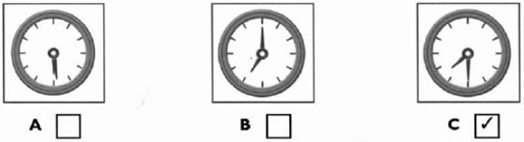
1. What’s Steve doing now?
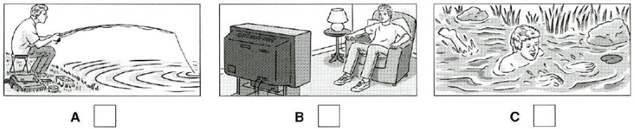
[a, b, c]
2. How are they going to get to the countryside?
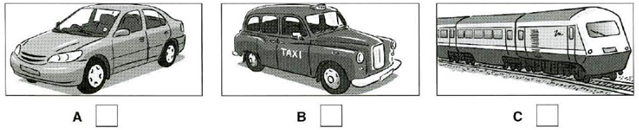
[a, b, c]
3.What will the woman do tonight?
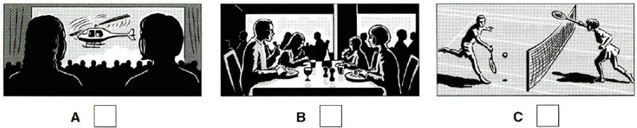
[a, b, c]
4. Where is the cat now?
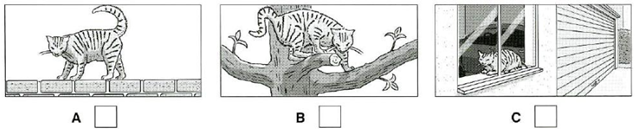
[a, b, c]
5. What job does Mary’s brother do?
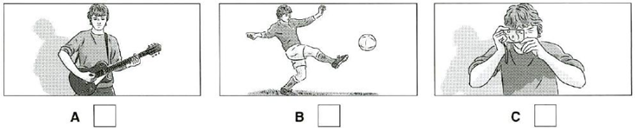
[a, b, c]
15
12 з 228 балів
Listening
Part 2
Questions 6-10
Listen to Jane telling ger father about the extra subjects she is doing at school. What subject does she do on each day?
For questions 6-10, make your choice next to each day.
You will hear the conversation twice.
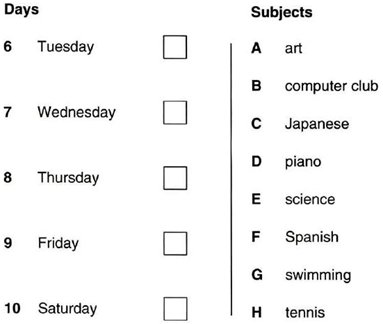
6.Tuesday [a)art, b)computer club, с)Japanese, d)piano, e)science, f)Spanish, swimming, tennis]
7.Wednesday
[a)art, b)computer club, c)Japanese, d)piano, e)science, f)Spanish, g)swimming, h)tennis]
8.Thursday
[a)art, b)computer club, c)Japanese, d)piano, e)science, f)Spanish, g)swimming, h)tennis]
9.Friday
[a)art, b)computer club, c)Japanese, d)piano, e)science, f)Spanish, g)swimming, h)tennis]
10.Saturday
[a)art, b)computer club, c)Japanese, d)piano, e)science, f)Spanish, g)swimming, h)tennis]
16
12 з 228 балів
Listening
Part 3
Questions 11-15
Listen to Peter talking to a friend about a school trip.
For questions 11-15, tick (v) A, B or C.
You will hear the conversation twice.
11.The first place Peter visited was the [castle, museum, cathedral]
12.Peter enjoyed listening to a talk about [paintings, stamps, clocks]
13.Peter thought the castle was [empty, cold, dark]
14.In a shop, Peter got [a book, some food, postcards]
15.Peter took photographs of [windows, people, a bus]
17
12 з 228 балів
Part 4
Questions 16-20
You will hear a telephone conversation about a show at a theatre.
Listen and complete questions 16-20.
You will hear the conversation twice.
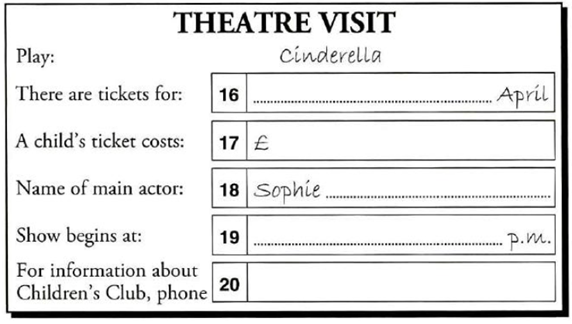
16.
17.
18.
19.
20.
18
12 з 228 балів
Part 5
Questions 21-25
You will hear a man leaving a message.
Listen and complete questions 21-25.
You will hear the information twice.
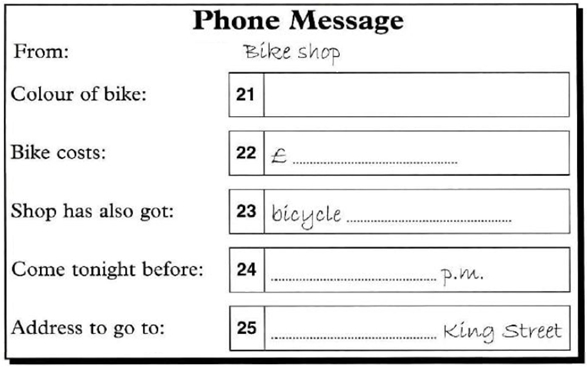
21.
22.
23.
24.
25.
19
12 з 228 балів
Reading
Read the texts below. For questions (1-12) choose the correct answer (A, B, C or D).
Charles Dickens
Charles Dickens was born in Portsmouth in 1812 and died in London in 1870. He is buried in Poets’ Corner in Westminster Abbey. Dickens spent (1) [most of, moreof, most, more of] his life in London and often used to walk (2) [among, for, between, through] ten and twenty miles all over the city when he was (3) [could, couldn't, can, can't] sleep and was thinking about the plot of a new novel. While he (4) [walked, walking, walk, was walking], he used to observe the sights, sounds and smells of London in order to write about them. Because of the Industrial Revolution Britain, and especially London (5) [grown, growing, was grown, grew] very quickly.
Roald Dahl’s Adventures
When Roald was sixteen, he decided to go off on his own to holiday in France. He (6) [swam, crossed, went, left] the Channel from Dover to Calais with £24 in his pocket (a lot of money in 1933). Roald wanted to see the Mediterranean Sea, so he took the train first to Paris, then to Marseilles where he (7) [got on, took off, came in, put on] a bus that went all the way along the coastal road towards Monte Carlo. He finished up at a place called St Jean Cap Ferrat and (8) [stood, spent, sat, stayed] there for ten days.
He travelled back home the same way but, by(9) [a, an, the, -] time he reached Dover, he (10) [had, have, saved, save]absolutely no money left. Luckily a fellow passenger (11) [was giving, gave, give, had been given]him ten shillings for his tram fare home. Roald never (12) [forgot, forgive, forget, forgiven]this kindness and generosity.
Рефлексія від 4 учнів
Сподобався:
0
Так: 4
Ні: 0
Зрозумілий:
0
Так: 4
Ні: 0
Потрібні роз'яснення:
0
Ні: 0
Так: 4