- Всеосвіта›
- Бібліотека тестів›
- Англійська мова›
- HS2 2019 unit6 p103 act9

Тест:
HS2 2019 unit6 p103 act9

12.11.2021

Вміст тесту:
1
2
3
4
5
6
7
8
9
10
11
12
Тест містить питання скопійовані з: HS2 2019 unit5 p94 act3.
1
12 з 144 балів
There are introduced the benefits of physical activity.
Match English and Ukrainian Equivalents.
1
Lowers risk of heart disease, stroke, and diabetes.
А
Зняття стресу.
2
Helps manage weight.
Б
Посилена аеробна фізична форма.
3
Reduced blood pressure.
В
Переваги для психічного здоров’я.
4
Enhanced aerobic fitness.
Г
Знижує ризик серцевих захворювань, інсульту та діабету.
5
Improved muscular strength and endurance.
Ґ
Контролює холестерин.
6
Stress relief.
Д
Поліпшення сну.
7
Lowers risk of certain types of cancer.
Е
Знижений артеріальний тиск.
8
Control cholesterol.
Є
Тривале життя.
9
Strengthens immune system.
Ж
Поліпшення м'язової сили та витривалості.
10
Improved sleep.
З
Допомагає контролювати вагу.
11
Mental health benefits.
И
Знижує ризик розвитку деяких видів раку.
12
Prolonged life.
І
Зміцнює імунну систему.
2
12 з 144 балів
Match the pictures with the words they define.
1

А
Biathlon
2

Б
Rebound tumbling
3

В
Martial arts
4
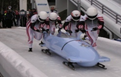
Г
Powerboat racing
5
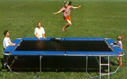
Ґ
Sport tourism
6

Д
Archery
7

Е
Skeet shooting
8

Є
Sky diving
9

Ж
Scuba diving
10

З
Rafting
11
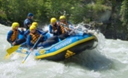
И
Car racing
12

І
Bobsleigh
13

К
Curling
14

Л
Slalom
3
12 з 144 балів
Fill in the gaps with proper equivalents.
!!! Use NO articles.
British English |
|
American English |
phone box |
|
|
|
| field |
aeroplane |
|
|
|
| schedule |
torch |
|
|
|
| gas |
boot |
|
|
|
| line |
wardrobe |
|
|
|
| railway car |
garden |
|
|
|
|
|













4
12 з 144 балів
Language learning Test. Choose the correct variant.
1. The new school claims to ........... students all the English they need in a few months. [a, b, c, d]
a) explain
b) pinstruct
c) learn
d) teach
2. I never ........... a chance of improving my English if l can help it. [a, b, c, d]
a) avoid
b) lose
c) miss
d) waste
3. Will you ........... me how to make that sound? [a, b, c, d]
a) learn
b) practice
c) show
d) train
4. Franck thought that the other students would think he was English, but his accent gave him ........ . [a, b, c, d]
a) away
b) in
c) out
d) up
5. ........ that he only started learning it one year ago, his English is excellent. [a, b, c, d]
a) Accounting
b) Considering
c) Imagining
d) Wondering
6. We were the ........... students in the class who could speak Ukrainian. [a, b, c, d]
a) alone
b) one
c) only
d) single
7. Your pronunciation would improve if you ........... with online or application records. [a, b, c, d]
a) exercised
b) practised
c) repeated
d) trained
8. The students ........... ever use the language laboratory. [a, b, c, d]
a) almost
b) hardly
c) nearly
d) practically
9. Priscilla asked for ........... lessons at home as she thought she would learn English more quickly that way. [a, b, c, d]
a) particular
b) peculiar
c) personal
d) private
10. Learners of English as a foreign language often fail to ........... between unfamiliar sounds in that language. [a, b, c, d]
a) differ
b) distinguish
c) separate
d) solve
11. Jonathan was surprised that Sonia's English was so ........... as she had never been to England. [a, b, c, d]
a) definite
b) fluent
c) liquid
d) national
12. If you want to learn a new language you must ........... classes regularly. [a, b, c, d]
a) assist
b) attend
c) follow
d) present
13. Would you ........... to me studying English privately? [a, b, c, d]
a) allow
b) agree
c) approve
d) permit
14. Spanish is the ........... language of most Spaniards. [a, b, c, d]
a) home
b) mother
c) native
d) nature
15. They are learning English, but they haven't ........... much progress. [a, b, c, d]
a) done
b) got
c) made
d) performed
16. There has been a great ........... in his English. [a, b, c, d]
a) escalation
b) improvement
c) increase
d) rise
17. If you don't know what that word means, ........... in the dictionary. [a, b, c, d]
a) give it up
b) look it up
c) make it up
d) show it up
18. Some language students reach a high ........... of competence in communication. [a, b, c, d]
a) degree
b) grade
c) mark
d) note
19. Don't ........... to correct me if I make a mistake. [a, b, c, d]
a) hesitate
b) mind
c) pause
d) stop
20. Please ........... your hand if you want to ask a question. [a, b, c, d]
a) arouse
b) put out
c) raise
d) rise
5
12 з 144 балів
Grammar test. Choose the correct variant.
1. Kirsten said that ___ would lend ___ her car if I needed it. [a, b, c, d]
a) he / me
b) I / her
c) she / me
d) they / it
2. Scientists still have no answer to _____ there is life on other planets. [a, b, c, d]
a) that
b) which
c) where
d) whether
3. It ___ obvious that we ___ a big problem with our old car one day. [a, b, c, d]
a) was / will have
b) is / were having
c) is / have
d) was / would have
4. She ___ to us ___ there was nothing to worry about, but actually there was so much. [a, b, c, d]
a) told / that
b) said / -
c) asked / if
d) told / -
5. I asked Lorena what Mike ___ about when I went into his room, but she told me that she ___ no idea. [a, b, c, d]
a) was talking / was having
b) talked / has
c) had been talking / had
d) talks / is having
6. I know the film starts at 9 pm, but I am not sure _____ it is today or tomorrow. [a, b, c, d]
a) that
b) if
c) what time
d) when
7. Keith: Shall we throw a party for Jane next Saturday ? [a, b, c]
Bill told Lara that Keith _____ for Jane the following Saturday.
a) suggested throwing a party
b) boasted about throwing a party
c) promised to throw a party
8. The police wanted to know ___ had murdered the businessman and ___ . [a, b, c, d]
a) when / whose
b) who / why
c) where / when
d) what / who
9. No one ___ me ___ we were going to pay such a lot of extra money for the package tour. [a, b, c, d]
a) announced / how
b) said / -
c) explained / that
d) told / -
10. We knew that it was true, but Russell ___ that he ___ from the company. [a, b, c, d]
a) refused / is fired
b) denied / had been fired
c) promised / was fired
d) admitted / has been fired
11. Alice told me that no one at the customs had ___ her ___ she had anything to declare and that she found it quite strange. [a, b, c, d]
a) asked / if
b) said / that
c) told / whether
d) wanted to know / -
12. Martha _____ to break up with him if Jack didn't stop smoking. [a, b, c, d]
a) said
b) warned
c) told
d) threatened
13. Miriam ___ me that she ___ how to dance the waltz from her grandmother. [a, b, c, d]
a) ordered / learns
b) told / learnt
c) said / had learnt
d) asked / was learning
14. Jason finally _____ to copying the homework from the Internet. [a, b, c, d]
a) refused
b) denied
c) told
d) admitted
15. Could you ___ her ___ the reports with her when she comes to the meeting? [a, b, c, d]
a) suggest / bringing
b) say / to bringing
c) ask / that she brought
d) tell / to bring
16. Ahmet _____ when he will be able to get rid of the plaster on his leg. [a, b, c, d]
a) had told
b) was telling me
c) wants to know
d) was saying
17. I am busy today and might forget it. Can you please _____ me to do the shopping before I come home? [a, b, c, d]
a) remind
b) offer
c) say
d) suggest
18. I asked ___ he said to her, but she ___ to talk to me. [a, b, c, d]
a) how / denied
b) what / refused
c) that / admitted
d) which / agreed
19. That tooth of yours looks awful. I _____ making an appointment at the dentist's as soon as possible. [a, b, c, d]
a) suggest that
b) remind you
c) advise you
d) suggest
20. His parents ___ Luke of getting into a fight with his younger brother, but he ___ having done anything to hide. [a, b, c, d]
a) complained / admitted
b) accused / denied
c) apologized / insisted
d) boasted / suggested
21. I wasn't ___ only patient in the waiting room, so I looked through ___ magazines on the table to pass the time. [a, b, c, d]
a) an / -
b) the / the
c) - / -
d) a / some
22. _____ Kizilirmak is the longest river and _____ Mount Agri is the highest mountain in Turkey. [a, b, c, d]
a) - / -
b) The / the
c) The / -
d) - / the
23. There wasn't any information on ___ departure time of ___ flight. [a, b, c, d]
a) the / the
b) a / -
c) the / an
d) a / the
24. As it has ___ hostile environment, no human being can survive in ___ Antarctic. [a, b, c, d]
a) the / -
b) an / the
c) the / the
d) a / the
25. You get five ___ Coke from ___ one-litre bottle. [a, b, c, d]
a) glass of / an
b) glasses of / a
c) glass / -
d) glasses / an
26. You need to do some more exercise _____ you become perfect in shape. [a, b, c, d]
a) due to
b) until
c) by
d) no sooner
27. The couple sitting before us kept talking _____ the movie. [a, b, c, d]
a) ago
b) while
c) when
d) during
28. It was so unlucky that she had an accident _____ she got her driving licence. [a, b, c, d]
a) no sooner
b) as soon as
c) during
d) while
29. ____ the ambulance arrived at the hospital, the injured man had already died. [a, b, c, d]
a) By the time
b) While
c) After
d) In case
30. He was lucky because he had ___ arrived at the bus stop ___ the bus came. [a, b, c, d]
a) no sooner / when
b) hardly / than
c) so / that
d) no sooner / than
31. My arm still hurts, but it's not ___ bad ___ it was before. [a, b, c, d]
a) so / that
b) as / as
c) enough / as
d) too / to
32. My friends don't agree with me, but I find maths _____ the other school subjects. [a, b, c, d]
a) less difficult than
b) difficult enough
c) less difficult than
d) more difficult
33. She finds even _____ rides in the amusement park so thrilling. [a, b, c, d]
a) less horrible than
b) horrible enough
c) the most horrible
d) as horrible as
34. If you do it a little _____, I'm sure you can solve this question. [a, b, c, d]
a) careful
b) most carefully
c) the last careful
d) more carefully
35. This price is by far _____ one you can ever get for this phone. [a, b, c, d]
a) as good as
b) the best
c) better
d) the better
36. He just failed to win the race, _____ his great effort. [a, b, c, d]
a) despite
b) although
c) nevertheless
d) however
37. Hurry up! I wouldn’t like _____ the start of the film. [a, b, c, d]
a) that we miss
b) to miss
c) that we lose
d) to lose
38. How many candidates have _____ for the job? [a, b, c, d]
a) appointed
b) applied
c) presented
d) undertaken
39. They arrived in the neighbourhood ___ days ___ . [a, b, c, d]
a) few … since
b) few … since
c) few … ago
d) a few … ago
40. She was _____ dark glasses because she didn’t want to be recognised. [a, b, c, d]
a) carrying
b) holding
c) bearing
d) wearing
41. The shop rang _____ that your new dress is ready. [a, b, c, d]
a) for saying
b) to say
c) for telling
d) to tell
42. Hello! I _____ you before now but I’ve been very busy. [a, b, c, d]
a) should have rung
b) must have rung
c) had to ring
d) ought to ring
43. I’d like to take _____ of this opportunity to thank you for your help. [a, b, c, d]
a) profit
b) benefit
c) advantage
d) occasion
44. He always looks brave on the screen but I wonder _____ in real life. [a, b, c, d]
a) what he is like
b) what is he like
c) how he is
d) how is he
45. She’s recovered from her illness and is playing ___ well as ___ . [a, b, c, d]
a) as … never
b) as … ever
c) so … never
d) so … ever
6
12 з 144 балів
Reading 1
Read the text below. Match choices (A-H) to (1-5). There are three choices you don't need to use.
A Work is honourable.
B To sum it up, there are many interpretations of what success is.
C So the question you must ask is «Why do you do it?».
D Work allows you to put your talents to good use.
E Work gives you a sense of purpose.
F The main purpose of work is making money.
G Some people go through life resenting and avoiding work.
H Work is a means to develop character.
A week has 168 hours. If you sleep eight hours a day, that leaves 112 hours per week of active time in your life. If you work about 50 hours a week, that is almost half of the active time available for you.
This is a very significant portion of your life that you spend working.
(1) [A, B, C, D, E, F, G, H] One obvious answer is that you need to provide for yourself and your family. But there has to be something more than just making money. Many billionaires, like Bill Gates, Larry Ellison and Warren Buffett, spend a significant amount of their time working, probably more than most people. And yet, they don't need any money. Work can be anything from being a volunteer to being a high-powered executive, and anything in between. Let’s look at the advantages work can give us.
(2) [A, B, C, D, E, F, G, H] Many people go through their working life thinking about retirement. They think about the day when they will just be able to sit back, relax and take it easy. But when the day arrives and you finally get to retirement, an interesting phenomenon happens to many people.
They enjoy the first few months of their newly found freedom and stress-free living, but after a while they start losing their sense of purpose. Their work gave them a sense of accomplishment that they now miss, and they start to feel worthless.
(3) [A, B, C, D, E, F, G, H] In many lines of work, you have to deal with people and their personalities, egos, beliefs, cultures, politics, habits, and all of the struggles and joys that make up the human existence. You also face conflicts and hard choices. Sometimes you even have to deal with difficult ethical issues. As you gain experience and are mature in your work, you develop character. You learn how to deal with different types of people and different situations.
(4) [A, B, C, D, E, F, G, H] Everyone has unique talents and gifts. Some are obvious to you. Others become apparent as you start applying them in your work activities. Work allows you to discover your strengths and weaknesses. And discovering and using our talents can be a very satisfying and rewarding experience.
Without work your talents stay dormant and do not find a way to flourish. It is a waste of your gifts that could otherwise have been put to good use.
(5) [A, B, C, D, E, F, G, H] When you do a good job, you feel a sense of pride and accomplishment. Being able to work and serve, in whatever capacity, is an honourable activity.
And I have never seen a successful person that does not do any type of work. Work is the very essence of what success is all about.
7
12 з 144 балів
Reading 2
Read the text below. For questions (6-11) Choose the correct answer (A, B, C or D).
STUDENTS INVITED TO NAME NEW MARS ROVER
NASA is looking for the right name for the next Mars rover.
In cooperation with Walt Disney Studios Motion Pictures, NASA will conduct a naming contest for its car-sized Mars Science Laboratory rover that is planned to be presented in 2010.
The contest begins on Tuesday, 18 November 2009, and is open to students of 5 to 18 years old. To enter the contest, students will submit essays explaining why their suggested name for the rover should be chosen. Essays must be received by 25 February 2010. In April 2010, the public will have the opportunity to know nine finalists' names via the Internet as additional information for judges to consider during the selection process. NASA will announce the winning rover name in May 2010.
Disney will provide prizes to students submitting winning essays, including a trip to NASA's Jet Propulsion Laboratory in Pasadena, California, where the rover is under construction. The grand prize winner will have the opportunity to place a signature on the spacecraft and take part in the history of space exploration.
«Mars exploration has always captured the public imagination», said Mark Dahl, programme executive for the Mars Science Laboratory at NASA Headquarters in Washington. «This contest will expand our ability to inspire students' interest in science and give the public a chance to participate in NASA's next expedition to Mars».
The Mars Science Laboratory rover will be larger and more capable than any craft previously sent to land there. It will check whether the environment in a carefully selected landing region has ever been favourable for supporting microbial life. The rover will search for minerals formed in the presence of water and look for several chemical building blocks of life.
«We are now in a phase when we're building and testing the rover before its journey to Marі», said John Klein, project manager for the Mars Science Laboratory at JPL. «As the rover comes together and begins to take shape, the whole team can't wait to call it by name».
6 What does the text tell about? [A, B, C, D]
A About a competition held by NASA.
B About NASA's Mars projects.
C About a new Walt Disney cartoon.
D About a Mars Science Laboratory rover.
7 What is the deadline for students' essays? [A, B, C, D]
A November 2009
B February 2010.
C April 2010.
D May 2010.
8 How is it planned to announce the finalists' names? [A, B, C, D]
A By TV.
B In a newspaper.
C By means of the Internet.
D On the radio.
9 What will the grand prize winner have? [A, B, C, D]
A A trip to NASA's Jet Propulsion Laboratory in Pasadena, California.
B The opportunity to see the rover under construction.
C The rover model.
D The opportunity to place a signature on the spacecraft.
10 What is the purpose of the contest according to Mark Dahl? [A, B, C, D]
A To attract students' interest to science.
B To choose the best name for the Mars rover.
C To tell about the new Mars rover.
D To give students a chance to travel to Mars.
11 Which of the following will the Mars Science Laboratory rover not do? [A, B, C, D]
A Check whether the environment in a carefully selected landing region has ever been favourable for supporting microbial life.
B Search for minerals formed in the presence of water.
C Look for several chemical building blocks of life.
D Study the flora and fauna.
8
12 з 144 балів
Reading 3
Read the text below. Choose from (A-H) the one which fits each space (17-22) best. There are two choices you do not need to use.
PHONE RAGE
A In addition
B who were from 536 organizations
C or face-to-face
D training for it
E right tone of voice
F telephone answering techniques
G are all common reasons
H and most effective way
What drives people to lose temper on the telephone? Being kept waiting, being connected to voice mail, being passed on to someone else (17) [A, B, C, D, E, F, G, H]. But what infuriates them most of all is talking to someone who sounds inattentive, unconcerned or insincere, according to a Reed survey published today.
The Reed survey found that nearly two thirds of people feel that «phone rage» - people losing their temper on the telephone - has become more common over the past five years. More than half of the respondents, (18) [A, B, C, D, E, F, G, H] said that they themselves had lost their tempers on the phone this year.
The reasons for this are threefold, according to Reed. People are much more likely to express anger over the phone, rather than in writing (19) [A, B, C, D, E, F, G, H] . Moreover, telephone usage has been rising steeply over recent years. Increasing numbers of transactions take place entirely by phone, from arranging insurance to paying bills. (20) [A, B, C, D, E, F, G, H], people's expectations have risen. Nearly three quarters of respondents to the Reed survey said they are more confident that their problems can be solved over the telephone than they were five years ago.
Companies are taking steps to improve their staff's (21) [A, B, C, D, E, F, G, H]. The survey found that 70 per cent of organizations require their staff to answer the telephone with a formal company greeting. In 43 per cent of organizations, staff have to give their own names when they answer the telephone.
But a third of organizations do not give any training, or they train only their receptionists. That may not be enough, the report says. As companies move towards «remote working», the need for the (22) [A, B, C, D, E, F, G, G] extends to every level of the organization.
9
12 з 144 балів
Reading 4
Read and complete the text below. For each of the empty spaces (28-34) choose the correct answer (A, B, C or D).
CALLENDALE CASTLE
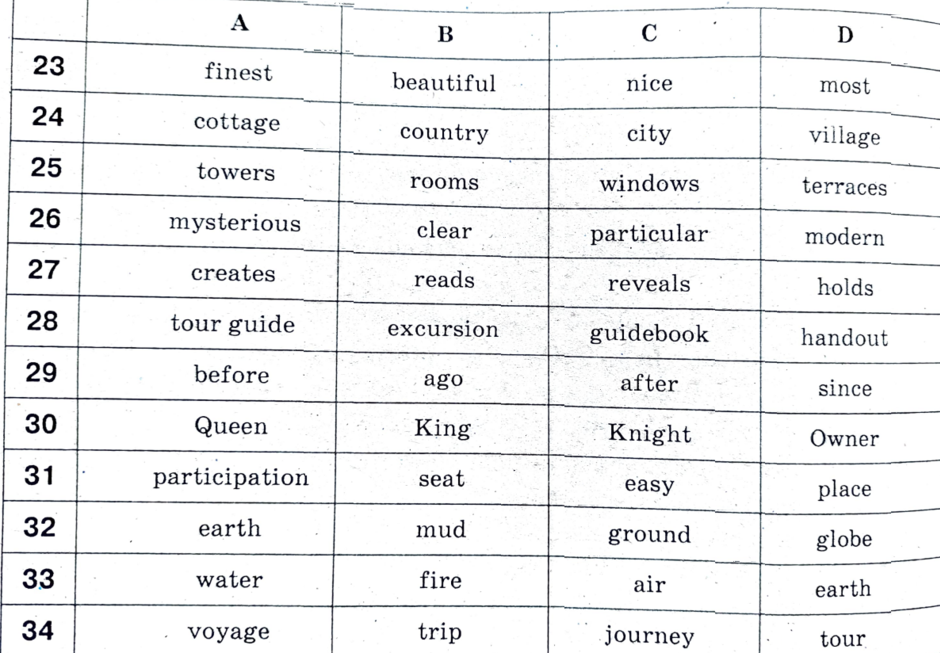
Callendale Castle, often called one of the (23) [A, B, C, D] castles in England, is built on a hill overlooking the (24) [A, B, C, D] of Callendale in West Bassetshire. On approaching Callendale village, the twin (25) [A, B, C, D] of the castle suddenly loomed through the mist, giving the village a (26) [A, B, C, D] appearance.
Callendale Castle (27) [A, B, C, D] many stories, and many secrets. A quick read through the (28) [A, B, C, D] gave me a colourful image of the way things must have been inside these forbidding stone walls all those years (29) [A, B, C, D]. A secret meeting between (30) [A, B, C, D] Henry V and a French ambassador took (31) [A, B, C, D] here during the 100 years' war. In 1814, the castle narrowly escaped being burnt to the (32) [A, B, C, D] when a lazy kitchen boy left a pig roasting on the open (33) [A, B, C, D] unattended.
The castle (34) [A, B, C, D] took me to a dark dank dungeon, complete with gruesome instruments of torture. Hidden in one corner there is a tiny cell, little more than a hole, where countless prisoners were left to rot away. It's hard to imagine how a grown person could fit into a place so small.
10
12 з 144 балів
Listening 1
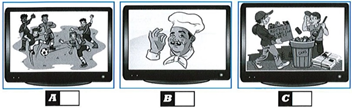
1. Which programme will they watch first? [A, B, C]
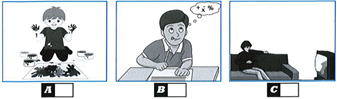
2. Why did the boy go to bed late? [A, B, C]
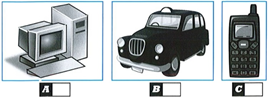
3. What did the girl see at the science museum? [A, B, C]
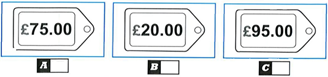
4. How much was the restaurant bill? [A, B, C]
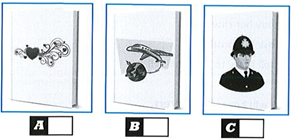
5. Which book will the girl borrow from her friend? [A, B, C]
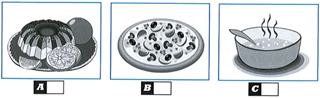
6. What did the girl cook? [A, B, C]
7. Which animal did the boy enjoy seeing best? [A, B, C]
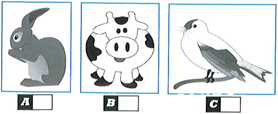
11
12 з 144 балів
Listening 2
8. You will hear a boy talking to a friend about his grandma’s house. What does the boy like most about it? [A, B, C]
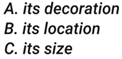
9. You will hear two friends talking about a birthday present for their friend, Mary. What do they decide to do? [A, B, C]

10. You will hear two friends talking about a concert. What do they agree on? [A, B, C]
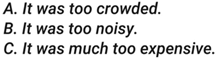
11. You will hear two friends talking about a party they went to. What happened? [A, B, C]

12. You will hear two friends talking about a competition. The girl feels [A, B, C]

13. You will hear two friends talking about a new student. What does the boy say about the student? [A, B, C]
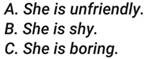
12
12 з 144 балів
Listening 3
20. Why did Isabella start to play basketball? [A, B, C]

21. Why does Isabella think she is such a good basketball player? [A, B, C]
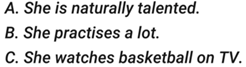
22. Who was the first to tell Isabella that she could play basketball as a professional? [A, B, C]
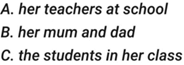
23. What was Isabella most proud of? [A, B, C]
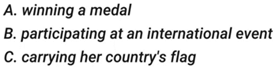
24. What are Isabella’s plans for the future? [A, B, C]
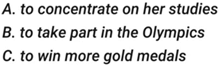
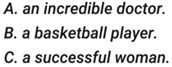
25. In ten years from now Isabella will definitely want to be [A, B, C]
Рефлексія від 11 учнів
Сподобався:
0
Так: 10
Ні: 1
Зрозумілий:
0
Так: 9
Ні: 2
Потрібні роз'яснення:
0
Ні: 7
Так: 4