- Всеосвіта›
- Бібліотека тестів›
- Англійська мова›
- HS2 2019 unit5 p94 act3

Тест:
HS2 2019 unit5 p94 act3

05.11.2021
Вміст тесту:
1
2
3
4
5
6
7
8
9
10
1
12 з 120 балів
Which of the following words are pronounced differently in British and American English?
Choose and tick them.
2
12 з 120 балів
Fill in the gaps with proper equivalents.
!!! Use NO articles.
British English |
|
American English |
film |
|
|
|
| truck |
trainers |
|
|
|
| faucet |
zebra crossing |
|
|
|
| potato chips |
motorway |
|
|
|
| soccer |
motorbike |
|
|
|
| daiper |
holiday |
|
|
|
| drugstore, pharmacy |







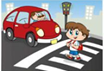







3
12 з 120 балів
Decide whether the sentence is written in British or American English.
1. Sales tax is not included. [British English, American English]
2. The water was dripping from the tap. [British English, American English]
3. The petrol tank in our car is empty. [British English, American English]
4. It was the worst railroad disaster in the history of our country. [British English, American English]
5. His sister attends the primary school in our town. [British English, American English]
6. Cellphones are not allowed in the hospital. [British English, American English]
7. Jim is our new neighbor. [British English, American English]
8. Should we really put the bottles into the boot of the car? [British English, American English]
9. Andy and Tom, would you read the dialog, please? [British English, American English]
10. I think I'll change Mary's nappy. [British English, American English]
11. She switched to public school for only one reason: basketball. [British English, American English]
12. He went to bank to encash an bank note. [British English, American English]
4
12 з 120 балів
General Grammar TEST
1. Leo drives a car well, but Collin does it … . [a, b, c, d]
a) better
b) the best
c) as well
d) best
2. Phillip is so quiet and obedient. He is … child I have ever met. [a, b, c, d]
a) well-behaved
b) better-behaved
c) the best-behaved
d) extraordinary
3. I am sure a trolleybus is … a metro. [a, b, c, d]
a) as convenient as
b) not as convenient as
c) most convenient as
d) the most convenient as
4. She … all the work and now she … in the next room. [a, b, c, d]
a) have done / rests
b) does / rests
c) had done / is resting
d) has done / is resting
5. She … this book this week and she … discuss it. [a, b, c, d]
a) have read / can
b) had read / can
c) has read / can
d) has read / could
6. “I hope you … well?” “Yes, I … ill for two weeks. Now I … well.” [a, b, c, d]
a) are feeling / have been / am
b) was feeling / was / am
c) feel / is / am
d) is feeling / are / is
7. - … you … the man for many years? - Yes, we … at Cambridge together. [a, b, c, d]
a) were / known / were
b) have / known / were
c) have / known / was
d) did / know / was
8. I … an exercise now but I … it in some minutes. [a, b, c, d]
a) have written / had finished
b) am writing / shall finish
c) wrote / is finishing
d) writes / will finish
9. Nina said Lucy complained that her friends never … any attention to what she told them. [a, b, c, d]
a) would pay
b) paid
c) had paid
d) have paid
10. They explained to us that the Local History museum, which was usually open every Sunday, … that day. [a, b, c, d]
a) was being closed
b) had been closed
c) has been closed
d) was closed
11. Lora wondered if … in town for the rest of the summer; she wanted him to go to the country with her. [a, b, c, d]
a) her cousin was going to stay
b) was her cousin going to stay
c) her cousin is going to stay
d) her cousin will be going to stay
12. Sharon said she … her key in her pocket, but she couldn’t find it there. [a, b, c, d]
a) left
b) has left
c) had left
d) had been left
13. Alice told me … that coat because it wasn’t long enough. [a, b, c, d]
a) not to buy
b) bought
c) don’t buy
d) didn’t buy
14. Life … different in a hundred years’ time, won’t it? [a, b, c, d]
a) will not be
b) will be
c) will not
d) would be
15. We can go out now; the danger is over, …? [a, b, c, d]
a) hasn’t it
b) is it
c) isn’t he
d) isn’t it
16. You’ll join us tonight, …? [a, b, c, d]
a) aren’t you
b) shall you
c) won’t you
d) don’t you
17. Countries should stop … weaponry to other countries in order to have peaceful world. [a, b, c, d]
a) submitting
b) protecting
c) subsequent
d) providing
18. If Olkerspor wins the … match, it will have the right to play in the final so this match is very important. [a, b, c, d]
a) final
b) semi-way
c) semi-final
d) semi-professional
19. That all guests have to sit in order of … in meetings shows a kind of hierarchy in the firm. [a, b, c, d]
a) prearrangement
b) precedence
c) acceptance
d) proposition
20. His … about the rates of inflation turned out to be incredibly true. [a, b, c, d]
a) prediction
b) predestination
c) preconception
d) preconceived
21. Archaeologists have found some fossils that are estimated to have lived in … times. [a, b, c, d]
a) pre-war
b) pre-historical
c) ancestor
d) prefabricated
22. He spent the … night working, so there was hardly … coffee left. [a, b, c, d]
a) each / every
b) all / some
c) every / no
d) whole / any
23. High blood is one of the three major risk factors for heart disease. Cigarette smoking and high blood pressure are … two. [a, b, c, d]
a) the other
b) another
c) one another
d) other
24. Of the two churches in the town, one is a Catholic Church and … is Lutheran. [a, b, c, d]
a) other
b) another
c) the other
d) others
25. Despite the huge budget deficit, … of local government spending is directed towards the private sector. [a, b, c, d]
a) a good many
b) a great quantity
c) a considerable group
d) very few
26. There were almost 2500 demonstrators in the square last weekend. This shows that … people attended the demonstration [a, b, c, d]
a) a large amount of
b) a great quantity of
c) much of
d) a great number of
27. I’m afraid I won’t be able to say … since I have … idea about the issue. [a, b, c, d]
a) everything / few
b) anything / no
c) nothing / any
d) something / none
28. … question in the test was checked in detail before given the students, and … including mistakes or causing ambiguity were corrected by the teachers. [a, b, c, d]
a) Either / none
b) Each / no
c) Every / any
d) All / the other
29. She spends … money on clothes whenever she goes shopping. [a, b, c, d]
a) a large amount of
b) a great number of
c) a couple of
d) several
30. Astronomers suggest that there are two separate universes, one made out of matter, our own, and … made out of antimatter. [a, b, c, d]
a) each
b) other
c) others
d) the other
31. I told Ann and Jason not to go outside without an umbrella. Look, ____ have got wet! [a, b, c, d]
a) there
b) why
c) where
d) they
32. There are several reasons … I cannot volunteer for playground duty. [a, b, c, d]
a) that
b) which
c) why
d) whom
33. They ran … the stairs into the roof to look … the things that they had used years ago. [a, b, c, d]
a) down / in
b) up / for
c) up / up
d) down / at
34. The thief ran … the street and hid … the bushes. [a, b, c, d]
a) across / over
b) into / beside
c) across / behind
d) along / from
35. The cat ran and disappeared … the trees in the woods [a, b, c, d]
a) under
b) toward
c) with
d) beside
36. Hiroshima … quite heavily by the Unites States bombing during the Second World War, but it … soon after the war. [a, b, c, d]
a) was damaged / was rebuilt
b) has been damaged / had rebuilt
c) was damaging / had been rebuilt
d) had been damaged / has been rebuilt
37. The day before the event, at least one man … dead in riots by supporters protesting against his prosecution. [a, b, c, d]
a) was shot
b) would be shot
c) was shooting
d) shot
38. More than 440.000 residential construction jobs … in the current housing downturn in the past month alone. [a, b, c, d]
a) have lost
b) were lost
c) have been lost
d) are lost
39. The police officers … the suspicious killing of a diplomat before a renowned businessman … a couple of days ago. [a, b, c, d]
a) have been investigating / was killed
b) were investigating / had been killed
c) will investigate / has been killed
d) had been investigating / was killed
40. After the home side … 3-2 in a thrilling football match, the winner players … by the supporters. [a, b, c, d]
a) had won / cheered up
b) won / were cheered up
c) had been won / were cheered up
d) wins / are cheered up
41. "When will I know the results of the examination?"
Maria asked the examiner when she … the results of the examination.
[a, b, c, d]
a) would know
b) knows
c) knew
d) will know
42. "Are you taking much money with you to France?"
My bank manager wanted to know if I … much money with me.
[a, b, c, d]
a) am taking
b) was taking
c) will take
d) were taking
43. "Why did you apply for this job?"
The sales manager asked me why I … for that job.
[a, b, c, d]
a) applied
b) have applied
c) had applied
d) would apply
44. "Do you watch television every evening, Chris?"
The interviewer asked Chris if he … every evening.
[a, b, c, d]
a) watches television
b) had watched television
c) is watching television
d) watched television
45. "What time does the film start, Peter?"
I asked Peter what time the … .
[a, b, c, d]
a) film starts
b) film started
c) film would start
d) film starting
5
12 з 120 балів
Reading 1
Read the text below. Match choices (A-H) to (1-5). There are three choices you do not need to use.
PLANNING FOR A YEAR OF ACHIEVEMENT
A Be flexible.
B Commit to your resolution.
C Use a system of reminders.
D Write it down.
E Be realistic.
F Track your progress.
G Reward yourself.
H Make a plan.
Are you busy making your New Year's resolutions or have you resolved never to make a New Year's resolution ever again? If the latter, you're not alone. So many people get demoralized when, year after year, they make decisions that they keep for only a few weeks or maybe even just a few days.
Our Eight Rules for New Year's Resolutions will help to set you up for success right from the start.
(1) [A, B, C, D, E, F, H, G] Successful resolutions start with a strong dedication to make ka change. To succeed, you must believe that you can accomplish what you set out to and that belief is supported by the unwavering support you give yourself.
(2) [A, B, C, D, E, F, G, H] A simple but powerful technique for making your goal real is to put your resolution into writing. There is something inside us that creates more commitment and drive when we take time to do this. Consider writing it down on cards and keeping them where you'll see them often - on your desk, the fridge, in your wallet.
(3) [A, B, C, D, E, F, G, H] This is where so many resolutions fall down. Articulating what you want to achieve is one thing; deciding how to do it is quite another. Don't miss out this step!
Start by envisioning where you want to be;
Then go back along your path to where you are today;
Write down all the milestones you noted in between; and
Decide what you will do to accomplish each of these milestones. You need to know each step and have a plan for what comes next.
(4) [A, B, C, D, E, F, G, H] Not everything will work out precisely the way you planned. If you are too riding in your approach to resolutions, the first minor obstacle can throw you off your course completely.
When creating your plan, try to predict some challenges you will face - make a contingency plan for the ones that have the highest probability and mentally prepare yourself for the others.
Realise that your resolution itself might change along the way as well. That's not failure, it's reality. As your life changes, so will your goals, dreams, and desires.
(5) [A, B, C, D, E, F, G, H] Although knowledge of a job well done can be a prize in itself, we all enjoy a little treat from time to time. Even the most committed person needs a boost and sometimes that is best accomplished due to an external reward.
When you are developing your plan, make a note of a few milestones where you will praise your-self once they are achieved. But spread them out you want to make sure the rewards remain special and are not too easy to get.
New Year's resolutions can be a pain or a pleasure. The choice is yours. The starting point is to focus on something that you really want and are ready to give your commitment to. Do this and you'll be in a great position to stay motivated and be successful!
6
12 з 120 балів
Reading 2
Read and complete the text below. For each of the empty spaces (1-12) choose the correct answer (A, B, C or D).
SO YOU WANNA BE A ROADIE?
The boy had already been called for lunch three (1) [time, times, tense, sometimes]. Each time the door was opened, deafening heavy metal music blasted through the rest of the house like a fireball. (2) [Finally, Therefore, So, Thus]he appeared in his teenage splendour, all dressed in black with studs and piercings. He seated himself among the adults with a scowl. He didn't contribute to the conversation (3) [if i, unless, but, provided that]addressed directly.
«What are you planning to do when you leave school?» the woman next to him asked at one moment.
«I wanna be a roadie», he replied. There was silence for a moment as everyone digested this. He looked pleased with the lack of reaction.
«I was a roadie for a (4) [whereas, times, second, while]», said one of the men at the table. «And the whole my job consisted of humping huge boxes around - from big trucks onto stages and then from stages into big trucks».
«Which band did you work for?» asked the boy.
«I didn't work for a band, I worked for the production company that staged the concerts - like most roadies do».
«But don't bands have their own roadies?»
«Yeah, they do», the man said, «bands have their own roadies - usually somebody's brother or best mate - who are trusted workers that travel with the band and form part of the «family» along with the musicians (5) [himself, herself, theirselves, themselves], their managers, the technicians, etc. But the vast majority of roadies are employed by the production company like I was, and they’re as low as they can be - they don't travel with the band, and they aren't (6) [let, allowed, must, permit]to do anything except for humping huge boxes around».
The boy wasn't going to let this put him off.
«What about (7) [free, charge, uncontrolled, open]concert tickets?»
«The roadie is the bottom of the pile, remember, and the last person who gets free tickets for the concert».
The boy was still not convinced.
«But you must get to meet the rock stars».
«The closest I ever came was when I was doing the Rolling Stones at Wembley. The door of the first one opened and Mick Jagger got out. He looked in my direction and then began walking towards me, a big smile on his face. I panicked! «What am I going to say to him?» I thought. Of course, he walked straight up to the woman standing (8) [near, by, nearby, next]to me, kissed her, spoke a few words and then walked away. That's all».
The boy refused to give in.
«But everyone involved in the rock music scene gets paid a lot of money - there's that at least».
«Roadies get paid a pittance! When you do a really big performance - one that involves days to set up - then you end up with quite a lot of money in your pocket, (9) [on, in, for, to]the simple reason that you work so many hours and don't really have time to spend any of it. I can't remember how (10) [much, many, few, lot]we got paid per hour, but to give you an indication of how much we earned, I did one concert at Wembley (I can't remember who was playing then) which finished late, and by the time we’d cleared up afterwards it was 4 or 5 in the morning. We walked home to south London! It must have been about 20 miles! And do you know why we walked? Because we worked out that if we' d caught a taxi, then we would have spent nearly all the money we'd earned that night! That's how well roadies get paid!»
The boy was looking a bit (11) [miserable, depressing, sadly, happily].
«But it can't be all bad, surely», he said.
«Well, no, you do get to see all the concerts for free», the man replied.
«It's OK», the boy told himself. No granddad's tales were going to (12) [prove to, satisfy, sure, convince]should or shouldn't do. He'd be a roadie if he wanted to. Or maybe he wouldn't be a roadie. Maybe he'd be a rock star instead.
7
12 з 120 балів
Reading 3
Read the texts below. For each of the empty spaces (1-12) choose the correct answer (A, B, C or D).
FLORENCE NIGHTINGALE
The (1) [well-knowner, well-knownest, more well-known, most well-known]nurse of all time must be Florence Nightingale, who (2) [become, became, has become, had become]famous for her work during the Crimean War in the middle of the nineteenth century.
Florence Nightingale was born in 1805 in Kingston, Jamaica. Her mother was Jamaican and her father was Scottish. Her mother (3) [run, ran, running, has run]a boarding house for invalid soldiers and was also an expert in herbal remedies which she used to treat the soldiers. When her mother died, Florence took over the boarding house and the care of the sick soldiers. (4) [At, On, With, In]1850 there was a serious outbreak of cholera in Jamaica. Florence worked night and day to help the victims and created her own herbal medicine for the disease. She also believed that clean conditions, fresh air and good food (5) [are, were, be, been]important in (6) [fight, fought, fighting, fighted]the disease, ideas which most doctors thought were ridiculous. During the war, she saved the lives of thousands of people.
HOW TO GET TO ENGLAND
London is a global transport hub, so you can (7) [easy, easily, ease, easier]fly to England from just about anywhere in the world. In recent years, the massive growth of budget airlines (8) [increasing, has increased, had increased, were increased]the number of routes and reduced the fares between England and other countries in Europe.
Your other main option for travel between England and mainland Europe is ferry, (9) [either, both, neither, or]port-to-port or combined with a long-distance bus trip-this type of travel has less environmental impact than (10) [fly, flying, flown, flew], although journeys can be long and financial savings not huge compared with budget airfares. International trains are much more comfortable, and another «green» option; the Channel Tunnel allows direct rail services between England, France and Belgium, with onward connections (11) [on, to, in, under]many other European destinations.
Getting from England to Scotland and Wales is easy. The bus and train systems are fully integrated and in most cases you won't even know you have (12) [cross, crosses, crossed, crossing]the border. Passports are not required - although some Scots and Welsh may think they should be!
8
12 з 120 балів
Listening 1
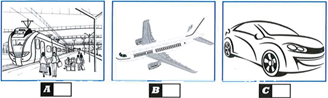
1. How had the girl expected to travel? [a, b, c]
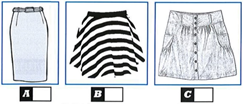
2. What skirt did the girl buy? [a, b, c]
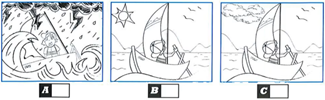
3. What is the weather forecast for Saturday? [a, b, c]
4. Which book has the boy already bought? [a, b, c]
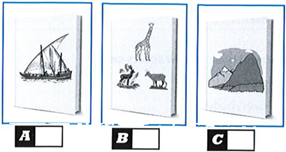
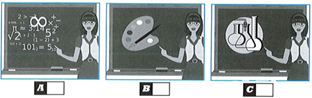
5. Which lesson did the girl have first? [a, b, c]
6. Who is the girl phoning? [a, b, c]

7. What is the boy’s mother going to get? [a, b, c]
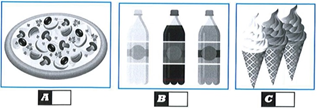
9
12 з 120 балів
Listening 2
8. You will hear two friends talking about a new sports center. What does the girl say about it? [a, b, c]
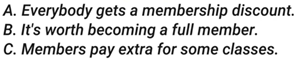
9. You will hear two friends talking about shopping online. How does the boy feel about it? [a, b, c]

10. You will hear a girl telling a friend about a holiday she’s been on. What does the girl say about herself and her cousin? [a, b, c]

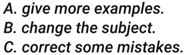
11. You will hear a boy asking a girl about an article he has written. The girl tells the boy to … [a, b, c]
12. You will hear two friends talking about a new television series. What does the boy think about it? [a, b, c]
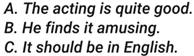
13. You will hear a girl talking about a new teacher. How do the girl’s parents feel? [a, b, c]

10
12 з 120 балів
Listening 3
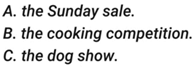
20. Daniel decided to try to raise money because [a, b, c]

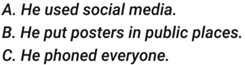
21. How did Daniel let people know about the event [a, b, c]
22. Daniel says that in the beginning he thought [a, b, c]
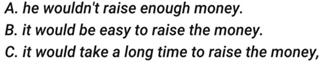
23. How did Daniel feel after the first event? [a, b, c]

24. Daniel’s favourite event was [a, b, c]
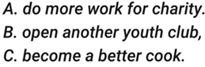
25. In the future, Daniel plans to [a, b, c]
Рефлексія від 8 учнів
Сподобався:
0
Так: 7
Ні: 1
Зрозумілий:
0
Так: 6
Ні: 2
Потрібні роз'яснення:
0
Ні: 5
Так: 3