- Всеосвіта›
- Бібліотека тестів›
- Англійська мова›
- HS2 2019 unit1 act17 p22

Тест:
HS2 2019 unit1 act17 p22

24.09.2021

Вміст тесту:
1
2
3
4
5
6
7
8
Тест містить питання скопійовані з: К3 40, HS 2, Unit 1 – General TEST 3, 4 – Keys.
1
12 з 96 балів
Guess the words by their consonants. Write articles and particles to where necessary.
svrgn
cntry
krn
lrcs
nthm
pss-wllw
prsh
fth
smbl
prclm
rgrd
gvrnmnt
strp
ndpndnc
2
12 з 96 балів
Match symbols of Ukraine with their meaning/date/notion.
1
The National Flag
А
The Trident (the Tryzub)
2
The Coat of Arms
Б
A pussy-willow
3
The National Anthem
В
The 24th of August
4
The Independence Day
Г
Pylyp Orlyk
5
The Constitution Day
Ґ
Two equal horizontal stripes of yellow and blue colours
6
The floral symbol
Д
The 28th of June
7
The national dishes
Е
Bandura
8
The main legislative power belongs to
Є
"Ukraine has not perished yet"
9
The author of the first Constitution of Ukraine
Ж
A guelder rose
10
The national musical instrument
З
Borscht and varenyky
11
The main religions
И
Verkhovna Rada
12
The floral symbol (associated with the awakening of nature)
І
The Ukrainian Orthodox and The Ukrainian Greek Catholic Churches
3
12 з 96 балів
Choose the correct preposition to finish the phrases
to get a mark [in, on, at]
to be fond [in, about, of]
to listen [-, on, to]
to be late [to, for, in]
to be good [at, in, for]
to be ready [for, on, to]smth
to help [about, for, on] the house
to go [to, for, about] a walk
to speak [up, in, on] the phone
to tell [on, for, about]
[in, on, at] 8 o’clock
[in, on, at] the morning/afternoon/evening
to go [-, to, in] bed
to come [to, in, -] home
to feed smb/smth [for, after, with]
to wash [up, after, on]
to put [at, on, into] (clothes)
to put [for, into, from...to] (the cupboard)
to be washed [on, by, for]
to border [at, with, on]
to prefer smth [on, with, to]smth
to arrive [to, in, at]London
to see smb [of, off, after]
to be keen [with, at, on]
to be satisfied [with, at, on]
to depend [from, on, in]
according [on, to, for]
4
12 з 96 балів
Write the names of the following musical instruments, use articles where necessary:






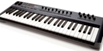




5
12 з 96 балів
Complete the sentences below with must or have to (or their past or future forms)
1. We ___ buy some food. We've got nothing to eat.
2. Yesterday he__ go to the bank to get some more money.
3. My hair is dirty. I__ wash it.
4. She's a very interesting person. You __ meet her at the conference next month.
5. My eyesight is rather poor. I _ wear glasses.
6. At the end of this term all the students __ take an exam.
7. There were no buses yesterday evening. We __ get home by taxi.
8. I'm going to bed early tonight. I __ get up early tomorrow morning.
9. We haven't got much time. We hurry. Otherwise we'll miss the train.
10. They arrived home very late last night. They __ wait for the last bus for half an hour.
11. The child is tired. He __ go to bed immediately.
12. We __ go to school on Saturday.
13. You __ take a better care of your dog.
14.__ (you) wear a tie to your office?
15. Yesterday Hugo __ go home earlier because his mother needed his help about the house.
16. A soldier __ follow orders.
17. If he changes his mind, all of us __ find a better solution to the problem.
18. If you want to make a really good father, you__ spend much time with your kids at home and outside.
19. It's too late. I'm afraid we'll__ ask someone to give us a lift.
6
12 з 96 балів
1. Yesterday John told me a funny joke. This joke was the [funnier, funniest, the funnier, the funniest] joke I’ve ever heard.
2. The house is on [far, the far, farther, the farthest]side of the lake.
3. The smaller the phenomena a scientist is investigating, [the bigger, the biggest, than big, and the bigger]is the time needed to conduct research.
4. … I’m feeling happy … sad, I try to keep a positive attitude.
[either / or, whether / or, when / I’m, rather / than]
5. … only is dark chocolate delicious, … it can be healthy.
[whether / or, just as / so, both / and, not / but]
6. … I have salad for dinner, … I can have ice cream for dessert.
[when / than, whether / or, if /then, when / soon]
7. He has already made [a, an, the, -] few contacts in the movie industry who might be able to help him get started.
8. That brand of organic coffee costs $85 … pound! That's … most outrageous price I've ever seen.
[- / the, - / a, the / the, a / the]
9. Last week was … first time that I had ever played golf, and I really felt like I was … worst player ever.
[the / a, a / the, the / the, the / -]
10. John bought … new car last week. Unfortunately, … car broke down after just two days.
[a / the, the / the, - / a, the / a]
11. Is there … water on … Moon?
[the / the, - / the, a / the, the / -]
12. Excuse me, is there … booking office around here? I need to buy …
[a / the, the / a, a / -, a / a]
13. I’m really sorry I couldn’t get … the meeting, but some relatives of mine turned … unexpectedly.
[at / in, to / up, in / down, on / into]
14. I ran … some interesting old books in that store … the corner.
[off / on, into / at, down / in, over / on]
15. He’s mad [with, in, to, about] country and western music. Whenever he finds a chance he listens to popular singers of this kind of music.
16. Sam has been … charge of preparing a dinner … 120 people.
[at / of, for / by, out / about, in / for]
17. All our aim is to resolve the conflict [through, between, with, at] peaceful and reasonable means.
18. Since they … acting, they … in three plays, a television commercial and two TV dramas.
[begin / have performed, began / have performed, begin / are performing, began / have been performing]
19. The peak … the prize for mountaineers, especially if it … before.
[is / has not been attained, will be / wasn’t attained, was / had not been attained, has been / weren’t attained]
20. She last drove a car three years ago. Since she … an accident, she … a car for three years.
[had had / didn’t drive, had had / hasn’t driven, had / hasn’t driven, has / hasn’t driven]
21. As a teenager, I …that I … just young and attractive.
[had been feeling / was, will feel / am, feel / have been, felt / was]
22. When Tom entered the room, his mom … him because he … hair and a beard. He looked totally different.
[wasn’t recognizing / was growing, didn’t recognize / had grown, hadn’t recognize / grew, didn’t recognize / grew]
23. A few years ago it … that certain cells of human body never … .
[is found / died, was found / die, has been found / died, had been found / dies]
24. If you visited my country, my people … probably … to have some very strange customs.
[would / be thought, had / been thought, would / have been thought, will / think]
25. The bridge I know best [called, calls, was being called, is called] Bosporus.
26. When a blind person …, he … by taking his arm and guiding him.
[was seen / is helped, is seen / should be helped, would be seen / should help, were seen / must be helped]
27. A school …, on the model of those at Alexandria, in which astronomy and logic …, mostly from Greek texts.
[set up / were taught, set up / were being taught, was set up / were taught, has been set up / have taught]
28. Mother: You … wash your hands when you come in. Small Boy: Ok! I … wash my hands when I come in.
[must / have to, should / need, may / can, may / need]
29. My diary isn’t in its regular place; someone [should have taken, was going to take, must have taken, would have taken] it.
30. Not until the guests came in, I ran out of sugar and I [could borrow, must borrow, need to borrow, had to borrow] from my neighbour.
31. You [needn’t take, can’t take, may not have taken, weren’t supposed to take]more pills, you look recovered.
32. If we have no money to take a taxi, we [must have got, will have to get, may get, could have got] on the bus.
33. Choose the correct question word: “ [What, Who, Why, Where]don’t you see a doctor?”
34. Choose the correct question word: “ [Where, What, Who, Whose] is this?” – “That’s my electronic dictionary.”
35. Choose the correct question word: “ [How, Who, Whose, Where] is your brother?” – “He is great, thanks for asking.”
36. Match the sentence: If Jack turns off the heating more often, [he could be better at social studies., it would not smell in his room., he can save more money., he would not spend time in the kitchen.]
37. Match the sentence: Phone the restaurant, [we might get lost., you might miss the appointment., we might win., it might be closed on Saturday.]
38. Match the sentence: If you phone me tonight, [I might not have time to talk to you., I will be able to post the photos on Fac, everyone will be able to hear us., people won’t know my address.]
39. Choose the sentence with the same idea: I will inform them this.
[I will inform this them., I will inform them of this., I will inform this to them., I will inform them with this.]
40. Choose the sentence with the same idea: Our school is built by bricks.
[Our school is built from bricks., Our school is built out of bricks., Our school is built with bricks., Our school is built of bricks.]
41. It is amazing that only a three- year- old child [escaped, rescued, survived, saved]the plane crash in which hundreds of passengers died.
42. If we do not [tolerate, converse, trick, deceive]one another, there will be no peace in society and no happiness; only prejudice, anger and tears.
43. If you want to [succeed, realize, cope with, fulfill] your dreams you should collect more information and work hard on your project.
44. He is famous because he is skillful and has a distinguished voice, which is why many people [approve, acknowledge, proclaim, admire] him.
45. The thieves [broke down, broke up, broke into, broke through] the house and stole all their valuables while they were spending their summer holiday in Antalya.
7
12 з 96 балів
Read and complete the text below. For questions (1-12) choose the correct answer (A, B, C or D).
Tomatoes – the Perfect Fruit
It is difficult to [Imagine, Think, Dream, Believe](1) a world without tomatoes. High in the Andes Mountains of modern-day Peru, the local inhabitants have been cultivating and eating tomatoes since pre-historic [Ages, Periods, Times, Dates](2), but the food has only become popular in the rest of the world [effectively, relatively, apparently, eventually](3) recently. These days, the bright red fruit plays an important role in the cooking of many cultures and is a key ingredient in many types of fast food [mixing, putting, giving, providing](4) both taste and colour to dishes that otherwise would be rather ordinary.
The tomato [admits, possesses, fits, belongs](5) to the nightshade family of plants, many members of which are poisonous when they were first [imported, arrived, appeared, presented](6) into North America, therefore, tomatoes were viewed with suspicion and people tended to use them as table decorations [except, better, apart, rather](7) than as food. In Europe, the tomato was first grown in Italy in 1555, although it wasn't [joined, combined, added, accompanied](8) with pasta until much later. The first [instruction, description, recipe, prescription] (9) for tomato ketchup dates from 1727 and in the 1800s, tomatoes began to be used more [greatly, broadly, wholly, widely](10) in sauces and soups. These days, as well as tasting good tomatoes are known to contain substances which are good for our health. Nutritionists [point, prove, mark, show](11) out, however, that many processed tomato products also contain additives such as salt and sugar which can [refuse, shorten, reduce, lower](12) the beneficial effects of the fruit.
Read the texts below. Match choices (A-H) to (1-5). There are three choices you do not need to use. Write your answers in the boxes.
Interesting Facts
1 [A, B, C, D, E, F, G, H] The Earl of Sandwich was the head of the English Navy in the American War of Independence. He loved playing cards and he didn't like stopping for lunch. So in 1762 he invented a snack made of two pieces of bread with something in the middle. What was it called? 0f course, sandwich!
2 [A, B, C, D, E, F, G, H]150 years ago in England, mothers and fathers in poor families had to go out to work in factories. There was no time to shop and cook. So they bought fast food in the street. The most popular was fried fish with a piece of bread.
3 [A, B, C, D, E, F, G, H]Then in the 1870s something new came from France pommes de terre a la mode. The English called them "chips". Soon there were fish'n'chip shops everywhere in working-class areas. They used to put your fish'n'chips in an old newspaper with a lot of salt and vinegar on top. Today fish'n'chips are still very popular in Britain but they come in clean white paper bags!
4 [A, B, C, D, E, F, G, H]The word hamburger comes from the German city Hamburg. In the Hamburg area the Tartars first made a sort of hamburger in the Middle Ages. They used to sit on pieces of meat when they rode horses; so the meat came out flat!
But the Americans invented the modern hamburger about 100 years ago. Now they forget the origin of the word and make cheeseburgers, fishburgers, beefburgers, eggburgers… in fact anythingburgers!
5 [A, B, C, D, E, F, G, H]Long thin sausages come from Frankfurt in Germany. They are called "frankfurters". Put one in bread, and it becomes a "hot dog". Why? Well the sausage looks like a long thin German dog, a "dachshund". Add chilli, and it tastes hot!
A What did the English put fish'n'chips in?
B What was invented by the British about 100 years ago?
C Why did the Earl of Sandwich use much salt and vinegar?
D What is the name for long thin sausages?
E When was a sandwich invented?
F Who ruled Germany in the Middle Ages?
G What didn't parents in low-income families have time to do?
H What did the Tartars use to sit on when they rode horses?
Read the text below. Choose from (A-H) the one which best fits each space (1-6). There are two choices you do not need to use.
Fun Reading Show
Knowing how to read is very important. Reading helps you _ [A, B, C, D, E, F, G, H](1). Many people want to get more children, adults, and families to read.
A special program was created to help others _ [A, B, C, D, E, F, G, H](2). This program is a tour that goes to different places. It gets people watching it to be a part of it.
The program puts on a show that [A, B, C, D, E, F, G, H](3). It has two funny people putting on a show. They go to schools all over California [A, B, C, D, E, F, G, H](4).
One of the things they do is a game show with someone in the audience. That person has to answer questions about books _ [A, B, C, D, E, F, G, H](5). They win a prize if they get the questions right.
The show is a part of a program that _ [A, B, C, D, E, F, G, H](6). It wants to get as many people involved in reading as they can. They are planning to travel to many different places.
A and perform
B learn about reading
C costs a lot of money
D is 20 minutes long
E travels a lot
F and reading
G asks questions
H understand things
Read the text below. For each of the empty space (1-6) choose the correct answer (A, B, C or D).
Woman-Pilot
In 1928 Amelia Earhart became famous as the first woman to fly from America to Europe. On that occasion she was a passenger but in 1932 at the age of thirty-five, she became the first woman to fly solo across the Atlantic. Amelia Earhart was a university graduate, could [spoke, be speaking, have spoken, speak](1) five languages and [married, was married, was to marry, had married](2) to a wealthy publisher, but she was also an expert pilot who was determined to fly long-distance routes which had not been attempted before.
In 1935 she [began, had begun, begun, beginning](3) a round-the-world flight, starting in California and heading west, but she crashed on take-off in Honolulu and [must, had had, had, was](4) to give up the attempt. However, in 1937 she decided to try again, this time in the opposite direction. A month after [leaving, left, leave, have left](5) California, she was in New Guinea, preparing for the flight to Howland Island, a tiny Pacific island where no aircraft had ever landed. The distance between these two points was over 4,000 kilometres, [furthest, far, farthest, farther](6) than anyone had flown non-stop before.
8
12 з 96 балів
Listening
Questions 1-7
There are seven questions in this part. For each question, there are three pictures and a short recording. Choose the correct picture.
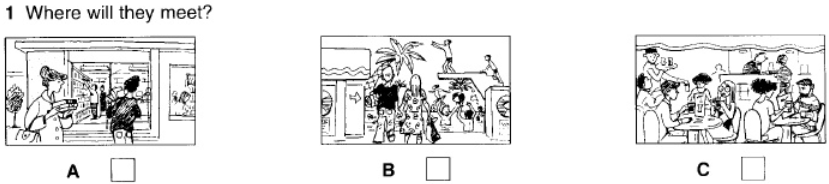
[A, B, C]

[A, B, C]

[A, B, C]
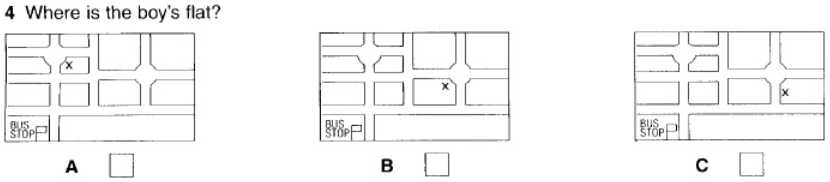
[A, B, C]
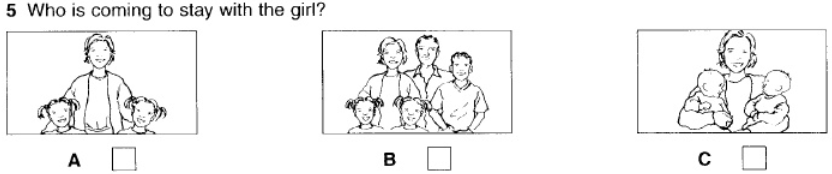
[A, B, C]

[A, B, C]
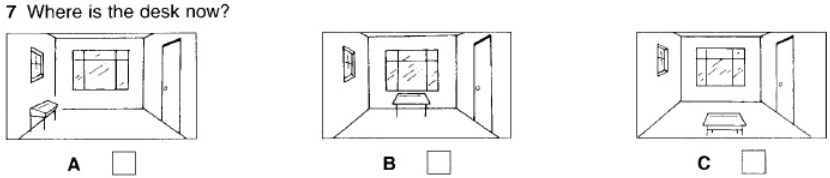
[A, B, C]
Questions 8-13
You will hear a tour guide talking to a group of tourists about a coach trip. For each question, choose the correct variant.

[A, B, C]
 [A, B, C]

[A, B, C]

[A, B, C]

[A, B, C]

[A, B, C]
Questions 14-19
You will hear a woman talking on the radio about a competition. For each question choose the correct information in a numbered space.
This month's competition
Prize: a computer + a (14) [print, colour, black]printer
Write a story:
-length: fewer than (15) [1500, 150, 1400]words
-subject: a short (16) [detective, adventure, crime]story which takes place in (17) [the present, the past, the future]
Write your name, address, telephone number and (18) [age, city, country] at the end.
Story must arrive on or before (19) [8th of March, 18th of March, 28th of March]
Questions 20-25
Look at the six sentences for this part. You will hear a conversation between a man, Marcus, and a woman, Cora, who work in the same office. Decide if each sentence is correct (T) or incorrect (F).
20 Marcus is often late for work. [T, F]
21 Cora disagrees with Marcus about the cause of traffic jams. [T, F]
22 Marcus agrees that cycling to work would be good for him. [T, F]
23 Marcus believes employers should provide buses. [T, F]
24 Marcus agrees to try coming to work by bus tomorrow. [T, F]
25 Cora suggests that Marcus is lazy. [T, F]
Рефлексія від 13 учнів
Сподобався:
0
Так: 12
Ні: 1
Зрозумілий:
0
Так: 9
Ні: 4
Потрібні роз'яснення:
0
Ні: 11
Так: 2