- Всеосвіта›
- Бібліотека тестів›
- Англійська мова›
- HS1 2021 30.12

Тест:
HS1 2021 30.12

19.12.2021

Вміст тесту:
1
2
3
4
5
6
7
8
9
10
11
Тест містить питання скопійовані з: HS1 2019 U7 p121 act24, HS1 2019 act11 p129 (29.10.21), HS1 - 2b (19.11), HS1 unit9 - 24.12.
1
12 з 132 балів
Choose only the names of the musical instruments.
2
12 з 132 балів
Complete phrasal verbs with correct prepositions.
1) викликати - to call
2) випадково зустріти - to come
3) перетворюватися на - to tun
4) шукати - to look
5) відвідати когось ненадовго - to call
6) чекати з нетерпінням - to look
7) раптово з'являтись - to turn
8) спускатись - to come
9) скасувати - to call
10) повернутись/змінитись на краще - to turn
11) заїхати за кимось - to call
12) дійти до якого-небудь рішення - to come
13) супроводжувати - to come
14) доглядати - to look
3
12 з 132 балів
Match the words with the appropriate pictures.
1
a surgeon
А

2
a dentist
Б

3
a fireman
В

4
an electrician
Г

5
a vet
Ґ

6
a librarian
Д

7
an architect
Е

8
a waiter/ waitress
Є

9
a miner
Ж

4
12 з 132 балів
Choose the appropriate derivatives of the following verbs.
to perform - [performly, performance, performation]
to arrange - [arrangement, arrant, arraign]
to present - [presence, presentation, presentiment]
to pick - [pickle, picky, picket]
to spectate - [spectral, specter, spectacular]
to impress - [imprecation, impressive, imprecise]
to create - [crease, creationism, creator]
to promote - [promotion, prominent, promise]
to occupy - [occupation, occult, occasion]
to refuse - [refund, refuel, refusal]
to publish - [public, publicist, publican]
to intend - [intention, intensive, intently]
5
12 з 132 балів
Match the grammar tense with the appropriate tense indicator.
1
Past Simple
А
recently, yet, today
2
Past Perfect
Б
since, for
3
Present Continuous
В
usually, sometimes, often
4
Present Perfect
Г
next, the day after tomorrow, soon
5
Present Perfect Continuous
Ґ
yesterday, ago, last
6
Future Perfect Continuous
Д
Look! Listen! Still
7
Present Simple
Е
For 10 years by next summer
8
Past Continuous
Є
by last year , by the moment you came
9
Future Simple
Ж
the whole evening yesterday, from 5 till 7 last Monday
6
12 з 132 балів
Write down the tense of each sentence. Pay attention to the form.(Example: Present Simple)
1. My cousin is speaking with her apprentice at the moment.
2. Jack has never been a good employer.
3. Did they get the dole last summer?
4. What college will their children apply next year?
5. I’ll be earning money for the holidays in the Carpathians from 11 a.m. till 1 p.m. on Sunday.
6. By next Friday she will have been working as an interpreter of English for 2 months.
7.April will have gone to the coffee shop before she comes here.
8.The plane had left by the time I got to the airport.
9.I've been working on this report since eight o'clock this morning.
10.We had been eating that delicious pizza when the waiter brought our bill.
7
12 з 132 балів
Choose tenses that are NOT used in Passive Voice.
8
12 з 132 балів
Use the verb in the correct Passive form.
1. Romeo and Juliet by Shakespeare. (WRITE)
2. The books yet. (NOT PUBLISH)
3. As soon as I got home, I realized that my wallet . (STEAL)
4. Dinner between 5 and 10 p.m. every day. (SERVE)
5. No letters since the start of the strike. (DELIVER)
6. The building when we got there (BUILD).
7. Progress in many fields of science in the last decade. (MAKE)
8. Since last week 5 of the 7 bullies . (CATCH)
9. Three workers by the new director next month. (TRANSFER)
10.The classroom next week. (DECORATE)
11.The church by a famous architect in the 18th century. (DESIGN)
12.The tunnel at the moment, so it's closed for all traffic. (REPAIR)
9
12 з 132 балів
General Test
1. Could you arrive on time? – I don’t know for certain. It depends [a, b, c, d] the traffic.
a) for b) of
c) on d) from
2. I went to that museum [a, b, c, d] some famous pictures.
a) to visit b) to watch
c) to see to d) to look at
3. We’re late, I expect the film [a, b, c, d] by the time we get to the theatre.
a) have started b) will start
c) will be starting d) will have started
4. I’m sure he was [a, b, c, d] lie!.
a) doing b) saying
c) making d) telling
5. My flat is on [a, b, c, d] second floor.
a) the b) a
c) an d) -
6. This car didn’t go as fast as my old one [a, b, c, d] .
a) do b) did
c) does d) will
7. The weather is [a, b, c, d] than the last week. It’s so windy!
a) worse b) bad
c) the worst d) badder
8. What is your busiest day of the week? - [a, b, c, d].
a) every day b) last week
c) in the morning d) Tuesday
9. I come home [a, b, c, d] school in the afternoon.
a) at b) in
c) from d) at
10. My old cat died last year, and I still [a, b, c, d] her.
a) lack b) fail
c) miss d) lose
11.Jake … meat in the oven while Cara … borsch. [a, b, c, d]
a) was stewing / cooked
b) was stewing / was cooking
c) has stewed / cooking
d) stew / cook
12.I [a, b, c, d] you photos when I get them.
a) send b) am sending
c) will send d) sent
13.The meeting was organized [a, b, c, d] Friday evening.
a) on b) to
c) at d) in
14.When I saw her, she [a, b, c, d] a car.
a) was driving
b) were driving
c) is driving
d) is driveing
15.Although, it was [a, b, c, d] , a few mountain climbers climbed the mountain.
a) beautiful b) dangerous
c) enjoy d) funny
16.Steven and his friends are very [a, b, c, d], that’s why they can get a good result.
a)naughty b) hard-working
c) sour d) shy
17.The road is very [a, b, c, d], so buses cannot go through.
a) big b) to clear
c) narrow d) wide
18. The clothes sold at the Night Market are [a, b, c, d] .
a) cheap b) untidy
c) clear d) loose
19. I fell down yesterday because the floor was [a, b, c, d].
a) clean b) clear
c) slippery d) untidy
20.The autobiography of David Beckam is on sale but is too [a, b, c, d].
a) rich b) expensive
c) dangerous d) popular
21. How much time do you [a, b, c, d] your homework?
a) make at b) bring to
c) give for d) spend on
22. Do you know that woman? Yes, I know [a, b, c, d].
a) hers b) she
c) her d) him
23. Why [a, b, c, d] a car?
a) don’t you got? b) haven’t you got?
c) haven’t you get? d) haven’t got you?
24. Your father usually has lunch at home, [a, b, c, d] he?
a) hasn’t b) does
c) doesn’t d) didn’t
25. We know their address, but they don’t know [a, b, c, d] .
a) ours b) their’s
c) our’s d) our
26. I [a, b, c, d] to London several times.
a) go
b) have been
c) have gone
d) went
27. Choose the sentence with the right word order. [a, b, c, d]
a) You easily can lose your friend’s trust.
b) You can lose easily your friend’s trust.
c) You can easily lose your friend’s trust.
d) Easily you can lose your friend’s trust.
28. The travel company made us [a, b, c, d] advantageous tour.
a) an b) a
c) nothing d) the
29. It’s cold outside. You have to dress up [a, b, c, d]
a) warm b) warmful
c) warmfully d) warmly
30. Put the butter [a, b, c, d] the fridge.
a) off b) into
c) out d) out of
31. We [a, b, c, d] to take a walk now.
a) will b) can
c) are going d) will be
32. We start [a, b, c, d] work at a quarter to nine.
a) the
b) a
c) -
d) any
33. Choose the sentence with the right word order. [a, b, c, d]
a) My brother finds always a way out of any situation.
b) Always my brother finds a way out of any situation.
c) My brother finds a way out of any situation always.
d) My brother always finds a way out of any situation.
34. I don’t know her very well, but my friends [a, b, c, d] .
a) do b) does
c) did d) are
35. He speaks neither English [a, b, c, d] French.
a) or b) both
c) nor d) either
36. I find that difficult to believe. Do you trust [a, b, c, d] ?
a) his
b) me
c) my
d) their
37. He received considerable financial [a, b, c, d] for his work.
a) reward b) repayment
c) receipt d) gift
38. It is difficult to [a, b, c, d] a date which is convenient for everyone.
a) vote b) organize
c) choose d) provide
39. The weather [a, b, c, d] . I think we can go roller skating to the park soon.
a) improves b) is improving
c) is being improved d) is being improving
40. In the café we … some delicious food, … some wine and then we … a lot in the city centre. [a, b, c, d]
a) were trying/ were drinking/were walking
b) had tried/drank/were walking
c) tried/drank/walked
d) had tried/had drunk/walked
41. Darrel has realized too late that he [a, b, c, d] for Jill for more than 3 hours when his aircraft lands.
a) will wait b) will have been waiting
c) will have waited d) will be waiting
42. Transfer this Active Voice sentence into the Passive one: The company is still constructing the building. [a, b, c, d]
a) The building is still constructed.
b) The building is still been constructed.
c) The building is still being constructed.
d) The building is still have being constructed
43. Please, [a, b, c, d] your seats and fasten belts.
a) do b) make
c) get d) take
44. Her office is [a, b, c, d] away than mine.
a) father b) more far
c) farther d) farer
45. All I can say is that, [a, b, c, d], you’re going to spend more time practicing your listening comprehension skills.
a) at personal experience
b) of personal experience
c) from personal experience
d) in personal experience
10
12 з 132 балів
Reading
TASK 1. Read the text below. Choose from (A-H) the one which best fits each space (1-6). There are two choices you do not need to use.
Glossary: henge – a prehistoric monument consisting of a circle of massive stone or wood uprights
Archaeologists have discovered evidence of what they believe was a second Stonehenge located a little more than a mile away from the world-famous prehistoric monument.
The new find on the west bank of the river Avon has been called "Bluestonehenge", after the colour of the 25 Welsh stones of (1) [A, B, C, D, E, F, G, H].
Excavations at the site have suggested there was once a stone circle 10 metres in diameter and surrounded by a henge – a ditch with an external bank, according to the project director, Professor Mike Parker Pearson, of the University of Sheffield.
The stones at the site were removed thousands of years ago but the sizes of the holes in (2) [A, B, C, D, E, F, G, H] indicate that this was a circle of bluestones, brought from the Preseli mountains of Wales, 150 miles away.
The standing stones marked the end of the avenue (3) [A, B, C, D, E, F, G, H], a 1¾-mile long processional route constructed at the end of the Stone Age. The outer henge around the stones was built about 2400BC but arrowheads found in the stone circle indicate the stones were put up as much as 500 years earlier.
Parker Pearson said his team was waiting for results of radiocarbon dating (4) [A, B, C, D, E, F, G, H] whether stones currently in the inner circle of Stonehenge were originally located at the other riverside construction.
Pearson said: "The big, big question is when these stones were erected and when they removed – and when we get the dating evidence we can answer both those questions." He added: "We speculated in the past (5) [A, B, C, D, E, F, G, H] at the end of the avenue near the river. But we were completely unprepared to discover that there was an entire stone circle.
Another team member, Professor Julian Thomas, said the discovery indicated (6)
[A, B, C, D, E, F, G, H] was central to the religious lives of the people who built Stonehenge. "Old theories about Stonehenge that do not explain the evident significance of the river will have to be rethought," he said. Dr Josh Pollard, project co-director from the University of Bristol, described the discovery as "incredible".
A which could reveal
B which they stood
C which it was once made up
D that this stretch of the river Avon
E that there might have been something
F that it should be considered as integral part
G that leads from the river Avon to Stonehenge
H about the necessity of excavations
TASK 2.Read the text below. Choose from (A-H) the one which best fits each space (1-6). There are two choices you do not need to use.
The necessity of telephones is unquestionable; they have become, especially since the 1950s, as essential tool in modern life. Can you imagine your life without one at home, even in your car, or when on holiday in the mountains, for instance? Hardly anybody would give (1) [A, B, C, D, E, F, G, H].
In recent years mobile phones have become particularly fashionable. Technically called cellular phones, they are one of the great contributions of technology to our lives. Although it has taken a long time to make them available to everybody, it is now clear that (2) [A, B, C, D, E, F, G, H]. Calls can now be made from far away areas of the world.
Smart phones perform a lot of necessary functions. They allow business people to remain within their offices’ reach, and drivers to travel alone safety. With their help you`ve got access to the Internet. Smaller and lighter models now allow users to take their telephones almost everywhere. You may go to the forest, be on board a ship, in a gym, (3) [A, B, C, D, E, F, G, H].
Nowadays, throughout the world, the smart phone has become a status symbol, without which in some cultures it is assumed that you belong to a «lower class» of «less successful» people. Yet, it is often amusing to hear such «successful» people using their phones to call friends from bars and restaurants (4) [A, B, C, D, E, F, G, H]. It is simply a way of showing off and making oneself look important to others.
Obviously, smart phones are convenient but this convenience also has its price. Although today’s cellular telephones (5) [A, B, C, D, E, F, G, H], they still remain more expensive to buy and use than regular telephones. On average, cellular phone calls are about twice as expensive as those from regular phones and additionally, you have to pay a monthly fee to use your phone.
Still, (6) [A, B, C, D, E, F, G, H], and price should continue to decrease. It may not be long before the cellular phone is as basic as a calculator in the lives of many people around the world
A you`ll be in touch with all the people you need
B are much cheaper than the first model available,
C a positive answer to this question
D they enable us to communicate with the most distant places
E when cheaper public pay phones are nearby
F mobile phones will continue to improve in quality
G the basic phones in use today are not used
H smart phones will be replaced by other gadgets
11
12 з 132 балів
Listening
Part 1
Questions 1-5
You will hear five short conversations.
There is one question for each conversation.
For questions 1-5, choose the right answer.
1. What will they eat for dinner this evening? [A, B, C]
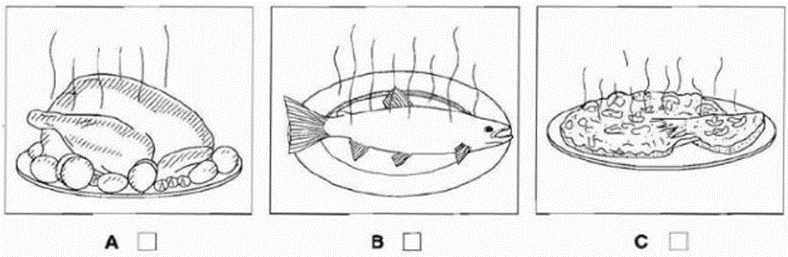
2. What time is it? [A, B, C]
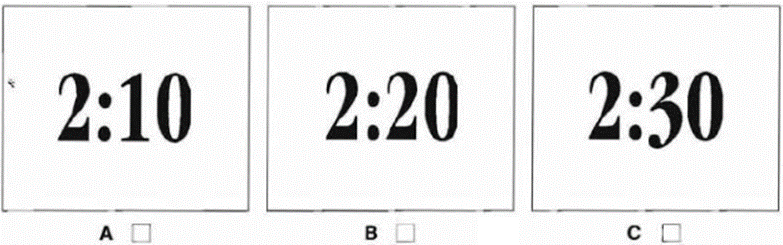
3. What’s Michelle going to read? [A, B, C]
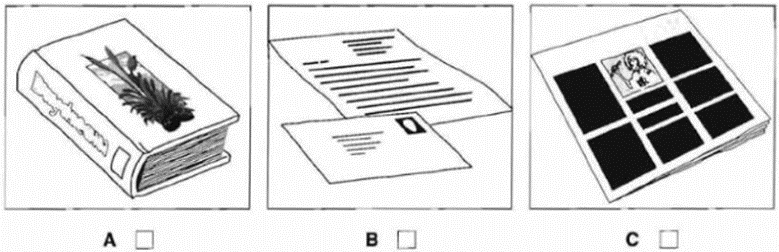
4. How much did the tickets cost? [A, B, C]
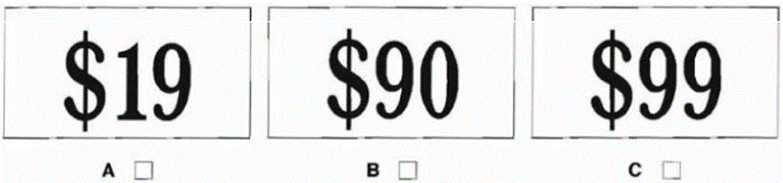
5. Where is the chemist’s? [A, B, C]
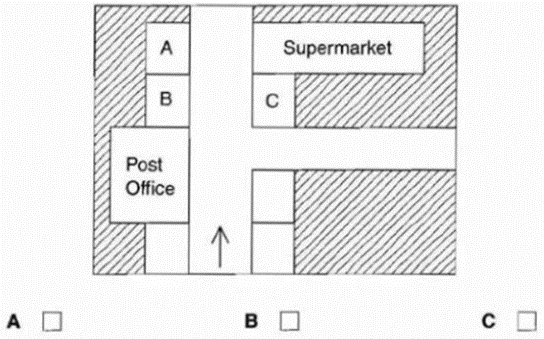
Part 2
Questions 6-10
Listen to Kate telling Emma about her family. Where is each person going today?
You will hear the conversation twice.
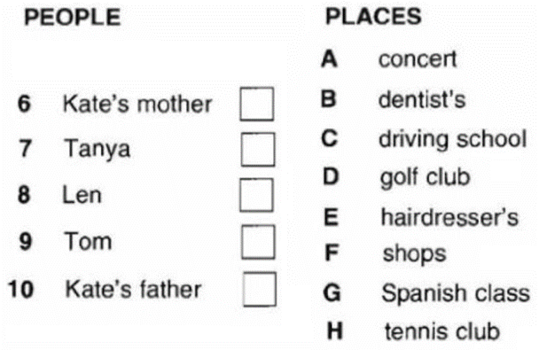
6. [A, B, C, D, E, F, G, H]
7. [A, B, C, D, E, F, G, H]
8. [A, B, C, D, E, F, G, H]
9. [A, B, C, D, E, F, G, H]
10. [A, B, C, D, E, F, G, H]
Рефлексія від 4 учнів
Сподобався:
0
Так: 2
Ні: 2
Зрозумілий:
0
Так: 2
Ні: 2
Потрібні роз'яснення:
0
Ні: 1
Так: 3