

Граматичний матеріал з англійської мови.
Тема: "Adjective".
Uses of adjectives
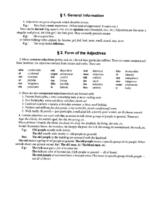
Adjectives tell the reader how much—or how many—of something you’re talking about, which thing you want passed to you, or which kind of something you want.
Please use three white flowers in the arrangement.
Three and white are modifying flowers.
Often, when adjectives are used together, you should separate them with a comma or conjunction. See “Coordinate Adjectives” below for more detail.
I’m looking for a small, good-tempered dog to keep as a pet.
My new dog is small and good-tempered.
Degrees of comparison
Adjectives come in three forms: absolute, comparative, and superlative.
Absolute adjectives describe something in its own right.
A cool guy
A messy desk
A mischievous cat
Garrulous squirrels
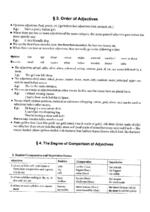
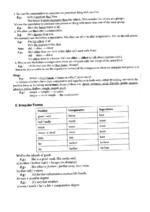
Comparative adjectives, unsurprisingly, make a comparison between two or more things. For most one-syllable adjectives, the comparative is formed by adding the suffix -er (or just -r if the adjective already ends with an e). For two-syllable adjectives ending in -y, replace -y with -ier. For multi-syllable adjectives, add the word more.
A cooler guy
A messier desk
A more mischievous cat
More garrulous squirrels
Superlative adjectives indicate that something has the highest degree of the quality in question. One-syllable adjectives become superlatives by adding the suffix -est (or just -st for adjectives that already end in e). Two-syllable adjectives ending in -y replace -y with -iest. Multi-syllable adjectives add the word most. When you use an article with a superlative adjective, it will almost always be the definite article (the) rather than a or an. Using a superlative inherently indicates that you are talking about a specific item or items.
The coolest guy
The messiest desk
The most mischievous cat
The most garrulous squirrels
Coordinate adjectives
Coordinate adjectives should be separated by a comma or the word and. Adjectives are said to be coordinate if they modify the same noun in a sentence.
This is going to be a long, cold winter.
Isobel’s dedicated and tireless efforts made all the difference.
But just the fact that two adjectives appear next to each other doesn’t automatically mean they are coordinate. Sometimes, an adjective and a noun form a single semantic unit, which is then modified by another adjective. In this case, the adjectives are not coordinate and should not be separated by a comma.
My cat, Goober, loves sleeping on this tattered woolen sweater.
No one could open the old silver locket.
In some cases, it’s pretty hard to decide whether two adjectives are coordinate or not. But there are a couple of ways you can test them. Try inserting the word and between the adjectives to see if the phrase still seems natural. In the first sentence, “this tattered and woolen sweater” doesn’t sound right because you really aren’t talking about a sweater that is both tattered and woolen. It’s a woolen sweater that is tattered. Woolen sweater forms a unit of meaning that is modified by tattered.
Another way to test for coordinate adjectives is to try switching the order of the adjectives and seeing if the phrase still works. In the second sentence, you wouldn’t say “No one could open the silver old locket.” You can’t reverse the order of the adjectives because silver locket is a unit that is modified by old.