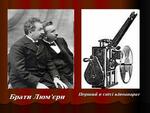
Lumiere's portable, suitcase-sized cinematographe served as a camera, film processing unit, and projector all in one. He could shoot footage in the morning, process it in the afternoon, and then project it to an audience that evening. His first film was the arrival of the express train at Ciotat. Other subjects included workers leaving the factory gates, a child being fed by his parents, people enjoying a picnic along a river. The ease of use and portability of his device soon made it the rage in France.
A film could be under a minute long and would usually present a single scene, authentic or staged, of everyday life, a public event, a sporting event or slapstick. There was little to no cinematic technique, usually no camera movement, and flat compositions reminiscent of the Stage.
Until 1927, motion pictures for films were produced without sound. This era is referred to as the silent era of film. To enhance the viewers' experience, silent films were commonly accompanied by live musicians and sometimes sound effects and even commentary spoken by the showman or projectionist.
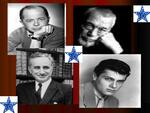
Stars powered the American Studio System from 1934-1946. Various studios, such as 20th-Century Fox (1935), Paramount Pictures (1912), Metro-Goldwyn-Mayer (1924), Columbia Pictures (1920), and Warner Brothers (1923) held long-term contracts both on directors and stars. A listing of some of the stars under contract to the studios gives some idea of the Studio System's power during these years.
Stars weren't free to seek their own contracts during these years. Often stars would be "loaned" by one studio to another for a particular project with the expectation that such offers would be reimbursed in kind. Stars also worked on more than one picture at a time and often were expected to churn out four or five pictures a year. For instance, Humphrey Bogart starred in 36 films between 1934 and 1942. Casablanca was one of four pictures he completed in 1943.
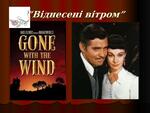
With the 1950s came the advent of television sets in every home, cinemascope and VistaVision. Several directors who made their reputations during the Studio Era in the 1940s (Billy Wilder, John Huston, Elia Kazan, Alfred Hitchcock, and John Ford) continued to make good films. The last vestiges of the Studio System dissolved in the face of new directors, new approaches to acting, and new ideas about the depiction of the real world in films.
During the 1960s the studio system in Hollywood declined, because many films were now being made on location in other countries, or using studio facilities abroad, such as Pinewood in England and Cinecittà in Rome. "Hollywood" movies were still largely aimed at family audiences, and it was often the more old-fashioned films that produced the studios' biggest successes. Productions like Mary Poppins (1964), My Fair Lady (1964) and The Sound of Music (1965) were among the biggest money-makers of the decade.
.
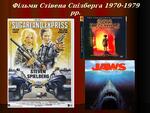
During the 1970s, a new group of American filmmakers emerged, such as Francis Ford Coppola, Steven Spielberg, George Lucas and Brian de Palma. The development of the auteur style of filmmaking helped to give these directors far greater control over their projects than would have been possible in earlier eras. This led to some great critical and commercial successes, like Coppola's The Godfather films, Spielberg's Jaws and Close Encounters of the Third Kind and George Lucas's Star Wars.
During the 1980s, audiences began increasingly watching movies on their home VCRs. In the early part of that decade, the movie studios tried legal action to ban home ownership of VCRs as a violation of copyright, which proved unsuccessful. Eventually, the sale and rental of movies on home video became a significant "second venue" for exhibition of films, and an additional source of revenue for the movie companies.
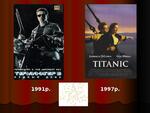
The early 1990s saw the development of a commercially successful independent cinema in the United States. Although cinema was increasingly dominated by special-effects films such as Terminator 2: Judgment Day (1991) and Titanic (1997), had significant commercial success both at the cinema and on home video.
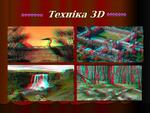
A 3D or 3-D (three-dimensional) film is a motion picture that enhances the illusion of depth perception. Derived from stereoscopic photography, a regular motion picture camera system is used to record the images as seen from two perspectives and special projection hardware and/or eyewear are used to provide the illusion of depth when viewing the film.