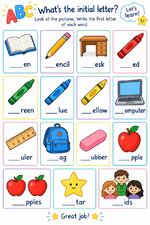
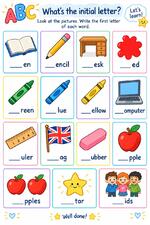
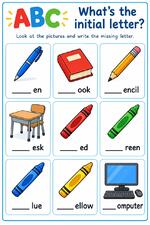
The given worksheets focuse on essential young learner topic covered throughout the curriculum, including school objects.
The primary pedagogical aim of filling in the initial letters of a word for young learners (like those studying Smart Junior 2) is to develop phonemic awareness and strengthen letter-sound correspondence.
Here is a breakdown of why this specific activity is so important for early literacy:
Phonics Reinforcement: It helps children isolate the very first sound they hear in a word (e.g., hearing the /p/ sound in "pencil") and connect it directly to the correct written letter (P).
Vocabulary Retrieval: It provides a visual and contextual clue. Seeing _en next to a picture of a pen prompts the child's brain to retrieve the complete word from memory.
Spelling Foundations: It builds early spelling confidence by breaking words down. Writing just one missing letter is less intimidating for a 7-year-old than writing an entire word from scratch.
Motor Skills & Recognition: It practices letter formation while reinforcing word boundaries, helping young EFL (English as a Foreign Language) students recognize where a word begins.