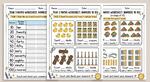
Core Educational Objectives of the worksheet.
Understanding Place Value: Teaching students that two-digit numbers are built from tens and ones (e.g., understanding that 42 is made of 4 tens and 2 ones).
Skip Counting by 10s and 5s: Developing the ability to count efficiently up to 100, which serves as a critical foundation for learning multiplication, telling time, and managing money.
Recognizing Patterns in a 100-Chart: Helping children see structural number patterns, such as numbers increasing by 1 vertically down a column or by 10 horizontally across a row.
Distinguishing "Teen" vs. "Ty" Sounds: Overcoming common pronunciation and recognition hurdles by helping students accurately identify the difference between numbers like 13 and 30, or 14 and 40.
Comparing and Ordering Numbers: Training students to determine which double-digit number is greater than, less than, or equal to another by looking at the tens digit first.