

"Have got" and "has got" are expressions that are often used in informal English to indicate possession or obligation. However, it's worth noting that "have got" can be considered more common in British English, while Americans often prefer to use "have" or "has" alone.
Possession:
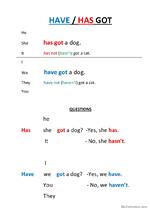
I have got a new car. (British English)
I have a new car. (American English)
He has got a cat. (British English)
He has a cat. (American English)
Obligation or Necessity:
I have got to finish my homework. (British English)
I have to finish my homework. (American English)
She has got to go to the dentist. (British English)
She has to go to the dentist. (American English)
In formal writing, it is generally recommended to use "have" or "has" without "got" to express possession:
I have a book.
She has a dog.
Remember that "have got" is not used in the present perfect tense. For example, instead of saying "I have got a new job," you would say "I have a new job" in formal English.