Самостійна робота 1 з Англійської мови за професійним спрямуванням (пустовойченко) готові відповіді
Кредит 1
Self-study 1
Part 1
VOCABULARY PRACTICE
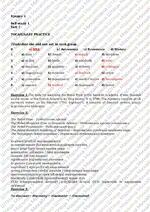
1Underline the odd one out in each group.
0 a) DNA b) Astronomy c) Economics d) History
1 a) doze b) dream c) supply d) sleepless
2 a) at last b) lastly c) suddenly d) soon
3 a) discount b) quantity c) delivery d) colleague
4 a) fingerprints b) evidence c) firework d) crime
5 a) promotion b) department c) market leader d) investigator
6 a) amazed b) worked c) depressed d) bored
The Nobel Prize
Exercise 1. Who founded the Nobel Prize? When was it founded? Where does it take place?
Exercise 2. Pay attention to the following word combinations. Translate them into Ukrainian:
The Nobel Prize –
The Nobel Memorial Prize in Economic Science –
The Nobel Foundation –
The Royal Swedish Academy of Sciences –
The Norwegian Nobel committee –
to award [ə′wÉ:d]
to commemorate [kə′meməreıt]
peace prize [′pi:s ′praız]
nomination [,nÉmı′neı∫(ə)n]
laureate [′lÉ:rııt]
significance [sıg′nıfıkəns]
to pioneer [,paıə′nıə]
superfluid [,s(j)υ:pə′flu:ıd]
strong interaction [′strÉŋ ,ıntə′rak∫(ə)n]
spectroscopy[prı′sıʒn spek′trÉskəpı]
blackbody [,blak′bÉdı] [′graυndbreıkıŋ]
CCD (chargecoupled device)[′t∫a:dʒ′kÙpld dı′vaıs]
Exercise 3. Mind the meanings of the following derivatives. Complete the
sentences below.
To discover→ discovery → discoverer → discovered
1. These dinosaur remains were one of the most important … of the century. 2. Scientists around the world are working … a cure for Aids. 3. Alexander Fleming is the … of penicillin. 4. Who … America? 5. I was the lucky … of a very valuable painting. 6. Researchers in this field have made some new important … . 7. In 1974 Hawking … that black holes give off radiation. 8. The drug is not a new … – it's been known about for years.
Exercise 4. Choose the right word.
1. The Nobel Prize is any of the prizes that are rewarded / awarded annually by four institutions. 2. The money is taken from a fund established under the will / want of Alfred Bernhard Nobel. 3. The first Nobel prizes were given on December 10, 1901, the fifth anniversary of the death of the founder / finder. 4. An additional award, the Prize for Economic Science in Memory of Alfred Nobel, was set in / set up in 1968 by the Bank of Sweden, and the first award was given in 1969. 5. Each award consists of a gold medal and a diploma bearing / passing the winner's name and a sum of money, the quantity / amount depending on the income of the foundation. 6. The collection / selection of the prize-winners starts in the early autumn of the year preceding the awards. 7. A prize is either given hole / entire to one person, divided equally between / among at most two works, or shared jointly by two or three persons.
Exercise 5. Read the passage about the Nobel Prize and say in what fields it is awarded.
The Nobel Prize
The Nobel Prize is an annual international monetary prize. The prize was established by a Swedish chemist and the inventor of dynamite Alfred Bernhard Nobel who left 31 million Swedish kronor. Under his will the capital was to be invested by his executors in safe securities and constitute a fund, the interest on which was to be annually distributed in the form of prizes “to those who, during the preceding year, shall have conferred the greatest benefit on mankind". The prize was to be awarded in five fields: physics, chemistry, physiology or medicine, literature, and peace. But in 1968 the Riksbank, the central bank of Sweden, created an economics prize to commemorate the bank's 300th anniversary. This prize, called the Nobel Memorial Prize in Economic Science, was first awarded in 1969. The bank provides a cash award equal to the other Nobel prizes. The Nobel prizes are internationally recognized as the most prestigious awards in each of these fields with the Prize in Economics, which is commonly identified with them. The first Nobel prizes were awarded on December 10, 1901, the fifth anniversary of Nobel’s death. They are presented annually at ceremonies in Stockholm, Sweden, and in Oslo, Norway, on this day. In Stockholm, the king of Sweden presents the awards in physics, chemistry, physiology or medicine, literature, and economic sciences. The peace prize ceremony takes place at the University of Oslo in the presence of the king of Norway. After the ceremonies, Nobel Prize winners give a lecture on a subject connected with their prize-winning work. The winner of the peace prize lectures in Oslo, the others in Stockholm. The lectures are later printed in the Nobel Foundation's annual publication, Les Prix Nobel (The Nobel Prizes). In his will, Nobel stated that the prizes for physics and chemistry would be awarded by the Royal Swedish Academy of Sciences, the prize for physiology or medicine by the Karolinska Institute in Stockholm, the literature prize by the Swedish Academy in Stockholm, and the peace prize by a five-person committee elected by the Norwegian Parliament. After the economics prize was created in 1968, the Swedish Academy of Sciences has held the responsibility of selecting the winners of that award. The fund is controlled by a board of directors, which serves for two year periods and consists of six members: five elected by the trustees of the awarding bodies mentioned in the will, and the sixth appointed by the Swedish government. All six members are either Swedish or Norwegian citizens. All the prize-awarding bodies have set up Nobel committees consisting of three to five people who make recommendations in the selection process. Additional specialists with expertise in relevant fields assist the committees. The Nobel committees examine nominations and make recommendations to the prize-awarding institutions. After deliberating various opinions and recommendations, the prize-awarding bodies vote on the final selection, and then they announce the winner. The deliberations and voting are secret, and prize decisions cannot be appealed. A prize for achievement in a particular field may be awarded to an individual, divided equally between two people, or awarded jointly among two or three people. According to the Nobel Foundation’s statutes, the prize cannot be divided among more than three people, but it can go to an institution. A prize may go awarded if no candidate is chosen for the year under consideration, but each of the prizes must be awarded at least 19 once every five years. If the Nobel Foundation does not award a prize in a given year, the prize money remains in the trust. Likewise, if a prize is declined or not accepted before a specified date, the Nobel Foundation retains the prize money in its trust. The prize amounts are based on the annual yield of the fund capital. In 1948 Nobel prizes were about $32,000 each; in 1997 they were about $1 million each. Since 2001 the grant has been 10,000,000 Swedish kronor approximately $1.4 million as of August 2009). In addition to a cash award, each prizewinner also receives a gold medal and a diploma bearing the winner's name and field of achievement. Prizewinners are known as Nobel laureates. The Nobel Prize in Physics requires that the significance of achievements being recognized is "tested by time." In practice it means that the lag between the discovery and the award is typically on the order of 20 years and can be much longer. For example, half of the 1983 Nobel Prize in Physics was awarded to Subrahmanyan Chandrasekhar for his work on stellar structure and evolution that was done during the 1930s. As a disadvantage of this approach, not all scientists live long enough for their work to be recognized. Some important scientific discoveries are never considered for a prize, as the discoverers may have died by the time the impact of their work is realized.
Among the latest Nobel Prizes in Physics are:
2008 1) YOICHIRO NAMBU for the discovery of the mechanism of spontaneous broken symmetry in subatomic physics.
2) MAKOTO KOBAYASHI and TOSHIHIDE MASKAWA for
the discovery of the origin of the broken symmetry which predicts the existence of at least three families of quarks in nature.
2009 1) CHARLES K. KAO “for groundbreaking achievements
concerning the transmission of light in fibers for optical communication”.
2) WILLARD S. BOYLE and GEORGE E. SMITH “for the invention of an imaging semiconductor circuit - the CCD sensor”.
2010 ANDRE GEIM and KONSTANTIN NOVOSELOV “for groundbreaking experiments regarding the two-dimensional material grapheme”
2011 SAUL PERLMUTTER, the other half jointly to BRIAN P. SCHMIDT and ADAM G. RIESS “for the discovery of the accelerating expansion of the Universe through observations of distant supernovae”.
2012 SERGE HAROCHE and DAVID J. WINELAND "for groundbreaking
experimental methods that enable measuring and manipulation of individual quantum systems"
Exercise 6. Answer the following questions.
1. What is the Nobel prize? 2. Who established it? 3. What fields is this award given in? 4. When and where is the Nobel prize commemorated? 5. What institutions award the Nobel prize? 6. What is the function of Nobel committees? 7. How are prize-winners chosen? 8. How much is the Nobel prize? 9. What is a disadvantage of choosing Nobel laureates?
Exercise 7. Here are the twentieth-century discoveries and inventions in physics. Using the Internet, fill in the table. The data in the table are correct.
Data Contributors Discoveries and inventions
1900 Max Planck
1911 Ernest Rutherford
1929 the first cyclotron
1932 James Chadwick
1946 the nuclear reactor
1947 the transistor
1952 Edward Teller
1960 the first laser
1964 Murray Gell-Mann
1971 The Intel Corporation
1980 the compact disc
1983 the Internet
Contributors: Enrico Fermi, Philips Electronics N.V. and Sony Corporation, Ernest Lawrence, Theodore H. Maiman, Bell Telephone Laboratories physicists, Tim Berners Lee.
Discoveries and inventions: quantum theory, the neutron, the concept of the "quark", the first microprocessor, modern theory of atomic structure, the first hydrogen bomb.
Exercise 8. Translate the following sentences into English in writing (according to the text).
1. Нобелівська премія - одна з найбільш престижних міжнародних премій. 2. Нобелівські премії засновані відповідно до заповіту Альфреда Нобеля. 3. Згідно із заповітом Нобеля, премія повинна присуджуватися за відкриття, винаходи і досягнення. 5. Ряд вчених помирає раніше, ніж їх відкриття або винаходи проходять необхідну ≪перевірку часом≫ для присудження премії.
Part 2
Writing practice
Write an essay expressing your thoughts on one of the following topics:
1.Does modern technology make life more convenient, or was life better when technology was simpler
2.Does modern technology make life more convenient, or was life better when technology was simpler
3.Comment on the quote of a philosopher, ‘He who knows does not talk. He who talks does not know’. What does this mean to you?