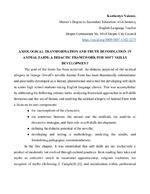
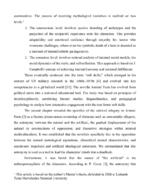
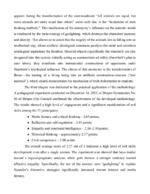
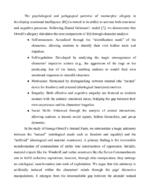
This study theoretically substantiates and practically evaluates the didactic potential of the satirical allegory in George Orwell’s Animal Farm as a literary tool for developing key soft skills (critical thinking, media literacy, empathy, reflection, and civic competence) among senior high school students during English language classes. With a methodology rooted in an interdisciplinary approach combining literary criticism, linguodidactics, and pedagogical psychology, the study traces the cultural evolution of soft skills from ancient mythological reception to modern competencies. The practical framework applies Allan Paivio’s Dual-Coding Theory and Daniel Goleman’s emotional intelligence (EQ) model. To overcome the characters' "limitations of thinking methods" in a classroom setting, a multi-layered methodology was developed, featuring visual conceptual modeling (Venn diagrams) and project-based tracking of linguistic alterations in the Seven Commandments. A pedagogical experiment was conducted on December 14, 2025, involving 23 participants at Dnipro Gymnasium No. 80. The empirical results confirmed the high effectiveness of the developed methodology, yielding an overall average soft skills development score of 2.27 out of 3 after a single session. Specifically, students demonstrated high levels of media literacy and critical thinking (2.65 points), reflection (2.43 points), and historical thinking (2.17 points). The data also revealed gender-specific analytical tendencies: male students leaned toward logical-pragmatic analysis, while female students exhibited higher levels of affective empathy. Integrating modern terminology like "gaslighting" to decode the characters' discursive strategies significantly heightened student engagement and contemporary media literacy. The study offers a novel interpretation of the novella’s zoomorphic allegory by identifying the genesis of "the artificial" through the anthropomorphic transformation of characters. It introduces and defines the categories of "constructions of utility" and "constructions of oppression," demonstrating the unidirectional and irreversible transformation of collective aspirations (and material objects like the windmill) into tools of totalitarian exploitation. Furthermore, it re-evaluates the character Boxer as a living being transformed into an artificial construction-resource ("raw material"). Finally, the study innovatively links Orwell's zoomorphic analysis to contemporary youth culture, framing the characters' "identification masks" as analogous to modern "fursonas," which serve as psychologically safe tools for emotional self-regulation and identity reflection in a globalized educational context.
Бібліотека методичних матеріалів
- Всеосвіта›
- Бібліотека методичних матеріалів›
- Англійська мова›
- Axiological Transformation & Truth Deterioration in Orwell's Animal Farm: a Didactic Framework for Soft Skills Development

Матеріал:
Axiological Transformation & Truth Deterioration in Orwell's Animal Farm: a Didactic Framework for Soft Skills Development
docx 
27.08.2026
8 Клас, 9 Клас, 10 Клас, 11 Клас, 12 Клас, I курс, II курс, III курс, IV курс, V курс, VI курс, Дорослі, Змішаний
25
0
0
0
Опис методичного матеріалу:
Вміст матеріалу:
Доступ до плеєра. Вбудувати плеєр: