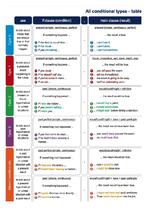
Examples of Conditionals and Their Benefits
Zero Conditional: ("If water freezes, it turns to ice.") Reinforces understanding of universal truths and factual information.
First Conditional: ("If you study, you will pass the test.") Teaches planning and the relationship between effort and results.
Second Conditional: ("If I had a pet, I would take care of it.") Encourages imagining hypothetical situations.
Third Conditional: ("If I had studied, I would have passed.") Develops reflective thinking about past events.
Mixed Conditionals: ("If I had studied harder, I would be more confident now.") Teaches complex reasoning and temporal relationships.
Activities to Foster Conditional Understanding
Role-Playing: Simulating real-life situations that require conditional thinking, such as planning a trip or solving a problem.
Interactive Games: Games like "What if?" to encourage creative use of conditionals.
Story Writing: Encouraging children to write stories that incorporate different types of conditionals.
Classroom Debates: Using conditionals to express arguments and hypothetical outcomes