Перегляньте інформацію, що наведена нижче (до завдань 1, 2, 5)
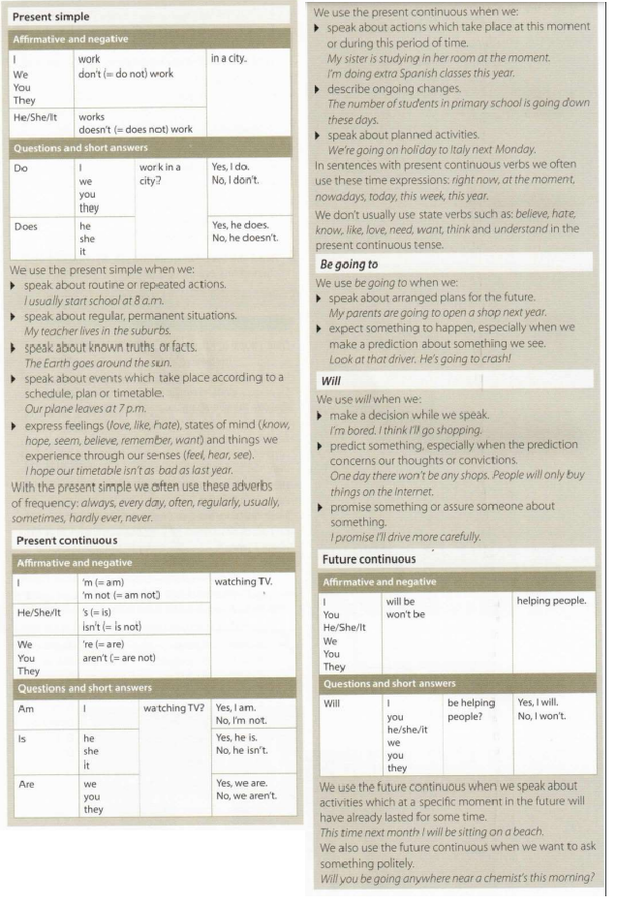
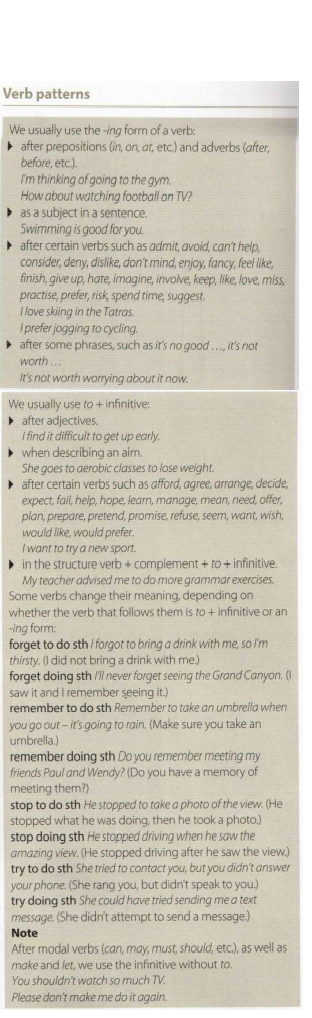


Перегляньте інформацію, що наведена нижче (до завдань 1, 2, 5)
Перегляньте інформацію, що наведена нижче (до завдань 1, 2, 5)
1
Choose the correct verb forms to complete the sentences (1-8).
1 I can't really help you now, I ['m doing, do] my maths homework.
2 What [are you doing, do you do] on Thursdays after school? We [need, are needing] your help.
3 This term we [are reading, read] crime novels in our after-school book club.
4 I can't go out with you tonight. My parents [will celebrate, are celebrating] their wedding anniversary and all the family [is, will be] there.
5 Look at those dark clouds. It looks like we [are having, are going to have] a storm soon.
6 We must hurry. The lecture will [start, starts] at seven o'clock.
7 Look, there's Thai chícken curry on the menu. I think I [have, 'll have] that.
8 I ['m going to, will] study medicine at university. I've always wanted to be a doctor.
2
Complete the sentences (1-5) with the verbs in brackets in the correct forms.
1 I managed (finish) the project despite (have) problems with my computer.
2 I've arranged (meet) Tony in a restaurant but it seems (be) closed.
3 You don't have (come) so early for the show, but you must (book) the ticket online.
4 Mike stopped (do) some shopping on his way back home.
5 My injury was so bad that I decided to give up (play) football.
3
Read the exam strategy. Choose the correct answer (A-D) to complete each sentence (1-5). The words in bold will help you.
1 After [A finished, B finishing, C to finish, D finish]my homework I went out for a run.
2 That was [A one, B a, C an, D the]best party I have ever been to!
3 Sally is fond of her cousins, but she doesn't see [A they, B their, C them, D they're]very often.
4 You don't need [A inviting, B invited, C invite, D to invite]everyone you know to the party.
5 Train tickets are cheaper late at night, so I think [A leaves, B will leave, C am leaving, D left]at 11 p.m. instead of 9 p.m.
4
Read the text below. For questions (1-10) choose the correct answer.
Mum has just announced that Aunt Caroline 1 [will come, comes, is coming, came]to stay with us for a few days at the end of the month. Aunt Caroline is my mum's younger sister, and they have always been quite close, despite 2 [have, they have, having, they had] some differences in tastes and lifestyle. I'm not entirely sure how I feel about her visit. She can be great fun, but she's sometimes difficult to get on with, especially now that I 3 [am, am being, have been, was] older. When I was 4 [an, a, the, one] child, I used to stay with her in her country house during the summer holidays. That was always a perfect time, and I look back on 5 [those, some, this, each] visits with great pleasure. Aunt Caroline 6 [would let, was letting, had let, did let] me climb the trees in her garden and explore the woods on my own. We also shared a love of edible treats of all kinds, including extravagant pastries and cakes. But she doesn't seem 7 [understand, to understand, understanding, understood] that I'm not a child any more, and she goes on treating me like the schoolgirl I once was. I suspect she 8 [will bring, is bringing, has brought, brings] me sweets again - which I no longer enjoy - and l'll have 9 [pretend, pretending, pretended, to pretend] that I'm thrilled in order to avoid looking ungrateful. Mum says I must meet Aunt Caroline at the station on Saturday morning. Perhaps once she 10 [is seeing, has seen, will see, see] my newly-acquired driving skills she'll realize that l'm all grown up now, and hopefully she will behave accordingly.
5
Complete the sentences (1-5) with the correct prepositions.
1 He applied a job in a record store.
2 loften dream becoming a rock star.
3 She complained the room service at the hotel.
4 Jan was suffering a headache when I saw him.
5 Could you please fill the application form?
6
Read the text below. For questions (1-10) choose the correct answer.
At what age do you hope to leave home? Most young people 1 [dream, approve, hope, know] of independence and living on their own, but a 2014 report from Eurofound suggests that more and more young people in Europe are living with their parents 2 [while, along, from, during] they are at university, and sometimes into their late twenties.
Slovenia leads the way, with 85% of 18-29 year olds still living in their parents' home, but the country that saw the 3 [best, most, more, ultimate] dramatic change was Hungary. In 2007, 40% of young people lived with their parents, and that figure went 4 [above, on, over, up] to 76% in 2011.
There are many reasons for this. The global financial crisis of 2008 hit young people the hardest and the 5 [effect, efforts, impacts, products] can still be seen today. Many young people complain 6 [in, from, about, for]having difficulties in finding well-paid jobs. Further education is now more expensive 7 [althought, because, however, that] scholarships and other forms of financial help are less generous than they were. The real estate market is also suffering 8 [from, out, off, of] the impact of the crisis because people have less money to buy property. All of this means young people simply can't afford to 9 [move, go, leave, hang] out of the family home. However, although the situation is far from perfect, many young people said living at home helps them 10 [collect, save, make, gather] up money to buy their own place in the future.
Рефлексія від 153 учнів
Сподобався:
Так: 104
Ні: 49
Зрозумілий:
Так: 98
Ні: 55
Потрібні роз'яснення:
Ні: 102
Так: 51