тест дає змогу перевірити рівень розуміння прочитаного тексту
- Всеосвіта›
- Бібліотека тестів›
- Англійська мова›
- The Petrykivka style of painting

Тест:
The Petrykivka style of painting
19.11.2022
Опис тесту (учням цей опис не показується):
Вміст тесту:
1
2
3
4
5
6
7
8
9
10
11
12
1
1 з 17 балів
There are many phenomena of folk art in Ukrainian culture, which make this culture unique and original among other cultures of the world — Kosiv ceramics, rugs from Podillya, embroidered towels and shirts created in all parts of Ukraine are among them. A place of honour among these artistic phenomena is taken by paintings created in the village of Petrykivka, in the land of Dnipropetrovshchyna.
Styles of painting similar to that of Petrykivka were once called “magic realism” or even “the greater realism” (a term coined by the prominent non-figurative artist Vasiliy Kandinskiy) and are part of what is usually called “primitive folk art,” though there is nothing really primitive in this art. “Primitive” artists usually have no formal art education and they create without any constraints of the “academic” rules of art.
“Magic realism” carries us back in time when the human mind was moved to conquer the reality of the exterior world in terms of art. The Petrykivka style of painting is a very poetic view of the world around us, or rather it is a world in itself, a world which is free to interpret the usual things in a very unusual manner.
Tradition has it that Petrykivka was founded by a group of Ukrainian Cossacks in the eighteenth century and it so happened that soon after its foundation, the village, for some mysterious reasons, began to attract people with artistic gifts who came to settle down there. It is difficult, or almost impossible to tell now what the very first paintings created in Petrykivka looked like, but we can make an educated guess basing our conclusions on the surviving paintings of more recent times, and on the art of Petrykivka of today.
As a matter of fact, thanks to the watercolours painted by Ye. Evenbakh in 1911 and 1913, we have a pretty good idea what the Petrykivka decorative paintings looked like in earlier times. In the interior, the stove (or rather, pich, which in Ukrainian peasant houses served several purposes — for cooking food, for providing warmth in cold seasons, and for resting on it; the pich had a horizontal section like a large shelf, on which one could sleep), was particularly lavishly decorated.
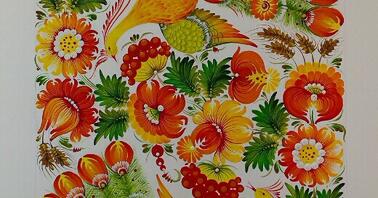
Early decorative paintings in Petrykivka were mostly murals on the walls of the peasants’ houses rather than easel paintings. The folk poetic interpretation of the surrounding world was and is at the basis of the Petrykivka paintings. Stylized flowers and guilder-rose are among the most popular motifs of the murals with even regular thistles and other weeds featuring rather prominently in the paintings. Murals decorated not only the walls of the houses, both inside and outside, but also the walls of barns and sheds, thus creating a decorative ensemble within individual households.
In all likelihood, for a considerable length of time, paintings decorated only the walls before they began to be done on other materials — paper, wood panels or canvas. Mineral pigments were used for making paints and instead of brushes short lengths of reed stocks, twigs or even fingers were used to apply the paint onto the primed walls, the primer mostly being a thin layer of clay. Egg-based paints were used in later times to do paintings on paper.
Three colours were predominant — red, yellow (or yellow-green), and dark blue.
It would be wrong to assume that it was only in the village of Petrykivka that such painting flourished — decorative paintings of a very similar style could — and still can — be found in many other villages of Ukraine. The local styles differ in certain details but they all preserve a number of basic elements and features that makes it possible to recognize them as belonging to one and the same basic style, which was given the name of Petrykivka painting.
Who founded the village of Petrykivka?
2
1 з 17 балів
When was this village founded?
3
1 з 17 балів
Where could the first paintings be seen?
4
1 з 17 балів
What was @ is at the basis of the Petrykivka paintings?
5
1 з 17 балів
What are the most popular motifs?
6
1 з 17 балів
What was used for making paints?
7
1 з 17 балів
What was used instead of brushes?
8
1 з 17 балів
What colours are predominant?
9
1 з 17 балів
The Petrykivka style was originated
10
1 з 17 балів
The first paintings were
11
1 з 17 балів
The village of Petrykivka began to attract
12
6 з 17 балів
Find the Ukrainian equivalents of theEnglish word combinations
1
a place of honour
А
калина
2
without any constraints
Б
художній дар
3
thistles
В
визначне місце
4
artistic gift
Г
певні деталі
5
guilder-rose
Ґ
без будь-яких обмежень
6
сertain details
Д
будяки
Рефлексія від 7 учнів
Сподобався:
0
Так: 6
Ні: 1
Зрозумілий:
0
Так: 7
Ні: 0
Потрібні роз'яснення:
0
Ні: 7
Так: 0