- Всеосвіта›
- Бібліотека тестів›
- Англійська мова›
- Reading Training course reviews + UoE B2

Тест:
Reading Training course reviews + UoE B2

03.09.2026
10 Клас, 11 Клас, 12 Клас, I курс, II курс, Дорослі
26
2
51
0
1

0
Вміст тесту:
1
2
3
4
5
6
7
8
9
10
11
12
13
14
15
16
17
18
19
20
21
22
23
24
25
26
Опис, який учні побачать перед початком тестування
You are going to read four reviews of training courses from a training company website. For questions 1–10, choose from the reviews (A–D). The reviews may be chosen more than once.
1
1 з 26 балів
Сhoose from the reviews (A–D).
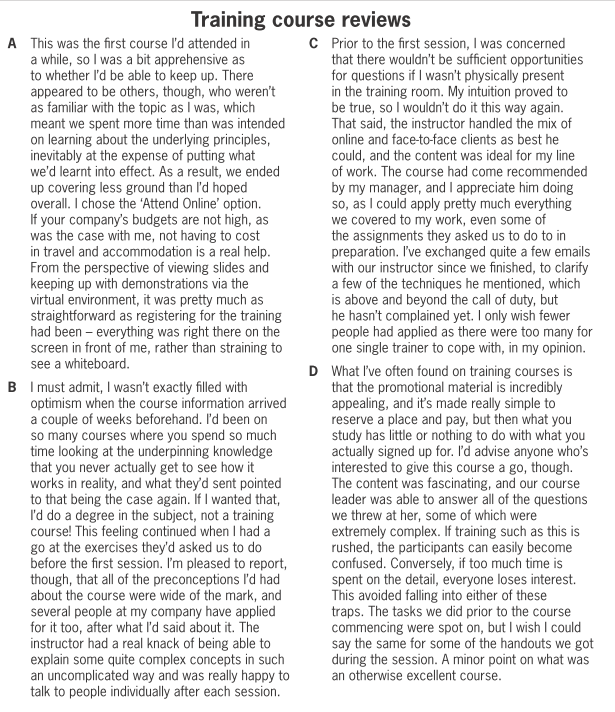
Which reviewer makes the following statements?
I’ve already recommended the course to several colleagues.
2
1 з 26 балів
Сhoose from the reviews (A–D).
Which reviewer makes the following statements?
Being able to contact the trainer after the course has been extremely useful.
3
1 з 26 балів
Сhoose from the reviews (A–D).
Which reviewer makes the following statements?
I thought that the pacing of the course was about right.
4
1 з 26 балів
Сhoose from the reviews (A–D).
Which reviewer makes the following statements?
There was a bit too much theory and not enough practical work.
5
1 з 26 балів
Сhoose from the reviews (A–D).
Which reviewer makes the following statements?
I would have preferred a face-to-face course.
6
1 з 26 балів
Сhoose from the reviews (A–D).
Which reviewer makes the following statements?
I was grateful for having a choice of ways of attending the course.
7
1 з 26 балів
Сhoose from the reviews (A–D).
Which reviewer makes the following statements?
Some of the materials didn’t seem to be particularly relevant.
8
1 з 26 балів
Сhoose from the reviews (A–D).
Which reviewer makes the following statements?
The pre-course tasks weren’t especially useful.
9
1 з 26 балів
Сhoose from the reviews (A–D).
Which reviewer makes the following statements?
I’m impressed by how knowledgeable the instructor was.
10
1 з 26 балів
Сhoose from the reviews (A–D).
Which reviewer makes the following statements?
Booking a place on the course was remarkably easy.
11
1 з 26 балів
For questions 11–18, read the text below and decide which answer (A, B, C or D) best fits each gap.
News sharing
The way we obtain our news coverage is always evolving. The public can gain information on current events from a wide variety of (11) ______ . Centuries ago, news was obtained either by word of mouth, with town criers (12) ______ citizens of news and by-laws, or from print, with notices posted on doors of the local inn. With the (13) ______ of radio, whole families could (14) ______ together in the living room to listen to the daily news bulletin. Even today, when TV sets occupy a prime (15) ______ in the most used rooms in our house, some listeners remain faithful to their radio stations. Except, of course, for the fact that many will (16) ______ in to them on their computer or tablet instead of turning their radio dial.
With the (17) ______ use of social media, news travels faster than ever before. Minute-by-minute coverage of the news no longer relies on TV networks. Increased internet access enables individuals to share photos, opinions and even live videos with one sharp (18) _____ on the screen.
12
1 з 26 балів
For questions 11–18, read the text below and decide which answer (A, B, C or D) best fits each gap.
News sharing
The way we obtain our news coverage is always evolving. The public can gain information on current events from a wide variety of (11) ______ . Centuries ago, news was obtained either by word of mouth, with town criers (12) ______ citizens of news and by-laws, or from print, with notices posted on doors of the local inn. With the (13) ______ of radio, whole families could (14) ______ together in the living room to listen to the daily news bulletin. Even today, when TV sets occupy a prime (15) ______ in the most used rooms in our house, some listeners remain faithful to their radio stations. Except, of course, for the fact that many will (16) ______ in to them on their computer or tablet instead of turning their radio dial.
With the (17) ______ use of social media, news travels faster than ever before. Minute-by-minute coverage of the news no longer relies on TV networks. Increased internet access enables individuals to share photos, opinions and even live videos with one sharp (18) _____ on the screen.
13
1 з 26 балів
For questions 11–18, read the text below and decide which answer (A, B, C or D) best fits each gap.
News sharing
The way we obtain our news coverage is always evolving. The public can gain information on current events from a wide variety of (11) ______ . Centuries ago, news was obtained either by word of mouth, with town criers (12) ______ citizens of news and by-laws, or from print, with notices posted on doors of the local inn. With the (13) ______ of radio, whole families could (14) ______ together in the living room to listen to the daily news bulletin. Even today, when TV sets occupy a prime (15) ______ in the most used rooms in our house, some listeners remain faithful to their radio stations. Except, of course, for the fact that many will (16) ______ in to them on their computer or tablet instead of turning their radio dial.
With the (17) ______ use of social media, news travels faster than ever before. Minute-by-minute coverage of the news no longer relies on TV networks. Increased internet access enables individuals to share photos, opinions and even live videos with one sharp (18) _____ on the screen.
14
1 з 26 балів
For questions 11–18, read the text below and decide which answer (A, B, C or D) best fits each gap.
News sharing
The way we obtain our news coverage is always evolving. The public can gain information on current events from a wide variety of (11) ______ . Centuries ago, news was obtained either by word of mouth, with town criers (12) ______ citizens of news and by-laws, or from print, with notices posted on doors of the local inn. With the (13) ______ of radio, whole families could (14) ______ together in the living room to listen to the daily news bulletin. Even today, when TV sets occupy a prime (15) ______ in the most used rooms in our house, some listeners remain faithful to their radio stations. Except, of course, for the fact that many will (16) ______ in to them on their computer or tablet instead of turning their radio dial.
With the (17) ______ use of social media, news travels faster than ever before. Minute-by-minute coverage of the news no longer relies on TV networks. Increased internet access enables individuals to share photos, opinions and even live videos with one sharp (18) _____ on the screen.
15
1 з 26 балів
For questions 11–18, read the text below and decide which answer (A, B, C or D) best fits each gap.
News sharing
The way we obtain our news coverage is always evolving. The public can gain information on current events from a wide variety of (11) ______ . Centuries ago, news was obtained either by word of mouth, with town criers (12) ______ citizens of news and by-laws, or from print, with notices posted on doors of the local inn. With the (13) ______ of radio, whole families could (14) ______ together in the living room to listen to the daily news bulletin. Even today, when TV sets occupy a prime (15) ______ in the most used rooms in our house, some listeners remain faithful to their radio stations. Except, of course, for the fact that many will (16) ______ in to them on their computer or tablet instead of turning their radio dial.
With the (17) ______ use of social media, news travels faster than ever before. Minute-by-minute coverage of the news no longer relies on TV networks. Increased internet access enables individuals to share photos, opinions and even live videos with one sharp (18) _____ on the screen.
16
1 з 26 балів
For questions 11–18, read the text below and decide which answer (A, B, C or D) best fits each gap.
News sharing
The way we obtain our news coverage is always evolving. The public can gain information on current events from a wide variety of (11) ______ . Centuries ago, news was obtained either by word of mouth, with town criers (12) ______ citizens of news and by-laws, or from print, with notices posted on doors of the local inn. With the (13) ______ of radio, whole families could (14) ______ together in the living room to listen to the daily news bulletin. Even today, when TV sets occupy a prime (15) ______ in the most used rooms in our house, some listeners remain faithful to their radio stations. Except, of course, for the fact that many will (16) ______ in to them on their computer or tablet instead of turning their radio dial.
With the (17) ______ use of social media, news travels faster than ever before. Minute-by-minute coverage of the news no longer relies on TV networks. Increased internet access enables individuals to share photos, opinions and even live videos with one sharp (18) _____ on the screen.
17
1 з 26 балів
For questions 11–18, read the text below and decide which answer (A, B, C or D) best fits each gap.
News sharing
The way we obtain our news coverage is always evolving. The public can gain information on current events from a wide variety of (11) ______ . Centuries ago, news was obtained either by word of mouth, with town criers (12) ______ citizens of news and by-laws, or from print, with notices posted on doors of the local inn. With the (13) ______ of radio, whole families could (14) ______ together in the living room to listen to the daily news bulletin. Even today, when TV sets occupy a prime (15) ______ in the most used rooms in our house, some listeners remain faithful to their radio stations. Except, of course, for the fact that many will (16) ______ in to them on their computer or tablet instead of turning their radio dial.
With the (17) ______ use of social media, news travels faster than ever before. Minute-by-minute coverage of the news no longer relies on TV networks. Increased internet access enables individuals to share photos, opinions and even live videos with one sharp (18) _____ on the screen.
18
1 з 26 балів
For questions 11–18, read the text below and decide which answer (A, B, C or D) best fits each gap.
News sharing
The way we obtain our news coverage is always evolving. The public can gain information on current events from a wide variety of (11) ______ . Centuries ago, news was obtained either by word of mouth, with town criers (12) ______ citizens of news and by-laws, or from print, with notices posted on doors of the local inn. With the (13) ______ of radio, whole families could (14) ______ together in the living room to listen to the daily news bulletin. Even today, when TV sets occupy a prime (15) ______ in the most used rooms in our house, some listeners remain faithful to their radio stations. Except, of course, for the fact that many will (16) ______ in to them on their computer or tablet instead of turning their radio dial.
With the (17) ______ use of social media, news travels faster than ever before. Minute-by-minute coverage of the news no longer relies on TV networks. Increased internet access enables individuals to share photos, opinions and even live videos with one sharp (18) _____ on the screen.
19
1 з 26 балів
For questions 19–26, read the text below and decide which answer (A, B, C or D) best fits each gap.
Learning from Experience
Making mistakes is a natural part of learning. (19) _____ student can master a new skill without making mistakes along the way. What matters is how we respond to them.
If students are given useful feedback, they can understand (20) _____ they need to improve and avoid repeating the same errors. Teachers often encourage learners (21) _____ responsibility for their own progress rather than simply waiting for instructions.
It is also important to set realistic goals. A task that is (22) _____ difficult may discourage learners, while a task that is too easy may not challenge them enough.
Students who review material regularly usually remember it (23) _____ than those who study only before a test. For this reason, revision should be spread (24) _____ a longer period of time.
By the end of the course, many students (25) _____ significant progress in their skills. Their final results may also be influenced by how much effort they have put into their studies.
If learners had been encouraged to reflect on their mistakes from the beginning, they (26) _____ more confident about their abilities now.
20
1 з 26 балів
For questions 19–26, read the text below and decide which answer (A, B, C or D) best fits each gap.
Learning from Experience
Making mistakes is a natural part of learning. (19) _____ student can master a new skill without making mistakes along the way. What matters is how we respond to them.
If students are given useful feedback, they can understand (20) _____ they need to improve and avoid repeating the same errors. Teachers often encourage learners (21) _____ responsibility for their own progress rather than simply waiting for instructions.
It is also important to set realistic goals. A task that is (22) _____ difficult may discourage learners, while a task that is too easy may not challenge them enough.
Students who review material regularly usually remember it (23) _____ than those who study only before a test. For this reason, revision should be spread (24) _____ a longer period of time.
By the end of the course, many students (25) _____ significant progress in their skills. Their final results may also be influenced by how much effort they have put into their studies.
If learners had been encouraged to reflect on their mistakes from the beginning, they (26) _____ more confident about their abilities now.
21
1 з 26 балів
For questions 19–26, read the text below and decide which answer (A, B, C or D) best fits each gap.
Learning from Experience
Making mistakes is a natural part of learning. (19) _____ student can master a new skill without making mistakes along the way. What matters is how we respond to them.
If students are given useful feedback, they can understand (20) _____ they need to improve and avoid repeating the same errors. Teachers often encourage learners (21) _____ responsibility for their own progress rather than simply waiting for instructions.
It is also important to set realistic goals. A task that is (22) _____ difficult may discourage learners, while a task that is too easy may not challenge them enough.
Students who review material regularly usually remember it (23) _____ than those who study only before a test. For this reason, revision should be spread (24) _____ a longer period of time.
By the end of the course, many students (25) _____ significant progress in their skills. Their final results may also be influenced by how much effort they have put into their studies.
If learners had been encouraged to reflect on their mistakes from the beginning, they (26) _____ more confident about their abilities now.
22
1 з 26 балів
For questions 19–26, read the text below and decide which answer (A, B, C or D) best fits each gap.
Learning from Experience
Making mistakes is a natural part of learning. (19) _____ student can master a new skill without making mistakes along the way. What matters is how we respond to them.
If students are given useful feedback, they can understand (20) _____ they need to improve and avoid repeating the same errors. Teachers often encourage learners (21) _____ responsibility for their own progress rather than simply waiting for instructions.
It is also important to set realistic goals. A task that is (22) _____ difficult may discourage learners, while a task that is too easy may not challenge them enough.
Students who review material regularly usually remember it (23) _____ than those who study only before a test. For this reason, revision should be spread (24) _____ a longer period of time.
By the end of the course, many students (25) _____ significant progress in their skills. Their final results may also be influenced by how much effort they have put into their studies.
If learners had been encouraged to reflect on their mistakes from the beginning, they (26) _____ more confident about their abilities now.
23
1 з 26 балів
For questions 19–26, read the text below and decide which answer (A, B, C or D) best fits each gap.
Learning from Experience
Making mistakes is a natural part of learning. (19) _____ student can master a new skill without making mistakes along the way. What matters is how we respond to them.
If students are given useful feedback, they can understand (20) _____ they need to improve and avoid repeating the same errors. Teachers often encourage learners (21) _____ responsibility for their own progress rather than simply waiting for instructions.
It is also important to set realistic goals. A task that is (22) _____ difficult may discourage learners, while a task that is too easy may not challenge them enough.
Students who review material regularly usually remember it (23) _____ than those who study only before a test. For this reason, revision should be spread (24) _____ a longer period of time.
By the end of the course, many students (25) _____ significant progress in their skills. Their final results may also be influenced by how much effort they have put into their studies.
If learners had been encouraged to reflect on their mistakes from the beginning, they (26) _____ more confident about their abilities now.
24
1 з 26 балів
For questions 19–26, read the text below and decide which answer (A, B, C or D) best fits each gap.
Learning from Experience
Making mistakes is a natural part of learning. (19) _____ student can master a new skill without making mistakes along the way. What matters is how we respond to them.
If students are given useful feedback, they can understand (20) _____ they need to improve and avoid repeating the same errors. Teachers often encourage learners (21) _____ responsibility for their own progress rather than simply waiting for instructions.
It is also important to set realistic goals. A task that is (22) _____ difficult may discourage learners, while a task that is too easy may not challenge them enough.
Students who review material regularly usually remember it (23) _____ than those who study only before a test. For this reason, revision should be spread (24) _____ a longer period of time.
By the end of the course, many students (25) _____ significant progress in their skills. Their final results may also be influenced by how much effort they have put into their studies.
If learners had been encouraged to reflect on their mistakes from the beginning, they (26) _____ more confident about their abilities now.
25
1 з 26 балів
For questions 19–26, read the text below and decide which answer (A, B, C or D) best fits each gap.
Learning from Experience
Making mistakes is a natural part of learning. (19) _____ student can master a new skill without making mistakes along the way. What matters is how we respond to them.
If students are given useful feedback, they can understand (20) _____ they need to improve and avoid repeating the same errors. Teachers often encourage learners (21) _____ responsibility for their own progress rather than simply waiting for instructions.
It is also important to set realistic goals. A task that is (22) _____ difficult may discourage learners, while a task that is too easy may not challenge them enough.
Students who review material regularly usually remember it (23) _____ than those who study only before a test. For this reason, revision should be spread (24) _____ a longer period of time.
By the end of the course, many students (25) _____ significant progress in their skills. Their final results may also be influenced by how much effort they have put into their studies.
If learners had been encouraged to reflect on their mistakes from the beginning, they (26) _____ more confident about their abilities now.
26
1 з 26 балів
For questions 19–26, read the text below and decide which answer (A, B, C or D) best fits each gap.
Learning from Experience
Making mistakes is a natural part of learning. (19) _____ student can master a new skill without making mistakes along the way. What matters is how we respond to them.
If students are given useful feedback, they can understand (20) _____ they need to improve and avoid repeating the same errors. Teachers often encourage learners (21) _____ responsibility for their own progress rather than simply waiting for instructions.
It is also important to set realistic goals. A task that is (22) _____ difficult may discourage learners, while a task that is too easy may not challenge them enough.
Students who review material regularly usually remember it (23) _____ than those who study only before a test. For this reason, revision should be spread (24) _____ a longer period of time.
By the end of the course, many students (25) _____ significant progress in their skills. Their final results may also be influenced by how much effort they have put into their studies.
If learners had been encouraged to reflect on their mistakes from the beginning, they (26) _____ more confident about their abilities now.
Рефлексія від 0 учнів
Сподобався:
0
Так: 0
Ні: 0
Зрозумілий:
0
Так: 0
Ні: 0
Потрібні роз'яснення:
0
Ні: 0
Так: 0