Конструктор тестів
- Всеосвіта›
- Бібліотека тестів›
- Англійська мова›
- Reading. Monarch Butterfly

Тест:
Reading. Monarch Butterfly

03.06.2021
Вміст тесту:
1
2
3
4
5
6
1
3 з 26 балів
Read the text.
Monarch Butterfly
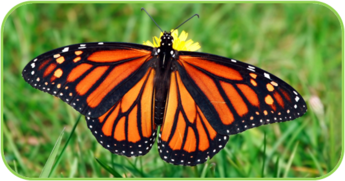
photo https://kids.nationalgeographic.com/animals/invertebrates/facts/monarch-butterfly
Monarchs are large, beautifully colored butterflies that are easy to recognize by their striking orange, black, and white markings. The wingspan of a full-grown monarch can reach nearly five inches (13 centimeters), although the average is closer to four inches (10 centimeters).
Monarch butterflies live in North, Central, and South America as well as Australia, some Pacific Islands, India, and Western Europe. Their markings include bright orange wings covered with black veins and rimmed with a black border and white dots. Females have thicker veins in their wings. A monarch's brilliant coloring tells predators: "Don't eat me. I'm poisonous." The butterflies get their toxins from a plant called milkweed, which is their only food source in the caterpillar stage. An animal that eats a monarch butterfly usually doesn't die, but it feels sick enough to avoid monarchs in the future.
Are these sentences true or false?
Monarchs are tiny butterflies. [True, False]
Monarchs live in Africa and Australia. [True, False]
Monarchs are poisonous. [True, False]
2
4 з 26 балів
Read the text.
The most amazing thing about monarch butterflies is the enormous migration that North American monarchs undertake each year. Every fall, as cold weather approaches, millions of these delicate insects leave their home range in Canada and the United States and begin flying south. They continue until they reach Southern California or central Mexico, more than 2,000 miles (3,200 kilometers) away!
These international travelers return to the same forests each year, and some even find the same tree that their ancestors landed on. Some estimates say up to a billion butterflies arrive in the mountains of Mexico each year.
Match words with their definitions.
1
enormous
А
a person in your family who lived a long time ago
2
ancestor
Б
extremely large
3
delicate
В
the movement every year of large numbers of birds or animals from one place to another
4
migration
Г
easily damaged or broken
3
6 з 26 балів
Complete the text with words from the box.
butterfly - pupa - caterpillars - way - eggs - leaves - shell
Scientists aren't sure how migrating monarchs know which to go, since they only live a few months and none makes the journey more than once. Toward the end of winter, the monarchs in Mexico and California mate. The males then die, while the females head north, depositing on milkweed plants along the way and eventually dying themselves. From these tiny, round eggs come small green-and-white-striped caterpillars, which feed on the milkweed . For about two weeks, they eat constantly and grow by shedding their skin. They are then ready to transform into pupae. To become a , also called a chrysalis, a monarch larva attaches itself with silk to a leaf or branch, sheds its skin, and forms a hard . This vase-shaped case starts out green with shiny golden dots and slowly becomes white, then see-through. After 9 to 15 days, a fully formed emerges.
Запитання №4 З вибором правильної відповіді у тексті
Запитання №5 На встановлення відповідності
Запитання №6 З однією правильною відповіддю
Рефлексія від 2 учнів
Сподобався:
0
Так: 2
Ні: 0
Зрозумілий:
0
Так: 2
Ні: 0
Потрібні роз'яснення:
0
Ні: 2
Так: 0