- Всеосвіта›
- Бібліотека тестів›
- Англійська мова›
- Reading Comprehension

Тест:
Reading Comprehension

14.12.2022


Вміст тесту:
1
2
3
4
5
6
7
8
9
10
Тест містить питання скопійовані з: Reading B1.
1
1 з 20 балів
Look at the text in each question. What does it say? Choose the correct answer.

2
1 з 20 балів
Look at the text. What does it say? Choose the correct answer.

3
1 з 20 балів
Look at the text. What does it say? Choose the correct answer.
Students who do not sign up before Friday lunchtime...

4
1 з 20 балів
Look at the text. What does it say? Choose the correct answer.
What should people at the restaurant do first?

5
1 з 20 балів
Look at the text. What does it say? Choose the correct answer.
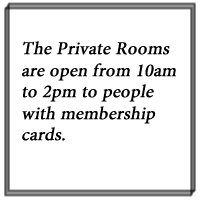
6
1 з 20 балів
Read and answer the question.
Different Colours can affect us in many different ways; that’s according to Verity Allen. In her new series ‘Colour me Healthy’, Verity looks at the ways that colours can influence how hard we work and the choices we make. They can even change our emotions and even influence how healthy we are.
‘Have you ever noticed how people always use the same colours for the same things?’ says Verity. ‘Our toothpaste is always white or blue or maybe red. It’s never green. Why not? For some reason we think that blue and white is clean, while we think of green products as being a bit disgusting. It’s the same for businesses. We respect a company which writes its name in blue or black, but we don’t respect one that uses pink or orange. People who design new products can use these ideas to influence what we buy.’
During this four-part series, Verity studies eight different colours, two colours in each programme. She meets people who work in all aspects of the colour industry, from people who design food packets, to people who name the colours of lipsticks. Some of the people she meets clearly have very little scientific knowledge to support their ideas, such as the American ‘Colour Doctor’ who believes that serious diseases can be cured by the use of coloured lights. However, she also interviews real scientists who are studying the effects of green and red lights on mice, with some surprising results.
Overall, it’s an interesting show, and anyone who watches it will probably find out something new. But because Verity is goes out of her way to be polite to everyone she meets on the series, it’s up to the viewers to make their own decisions about how much they should believe.
What is the writer doing in this text?
7
1 з 20 балів
Read and answer the question.
Different Colours can affect us in many different ways; that’s according to Verity Allen. In her new series ‘Colour me Healthy’, Verity looks at the ways that colours can influence how hard we work and the choices we make. They can even change our emotions and even influence how healthy we are.
‘Have you ever noticed how people always use the same colours for the same things?’ says Verity. ‘Our toothpaste is always white or blue or maybe red. It’s never green. Why not? For some reason we think that blue and white is clean, while we think of green products as being a bit disgusting. It’s the same for businesses. We respect a company which writes its name in blue or black, but we don’t respect one that uses pink or orange. People who design new products can use these ideas to influence what we buy.’
During this four-part series, Verity studies eight different colours, two colours in each programme. She meets people who work in all aspects of the colour industry, from people who design food packets, to people who name the colours of lipsticks. Some of the people she meets clearly have very little scientific knowledge to support their ideas, such as the American ‘Colour Doctor’ who believes that serious diseases can be cured by the use of coloured lights. However, she also interviews real scientists who are studying the effects of green and red lights on mice, with some surprising results.
Overall, it’s an interesting show, and anyone who watches it will probably find out something new. But because Verity is goes out of her way to be polite to everyone she meets on the series, it’s up to the viewers to make their own decisions about how much they should believe.
According to Verity, why is a knowledge of colour important?
8
1 з 20 балів
Read and answer the question.
Different Colours can affect us in many different ways; that’s according to Verity Allen. In her new series ‘Colour me Healthy’, Verity looks at the ways that colours can influence how hard we work and the choices we make. They can even change our emotions and even influence how healthy we are.
‘Have you ever noticed how people always use the same colours for the same things?’ says Verity. ‘Our toothpaste is always white or blue or maybe red. It’s never green. Why not? For some reason we think that blue and white is clean, while we think of green products as being a bit disgusting. It’s the same for businesses. We respect a company which writes its name in blue or black, but we don’t respect one that uses pink or orange. People who design new products can use these ideas to influence what we buy.’
During this four-part series, Verity studies eight different colours, two colours in each programme. She meets people who work in all aspects of the colour industry, from people who design food packets, to people who name the colours of lipsticks. Some of the people she meets clearly have very little scientific knowledge to support their ideas, such as the American ‘Colour Doctor’ who believes that serious diseases can be cured by the use of coloured lights. However, she also interviews real scientists who are studying the effects of green and red lights on mice, with some surprising results.
Overall, it’s an interesting show, and anyone who watches it will probably find out something new. But because Verity is goes out of her way to be polite to everyone she meets on the series, it’s up to the viewers to make their own decisions about how much they should believe.
Who does the writer respect least?
9
1 з 20 балів
Read and answer the question.
Different Colours can affect us in many different ways; that’s according to Verity Allen. In her new series ‘Colour me Healthy’, Verity looks at the ways that colours can influence how hard we work and the choices we make. They can even change our emotions and even influence how healthy we are.
‘Have you ever noticed how people always use the same colours for the same things?’ says Verity. ‘Our toothpaste is always white or blue or maybe red. It’s never green. Why not? For some reason we think that blue and white is clean, while we think of green products as being a bit disgusting. It’s the same for businesses. We respect a company which writes its name in blue or black, but we don’t respect one that uses pink or orange. People who design new products can use these ideas to influence what we buy.’
During this four-part series, Verity studies eight different colours, two colours in each programme. She meets people who work in all aspects of the colour industry, from people who design food packets, to people who name the colours of lipsticks. Some of the people she meets clearly have very little scientific knowledge to support their ideas, such as the American ‘Colour Doctor’ who believes that serious diseases can be cured by the use of coloured lights. However, she also interviews real scientists who are studying the effects of green and red lights on mice, with some surprising results.
Overall, it’s an interesting show, and anyone who watches it will probably find out something new. But because Verity is goes out of her way to be polite to everyone she meets on the series, it’s up to the viewers to make their own decisions about how much they should believe.
Which of the following would make a good title for the text?
10
11 з 20 балів
Easter Island is a small triangle of rock situated in the Pacific Ocean. It’s about 2,000 miles [for, from, on, by]the nearest city. Easter Island is [important, interesting, famous, fascinating] for its statues.Hundreds of these huge, stone faces can be [looked, located, found, situated]all over the island. Who made them? How [have, were, had, did]they move these giant pieces of rock? What happened [to, with, about, for]the people who lived there? Studies show that people [once, first, just, already] arrived on the island about 1600 years ago. They had a very advanced culture. They made many objects and they had their [only, own, clever, self]written language. However, the number of people on the island grew and grew [so, until, although, because]it reached about 10,000 people. Soon there were too many people and there wasn’t [many, some, too, enough]food to eat. A terrible war started and [many, few, lot, enough]of the statues were broken. When western explorers [invented, discovered, sail, came] the island on Easter Day in 1722, the huge rock statues were the only sign that a great society had once lived there.
Рефлексія від 64 учнів
Сподобався:
0
Так: 54
Ні: 10
Зрозумілий:
0
Так: 48
Ні: 16
Потрібні роз'яснення:
0
Ні: 53
Так: 11