Unit 1: Introductions; Unit 2: Work and Leacure; Unit 3: Problems.
- Всеосвіта›
- Бібліотека тестів›
- Англійська мова›
- Progress test 1 (Units 1–2) - Market Leader Elementary 3rd Ed.

Тест:
Progress test 1 (Units 1–2) - Market Leader Elementary 3rd Ed.

30.05.2021
Опис тесту (учням цей опис не показується):
Вміст тесту:
1
2
3
4
5
6
7
8
9
10
11
12
13
Опис, який учні побачать перед початком тестування
Unit 1: Introductions; Unit 2: Work and Leacure; Unit 3: Problems.
Тест містить питання скопійовані з: Final Test.
1
14 з 100 балів
Vocabulary: Complete the conversation with words from the box.
a restaurant August Friday Barcelona Germany golf Poland Polish
A: Is Kasia fromGermany?
B: No, she isn’t. She’s from Warsaw, in .
A: Really? And is her husband also ?
B: Yes, he is.
A: Does Kasia work at home one day every week?
B: Yes, that’s right. She works at home every .
A: When does she usually go on holiday?
B: She goes on holiday every . It isn’t a busy month in the office. She usually goes back to Poland but last year she went to , in Spain.
A: Do you and Kasia sometimes play at the weekend?
B: No, Kasia doesn’t play but we sometimes go to after work.
2
6 з 100 балів
Vocabulary: Match the sentence beginnings with the endings.
0 — Є
0) I don’t like going - Є) to the gym.
Beginnings
Endings
1
Piet often works flexible
А
watching football on TV.
2
Jorge quite likes
Б
to music.
3
Pete and Gregor often play
В
holiday in August.
4
We never listen
Г
football on Sunday.
5
Susan loves going
Ґ
out to restaurants.
6
I usually go on
Д
hours.
3
10 з 100 балів
Reading: Read the article and decide if the statements are true or false.
E.g.: Clara Shih is a student. False
Clara Shih studied a book called The Facebook Era. [True, False]
She worked at Google. [True, False]
Her company is called Hearsay Social. [True, False]
She started her company in Hong Kong. [True, False]
She says starting an Internet business isn’t too expensive. [True, False]

4
10 з 100 балів

Reading: Read the article. Choose the best option to complete the sentences.
E.g.: At university, Clara studied computer science. ( computer science/ Chinese/ business)
Clara Shih wrote about [accounting, design, marketing] .
Hearsay Social [sells products through, helps businesses use, introduce people on]social networking sites.
Shih’s parents are from [the US, Hong Kong, the UK] .
The article says Shih learned [about hard work, Chinese, to use computers] from her parents.
Shih says [travel, education, technology] helps young businesspeople.
5
10 з 100 балів
Reading: 1. Read to the telephone call.
Alan: Technical Support, Alan speaking. How can I help?
Sofia: Hello. This is Sofia Sanchez from Marketing. I have a problem with my computer.
Alan: What’s the problem?
Sofia: It’s my e-mail. It doesn’t work. I can’t read or send e-mails.
Alan: Hmm. Are you connected to the Internet?
Sofia: Er … I don’t know.
Alan: Can you use the web?
Sofia: Uh … no, I can’t. I can’t see any web pages.
Alan: OK, so you have a problem with the Internet connection. We’ll send a technician to look at it. Let me take your details. It’s Sofia …
Sofia: Sofia Sanchez. S-A-N-C-H-E-Z.
Alan: And your department?
Sofia: Marketing.
Alan: Right. And what’s your phone number?
Sofia: It’s 4922.
Alan: 4922? OK. And the problem is with your computer’s e-mail and Internet connection.
Sofia: That’s right.
Alan: And what’s your office number?
Sofia: I’m in office number 568.
Alan: 568. OK, I’ll send a technician.
Sofia: Can he come this morning? I have a meeting this afternoon and I have a lot of work!
Alan : What time is your meeting?
Sofia: It’s at two o’clock.
Alan: Two o’clock? OK … let me see. How about eleven o’clock?
Sofia: OK. Yes, eleven o’clock is good.
Technical Support Service Request: Fill in the table:
Name of calle
Department
Phone number
Office number
Technician appointment time
6
20 з 100 балів
Language: Complete the conversation with words from the box.
are does don’t how is ’m what what’s where works
A: I Ursula Becker.
B: Nice to meet you, Ursula. My name’s David Lopez.
A: you a sales manager?
B: No, I’m not. I work in television.
A: your job?
B: I’m Director of Advertising.
A: do you work?
B: At Channel 10.
A: your wife in television, too?
B: No, she isn’t. She works for a magazine.
A: does she do?
B: She’s a graphic designer.
A: she travel in her job?
B: No, but she sometimes at the weekend.
A: often does she do that?
B: Two or three times a month.
A: What about you? Do you work at the weekend?
B: No, I .
7
20 з 100 балів
Vocabulary: Complete the sentences with at, on, in or - (nothing):
The first interview is [on, at, in] 17th December.
When he travels all day, he can't sleep [on, at, in] nihgt.
Susan sometimes works [on, at, in] Saturdays.
Do you often go out [on, at, in] the evenings?
Our flight arrives [on, at, in] 8.30 a.m.
Can I see you [at, in, -] next Monday?
There's a stuff party [at, in, -] every March.
Hurry up! The shop closes [at, in, -] 10 minutes!
He travelled to China [at, in, -] 1999.
I'm sorry. Mr Moor's busy [at, in, -] the moment
8
5 з 100 балів
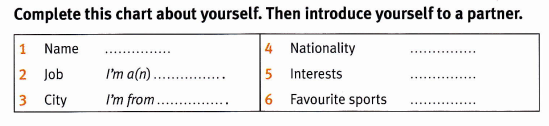
Speaking:
9
1 з 100 балів
Where do most visitors to Los Roques _____ from?
10
1 з 100 балів
What time do you want me to ___ you ___ from the airport?
11
1 з 100 балів
Why __________about the different packages on offer and call me back?
12
1 з 100 балів
I’m sorry, but Lorna _____ on Mondays. It’s her day off.
13
1 з 100 балів
Claudio _____ responsible for the front desk operations.
Опис, який учні побачать після проходження тестування
Thanks for passing!
Рефлексія від 28 учнів
Сподобався:
0
Так: 23
Ні: 5
Зрозумілий:
0
Так: 24
Ні: 4
Потрібні роз'яснення:
0
Ні: 11
Так: 17