- Всеосвіта›
- Бібліотека тестів›
- Англійська мова›
- Old HS1 Unit6 #2

Тест:
Old HS1 Unit6 #2

01.09.2021


Вміст тесту:
1
2
3
4
5
6
7
8
9
10
1
12 з 120 балів
Match the words with the pictures.
Pictures
Words
1

А
a driveway
2

Б
a cellar
3
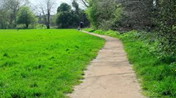
В
a porch
4

Г
an entry hall
5

Ґ
an attic
6
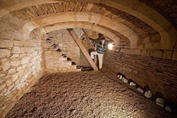
Д
a path
7

Е
a roof
2
12 з 120 балів
Fill in the blanks.
1) A room, where you can take a shower and brush your teeth, is called
2) A place, where people usually leave their cars. It can be inside the house, under the house or at it. It is called
3) A room in the house, where you can cook food, is called
4) A room, where people usually gather together to have meals, is called
5) It’a a territory near the house, where people plant and grow different fruit trees. It’s
6) A level in the house is called .
3
12 з 120 балів
Tick the items, which belong to the bathroom.
4
12 з 120 балів
Match two parts of the idioms.
1
an armchair
А
the table
2
top
Б
from the oven
3
to have
В
from the oven
4
fresh
Г
critic
5
to throw
Ґ
under a rug
6
on the wrong side
Д
shelf
7
to sweep
Е
of the bed
8
under
Є
a full plate
5
12 з 120 балів
Match the tense form with its indicator.
Tense
Tense indicator
1
Present Simple
А
yet
2
Present Continuous
Б
by the time he arrived at the station.
3
Past Simple
В
Look!
4
Future Simple
Г
all my life
5
Present Perfect
Ґ
in a year
6
Past Continuous
Д
while Jack will be watching a new documentary.
7
Future Continuous
Е
at 4 p.m. three days ago
8
Past Perfect
Є
usually
9
Future Perfect
Ж
by next Friday
10
Present Perfect Continuous
З
last month
6
12 з 120 балів
Open the brackets. Fill in the blanks with the correct form of the predicate.
1) This armchair critic (to buy) an expensive full length mirror at this time tomorrow.
2) Your hands are dirty, I (to bring) you a napkin in a second.
3) The shop assistant (to finish) telling the customers about the advantages of this bunk by 10 a.m.
4) Who (to clean) the dining room while you will be watching cartoons?
5) Her son (to fall) asleep in the attic by the time we get back home.
6) I hope, your husband (to repair)
the roof next spring.
will repair
7) Robert (to bring)
these novels back to the library after he finishes to write the report on them.
8) We are sure, that Nora (to watch) this adventure film the whole evening tomorrow.
9) They (to shoot) this science-fiction film by the end of the next year.
10) The costume designer (to hire) a lot of talented people next year.
11) Our camera operator (to look for) nice places for filmmaking the whole day tomorrow.
12) As soon as your brother stops playing the guitar, we (to listen) to your problem.
7
12 з 120 балів
Define the tense form of the following sentences.
1) Kate has been looking for a new house for her family for half a year already. [Present Simple, Present Perfect, Present Perfect Continuous, Present Continuous]
2) What were you doing yesterday from 5 till 6? – I was repairing the tap in the bathroom. [Past Simple, Past Perfect, Past Continuous, Present Continuous]
3) How often do they have supper in the dining room? – Every Sunday. [Present Simple, Present Perfect, Present Perfect Continuous, Present Continuous]
4) Which of Mag’s relatives is sitting at the fireplace now? – Her grandpa is. [Present Perfect Continuous, Present Continuous, Present Simple, Present Perfect]
5) Where did he leave his car last night? – In the garage near the house.
[Past Simple, Past Continuous, Past Perfect, Present Perfect]
6) Who has just cooked vegetables in the kitchen? – Sam has.
[Present Perfect Continuous, Present Continuous, Present Simple, Present Perfect]
7) Molly will present Liz with a jewellery box at her birthday party.
[Future Perfect, Future Continuous, Future Simple, Present Continuous]
8) Lily will have finished reading this biography by tomorrow morning.
[Past Perfect, Future Perfect, Future Simple, Present Simple]
9) Did you discuss the poem by William Shakespeare at the Literature lesson last Tuesday? – Yes. we did. [Past Simple, Past Perfect, Past Continuous, Present Perfect]
10) This writer had written 7 novels by the time he became famous. [Past Continuous, Past Perfect, Present Perfect, Present Perfect Continuous]
8
12 з 120 балів
General Test. Choose the correct variant.
1. Let’s start the meeting now. – I think we should wait until [everyone is, everyone are, somebody is, nobody is] here.
2. Although the police [take, had taken, have taken, has taken] every precaution, the robber managed to escape.
3. She [employs, employed, will have employed, had employed] a maid by next year.
4. I [am driven, have driven, drove, had driven] along the road for a kilometer when I realized that I was on the wrong road.
5. Judy [like, likes, liked, liking] watching horror films although she has nightmares afterwards.
6. It’s lovely to wake up in the morning and [hears, heard, hear, here] birds singing.
7. Weather report: ‘It’s seven o’clock in Frankfurt and [it's snowing, there is snow, it snows, it snowed].
8. The teacher scolded Farid: he [play, will play, played, was playing] while the teacher was talking.
9. Maria [make, has made, will make, made] an appointment to see the doctor. It si at 10.00 am tomorrow.
10. Everyone knew that [completing, making, working, engaging] this task would require a considerable effort.
11. Turn off this machine, please. The harsh sound really [bothers, drives, takes, worries] me crazy.
12. The idea to [walk, do, go, pay] a visit to the local council residence was welcomed by all the visitors.
13. The inconsiderate driver was [inflicted, condemned, fines, worried] for parking his vehicle in the wrong place.
14. Mr. Tanner did his best to fix the faulty oven, but his [craft, skill, service, technique] at repairing electrical devices wasn’t good enough to succeed.
15. If you go on [concerning, affecting, disturbing, afflicting] me like this, I will never be able to finish writing my report.
16. Don’t get so nervous about his coming late. When you get to know him better, you’ll learn to take it [nice, easy, loose, fine] .
17. The first thing for all of you to remember is that [missing, resisting, neglecting, escaping] your duties may result in an instant dismissal.
18. What you are saying is quite [famous, accustomed, familiar, obvious] , so give us, please, more details on the situation.
19. Patrick is a [continuous, spontaneous, compulsive, instant] gambler to resist placing a bet on the final game.
20. Mrs. Hurston was in deep [grief, wish, regret, disturbance] after her husband’s unexpected death.
21. The relations between these two countries have become very [funny, boring, excitable, tense] after the unpleasant incident at the border.
22. The professor wasn’t [familiar, actual, knowledgeable, present] with the current political affairs in his country after his long stay abroad.
23. It’s not easy to make Stanley furious, the boy is very gentle by [personality, nature, reaction, himself] .
24. Michael was a terrible [fiance, culprit, boaster, coward], he was even afraid to say at home alone.
25. In spite of our big effort, we have not managed to [raise, rear, score, compose] enough money for the renovation of the school buildings.
26. A young tourist has been declared [missing, deserter, absent, vanished] after he got lost in the mountains last Monday.
27. Michael was [fixed, filled, stored, loaded] with anger when he saw his car had been scratched.
28. You needn’t hurry. You may take your [thinking, minute, time, while] before you give me the definite answer.
29. George didn’t attend school for six weeks as he had to stay in hospital where he was [mended, treated, relieved, fixed] for pneumonia.
30. I don’t believe a [phrase, sentence, matter, word] of what he says.
31. It was [high, latest, fair, main] time we did something about the case, but we had no idea how to react.
32. We couldn’t stand his nasty [disposition, character, guilt, habit] of spitting on the floor and we moved him from our department.
33. Nobody took any [attention, information, notice, sight] of the warning and they went swimming in the contaminated water.
34. Your staying in this room longer than seven days will [appear, stand, mean, prove] having to pay extra money.
35. They say that a friend in [need, lack, wish, miss] is a friend indeed.
36. The students have asked their professor to [give, postpone, have, interrupt] making a test until after Christmas.
37. Betty told her younger sister to [leave, put, make, set] her alone because she didn’t feel like playing games.
38. This species of mosquito can be dangerous, but happily, it is rather [scarcely, few, minor, rare] in this area.
39. The most probable [origin, background, reason, factor] for your chronic headache is lack of good rest.
40. Your rude behavior was an [variant, insult, injury, abuse] to the host and his wife. I don’t think they will invite us to their home again.
41. Eric’s father works as an interpreter. The man is [knowledgeable, fluent, speechless, outspoken] in three languages.
42. That tall fair woman [looks like, recalls, reminds, remembers] me of my mother.
43. Studs was only the boy’s [figure, label, identity, nickname]. His real name was William.
44. It’s interesting to know how the rumour about my promotion began to [spread, progress, publicize, emit] .
45. When the singer finished his songs, the audience [opposed, shouted, clapped, kept silent] for five minutes.
9
12 з 120 балів
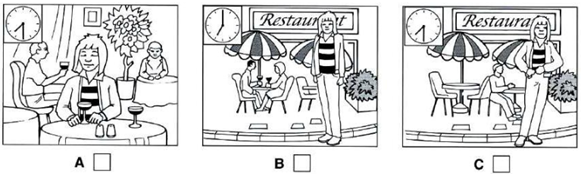
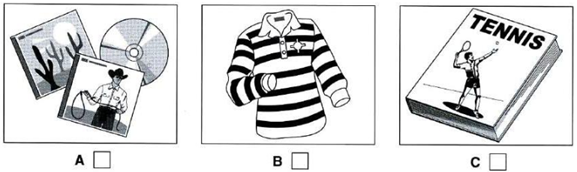
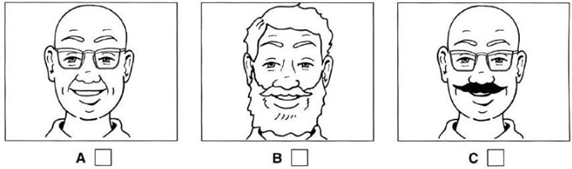
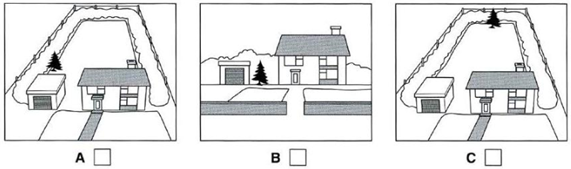
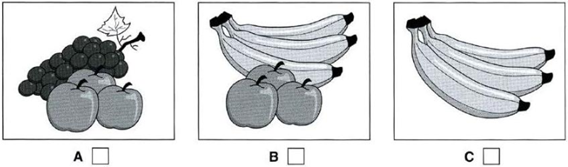
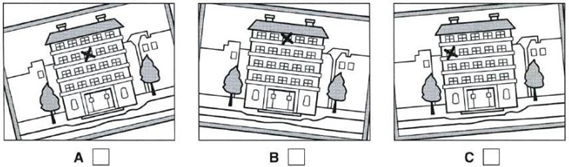
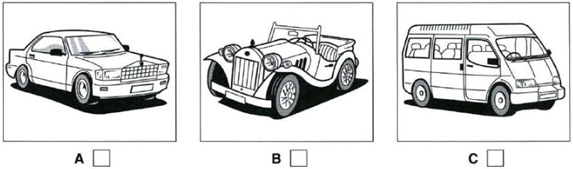
Part 1. Questions 1-7. There are seven questions in this part. For each question, there are three pictures and a short recording. Choose the correct picture and variant in the box.
When and where are they meeting? [A, B, C]

What will Chris get for his birthday? [A, B, C]
What does Mr Jones look like? [A, B, C]
Where is he going to plant the tree? [A, B, C]
What is the man going to buy? [A, B, C]
Which is Gary’s room? [A, B, C]
Which is the best vehicle for the man? [A, B, C]
Part 2. Questions 8-13. You will hear a recorded message about an arts festival. For each question, choose the correct variant in the box.
The festival takes place from [12 to 18 May, 12 to 20 May, 12 to 28 May]
What is on at the Theatre Royal on 19 May? [jazz, opera, classical music]
During lunchtime jazz concerts at the Corn Exchange they sell [soft drinks and sandwiches, wine and sandwiches, soft drinks and light meals]
What is on at the cathedral? [music, poetry, films]
What does the festival programme offer at lckworth? [a walk and a book reading, a concert and a meal, a walk and a concert]
You can't use a credit card if you book [by post, by fax, by telephone]
Part 4. Questions 20-25. Look at six sentences for this part. You will hear a conversation between a girl, Kate, and a boy, George. Decide if each sentence is correct or incorrect.
20. Kate stopped taking her medicine. [yes, no]
21. George thinks Kate should stay away from class. [yes, no]
22. Kate had an accident on her bike last week. [yes, no]
23. George thinks Mr Gray is a lazy lecturer. [yes, no]
24. Kate will miss three lectures. [yes, no]
25. Kate wants to stay at home at the weekend. [yes, no]
10
12 з 120 балів
Read the text below. For questions (1—5) choose the correct answer (А, В, C, or D).
The wallet is a tiny, often pocket sized tool for storing cash, and other small articles such as credit cards, bank cards, drivers licenses, identification cards, and other valuables such as these. Usually it is made from fabrics such as leather, or synthetic plastics. Typically, wallets are associated with men, as most women carry a similar object known as a purse. However, in modern day society, many women now also carry wallets as they are smaller and often, more convenient. Some women carry purses with wallets tucked inside of them.
Wallets were invented in the late 1600's, almost immediately after paper currency wa s introduced. Paper currency was invented in Massachusetts in 1690. Prior to this, simple purses were used to carry around metal coins. The first wallets were generally made from cow or horse leather, and had one small pouch for where people would place their identification cards (known then as calling cards).
Today's modern wallet, which has many different slots for our many cards, was invented in the 1950's, because of the invention of the first credit card. Wallets virtually remained the same throughout the 20th century, with the exception of the Velcro wallet which was introduced in the 1970's. Late in the 20th century, in 1996, what is known as the All-ett billfold wallet was invented. This type of wallet reduced the bulkiness of the original wallet by nearly half. In the 21st century, wallets have evolved in many ways including numerous shapes, sizes and color, all mostly for stylistic purposes rather than function.
Wallets are a huge hit among pick-pockets, who target people carrying wallets in the pockets of their pants. To avoid this, some wallet owners have chains connecting their wallets to their pants. Other wallet owners have inside pockets on their coats, so that they can not be pick-pocketed without noticing.
Although the wallet was originally designed to carry around cash, in modern society they are more often used for carrying credit cards. With the advanced systems of banks and other money institutes, people feel that carrying around cash is often unnecessary and a hassle. Some people still like to carry around change purses, which can be convenient for small purchases where using a credit card or bank card would be silly and wasteful.
1) According to paragraph 1 wallets [A. have a great value for their owners, В. are an object of men's outfit, C. contain important belongings, D. are seldom used by women]
2) According to paragraph 2 [A, B, C, D]
A wallets were introduced in Massachusetts
В people used the first wallets for small change
C at first wallets looked like tiny leather purses
D the first wallets served for carrying documents
3) It is stated in the passage that [A, B, C, D]
A the purpose of the wallet has changed overtime
В people prefer paying for small things in cash
C the purse is usually smaller than the wallet
D the ideal shape of the wallet has been found
4) It is NOT mentioned in the passage that wallets are
[A. made of various materials, В. often stolen from their owners, C. over three hundred years old, D. used for virtual money]
5) The author states that
[A, B, C, D]
A the wallet wasn't changed for 200 years
В square wallets are multifunctional
C there have been two types of wallets
D modern wallets have become thinner
Read the texts below. For each of the empty spaces (1-5) choose the correct answer.
THOMAS COOK
The father of modern mass tourism was Thomas Cook who organized the first package tour in history. He arranged for the rail company [would charge, to charge, charging, had charged] one shilling per person for a group of campaigners from Leicester to a rally in Loughborough, eleven miles away.
Cook was paid a share of the fares actually charged to the passengers, as the railway tickets [couldn't be issued, couldn’t issue, can’t be issued, can’t issue] at his own price.
There [has been, have been, were, had been]railway excursions before, but this one included entrance to an entertainment held in private grounds, rail tickets and food for the train journey.
Cook immediately saw the potential of a convenient 'off the peg ' holiday product in [whose, that, which, whose] everything was included in one cost. Afterwards he pioneered package holidays in both Britain and on the European continent (where Paris and the Alps were [most popular, the most popular, far popular, the more popular] destinations).
Рефлексія від 8 учнів
Сподобався:
0
Так: 3
Ні: 5
Зрозумілий:
0
Так: 3
Ні: 5
Потрібні роз'яснення:
0
Ні: 4
Так: 4