- Всеосвіта›
- Бібліотека тестів›
- english›
- O. Karpiuk English 11 "Speaking about ART" FINAL TEST 2

Тест:
O. Karpiuk English 11 "Speaking about ART" FINAL TEST 2

10.03.2024
Вміст тесту:
1
2
3
4
5
6
7
8
1
9 з 81 бала
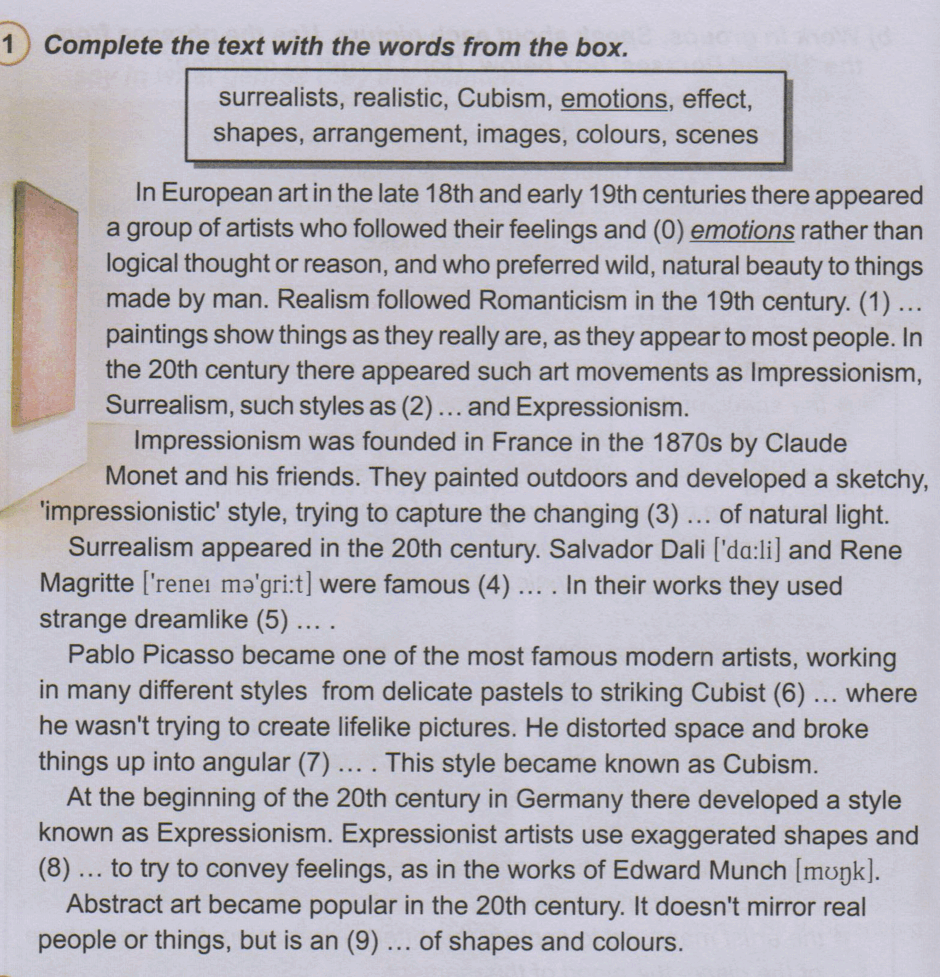
1
(1)
А
Cubism
2
(2)
Б
realistic
3
(3)
В
surrealists
4
(4)
Г
images
5
(5)
Ґ
shapes
6
(6)
Д
scenes
7
(7)
Е
effect
8
(8)
Є
arrangement
9
(9)
Ж
colours
2
10 з 81 бала
Human have been painting on walls or [other, another, the other, each other]hard surfaces for centuries.
From Paleolithic cave paintings and Renaissance frescoes up to the graffiti of the 20th century, this art form has [presented, evolved, rehearsed, enjoyed]with our civilisation.
But when people started painting on buildings and walls in the streets, the legality and artistic [value, critic, release, review]of such graffiti and murals began to be questioned.
Many people considered it a form of vandalism, especially because, to begin with, it was connected with street gangs and [they're, they, them, their]activities.
Public response to street art slowly began to change in the 1970th, when graffiti artists started to use it to express their disappointment with the social and [traditional, political, classical, psychological]situation of the time.
It became not only a form of rebellious activism, but also an easy and quite cheap way for young artists to show off their works.
[Both, All, Everyone, Those]they needed were cans of aerosol paint and their talent.
[Both, Some, Any, No]of those aspiring artists succeeded, like Jean-Michel Basquiat, who started off by spray-painting graffiti on buildings and later became a renowned artist with [commercials, adaptations, exhibitions, auditions]in many famous art galleries.
In 2017 one of his paintings was auctioned for over $100,000,000! Nowadays, colourful murals can be found in most cities around the world and, for many people, they're as much real art as [either, neither, none, other]oil paintings or sculptures.
Apart from artistic expression, they often try to convey an important message. The most famous modern street artist, Banksy, remains anonymous because of the danger of being arrested, but his art offers a satirical and thought-provoking commentary on [both, neither, every, each]politics and society. He is so popular that his works or 'installations' are often removed and than sold.
3
11 з 81 бала
MATCHING:
1
all the people who act in a film
А
director
2
the most important actor or actress in a film
Б
cast
3
person who makes a film
В
star
4
music of a film
Г
plot
5
story of a film
Ґ
soundtrack
6
a part of a film happening in one place
Д
audience
7
people who watch film in the cinema
Е
scene
8
a film which continues the story of an earlier film
Є
special effects
9
images, often created by a computer
Ж
sequel
10
words of the film
З
subtitles
11
transcription (usually translation) of the dialogue of a film that appears at the bottom of the screen
И
script
Запитання №4 Із заповненням пропусків у тексті
Запитання №5 На встановлення відповідності
Запитання №6 З вибором правильної відповіді у тексті
Запитання №7 На встановлення відповідності
Запитання №8 З вибором правильної відповіді у тексті
Рефлексія від 4 учнів
Сподобався:
0
Так: 4
Ні: 0
Зрозумілий:
0
Так: 4
Ні: 0
Потрібні роз'яснення:
0
Ні: 4
Так: 0