- Всеосвіта›
- Бібліотека тестів›
- Англійська мова›
- НМТ Англійська мова (тренувальний, 2025, 1 сесія)

Тест:
НМТ Англійська мова (тренувальний, 2025, 1 сесія)

13.12.2025
Вміст тесту:
1
2
3
4
5
6
7
8
9
10
11
12
13
14
15
16
17
18
19
20
21
22
23
24
25
26
27
28
29
30
31
32
1
1 з 32 балів

This advertisement is about ___________.
Aa recreation event
Ban industrial exhibition
Csocial networking
Dan on-campus event
Ea charity campaign
Femployment opportunities
Gan environmental project
Han online conference
2
1 з 32 балів

This advertisement is about ___________.
Aa recreation event
Ban industrial exhibition
Csocial networking
Dan on-campus event
Ea charity campaign
Femployment opportunities
Gan environmental project
Han online conference
3
1 з 32 балів

This advertisement is about ___________.
Aa recreation event
Ban industrial exhibition
Csocial networking
Dan on-campus event
Ea charity campaign
Femployment opportunities
Gan environmental project
Han online conference
4
1 з 32 балів

This advertisement is about ___________.
Aa recreation event
Ban industrial exhibition
Csocial networking
Dan on-campus event
Ea charity campaign
Femployment opportunities
Gan environmental project
Han online conference
5
1 з 32 балів

This advertisement is about ___________.
Aa recreation event
Ban industrial exhibition
Csocial networking
Dan on-campus event
Ea charity campaign
Femployment opportunities
Gan environmental project
Han online conference
6
1 з 32 балів
The History of Email
With billions of people all over the world sending emails every day, both at work and personally, we tend to take for granted this method of communication and consider email as an inherent part of our modern digital lives. In reality, however, email is a relatively recent luxury.
We have Ray Tomlinson to thank for initiating the incredible new era of communication that we now enjoy – he sent the first email in 1971. Tomlinson was born in New York, USA, in 1941. He started his impressive working career as a computer engineer. No one asked him to invent email – it was something that Tomlinson was working on as a personal side project.
Email began as an experiment to see if two computers could exchange a message. The concept of sending another person a message through a computer was not invented by Tomlinson because computer scientists had been exchanging messages on machines for years. Yet these previous forms of electronic communication only allowed people to send messages to other users of the same computer or to numbered mailboxes where the messages had to be printed out.
Tomlinson wanted to send messages to people, not mailboxes, so he decided to modify and combine the programmes that were already out there. Speaking to The Verge in 2012, Tomlinson said, “There was no really good way to leave messages for people. The telephone worked up to a point, but someone had to be there to receive the call. And if it wasn't the person you wanted to get, it was an administrative assistant or an answering service. That was the sort of mechanism you had to go through to leave a message, so everyone obsessed with the idea that you could leave messages on the computer.” Email was initially seen as a speedy way for programmers and researchers to keep in touch – particularly targeted at those who can’t be relied on to answer their phones. Tomlinson was frequently asked what the first message was and to many people’s disappointment he said, “The test messages were entirely forgettable, and I have, therefore, forgotten them.”
In 1972, Ray Tomlinson sent the first email, using the @ symbol to indicate the location of the recipient. Tomlinson understood that he needed to use a symbol that would not appear in anyone’s name. The logical choice for Tomlinson was the only preposition on the keyboard – “at” sign, both because it was unlikely to appear in anyone’s name, and it turned an email address into a phrase: “user ‘at’ host”.
Queen Elizabeth II was the first head of state to use email. She tried out the electronic mail programme on 26 March, 1976 during a visit to the Royal Signals and Radar Establishment in Malvern, England. They gave her the username HME2 for “Her Majesty Elizabeth II.”
What Tomlinson didn’t invent was the term “email”. It wasn’t coined until several years later. By 1993 the word “electronic mail” had been replaced by “email” in the public lexicon and internet use became more widespread.
What is mentioned in PARAGRAPH 1?
AEmail is the most widespread means of written communication.
BEmail is a preferable means in business communication.
CEmail has advantages over other types of messaging.
DEmail is a comparatively new way of sharing information.
7
1 з 32 балів
The History of Email
With billions of people all over the world sending emails every day, both at work and personally, we tend to take for granted this method of communication and consider email as an inherent part of our modern digital lives. In reality, however, email is a relatively recent luxury.
We have Ray Tomlinson to thank for initiating the incredible new era of communication that we now enjoy – he sent the first email in 1971. Tomlinson was born in New York, USA, in 1941. He started his impressive working career as a computer engineer. No one asked him to invent email – it was something that Tomlinson was working on as a personal side project.
Email began as an experiment to see if two computers could exchange a message. The concept of sending another person a message through a computer was not invented by Tomlinson because computer scientists had been exchanging messages on machines for years. Yet these previous forms of electronic communication only allowed people to send messages to other users of the same computer or to numbered mailboxes where the messages had to be printed out.
Tomlinson wanted to send messages to people, not mailboxes, so he decided to modify and combine the programmes that were already out there. Speaking to The Verge in 2012, Tomlinson said, “There was no really good way to leave messages for people. The telephone worked up to a point, but someone had to be there to receive the call. And if it wasn't the person you wanted to get, it was an administrative assistant or an answering service. That was the sort of mechanism you had to go through to leave a message, so everyone obsessed with the idea that you could leave messages on the computer.” Email was initially seen as a speedy way for programmers and researchers to keep in touch – particularly targeted at those who can’t be relied on to answer their phones. Tomlinson was frequently asked what the first message was and to many people’s disappointment he said, “The test messages were entirely forgettable, and I have, therefore, forgotten them.”
In 1972, Ray Tomlinson sent the first email, using the @ symbol to indicate the location of the recipient. Tomlinson understood that he needed to use a symbol that would not appear in anyone’s name. The logical choice for Tomlinson was the only preposition on the keyboard – “at” sign, both because it was unlikely to appear in anyone’s name, and it turned an email address into a phrase: “user ‘at’ host”.
Queen Elizabeth II was the first head of state to use email. She tried out the electronic mail programme on 26 March, 1976 during a visit to the Royal Signals and Radar Establishment in Malvern, England. They gave her the username HME2 for “Her Majesty Elizabeth II.”
What Tomlinson didn’t invent was the term “email”. It wasn’t coined until several years later. By 1993 the word “electronic mail” had been replaced by “email” in the public lexicon and internet use became more widespread.
What does the author say about Ray Tomlinson?
AHe is credited with the invention of the computer.
BHe started his engineering career in New York.
CHe had engineering achievements apart from his job.
DHe was inspired to invent email by his colleagues.
8
1 з 32 балів
The History of Email
With billions of people all over the world sending emails every day, both at work and personally, we tend to take for granted this method of communication and consider email as an inherent part of our modern digital lives. In reality, however, email is a relatively recent luxury.
We have Ray Tomlinson to thank for initiating the incredible new era of communication that we now enjoy – he sent the first email in 1971. Tomlinson was born in New York, USA, in 1941. He started his impressive working career as a computer engineer. No one asked him to invent email – it was something that Tomlinson was working on as a personal side project.
Email began as an experiment to see if two computers could exchange a message. The concept of sending another person a message through a computer was not invented by Tomlinson because computer scientists had been exchanging messages on machines for years. Yet these previous forms of electronic communication only allowed people to send messages to other users of the same computer or to numbered mailboxes where the messages had to be printed out.
Tomlinson wanted to send messages to people, not mailboxes, so he decided to modify and combine the programmes that were already out there. Speaking to The Verge in 2012, Tomlinson said, “There was no really good way to leave messages for people. The telephone worked up to a point, but someone had to be there to receive the call. And if it wasn't the person you wanted to get, it was an administrative assistant or an answering service. That was the sort of mechanism you had to go through to leave a message, so everyone obsessed with the idea that you could leave messages on the computer.” Email was initially seen as a speedy way for programmers and researchers to keep in touch – particularly targeted at those who can’t be relied on to answer their phones. Tomlinson was frequently asked what the first message was and to many people’s disappointment he said, “The test messages were entirely forgettable, and I have, therefore, forgotten them.”
In 1972, Ray Tomlinson sent the first email, using the @ symbol to indicate the location of the recipient. Tomlinson understood that he needed to use a symbol that would not appear in anyone’s name. The logical choice for Tomlinson was the only preposition on the keyboard – “at” sign, both because it was unlikely to appear in anyone’s name, and it turned an email address into a phrase: “user ‘at’ host”.
Queen Elizabeth II was the first head of state to use email. She tried out the electronic mail programme on 26 March, 1976 during a visit to the Royal Signals and Radar Establishment in Malvern, England. They gave her the username HME2 for “Her Majesty Elizabeth II.”
What Tomlinson didn’t invent was the term “email”. It wasn’t coined until several years later. By 1993 the word “electronic mail” had been replaced by “email” in the public lexicon and internet use became more widespread.
Before Ray Tomlinson’s invention it was impossible _______.
Ato leave a message on a computer
Bto send information to a certain mailbox
Cto exchange information through several computers
Dto share messages on an electronic machine
9
1 з 32 балів
The History of Email
With billions of people all over the world sending emails every day, both at work and personally, we tend to take for granted this method of communication and consider email as an inherent part of our modern digital lives. In reality, however, email is a relatively recent luxury.
We have Ray Tomlinson to thank for initiating the incredible new era of communication that we now enjoy – he sent the first email in 1971. Tomlinson was born in New York, USA, in 1941. He started his impressive working career as a computer engineer. No one asked him to invent email – it was something that Tomlinson was working on as a personal side project.
Email began as an experiment to see if two computers could exchange a message. The concept of sending another person a message through a computer was not invented by Tomlinson because computer scientists had been exchanging messages on machines for years. Yet these previous forms of electronic communication only allowed people to send messages to other users of the same computer or to numbered mailboxes where the messages had to be printed out.
Tomlinson wanted to send messages to people, not mailboxes, so he decided to modify and combine the programmes that were already out there. Speaking to The Verge in 2012, Tomlinson said, “There was no really good way to leave messages for people. The telephone worked up to a point, but someone had to be there to receive the call. And if it wasn't the person you wanted to get, it was an administrative assistant or an answering service. That was the sort of mechanism you had to go through to leave a message, so everyone obsessed with the idea that you could leave messages on the computer.” Email was initially seen as a speedy way for programmers and researchers to keep in touch – particularly targeted at those who can’t be relied on to answer their phones. Tomlinson was frequently asked what the first message was and to many people’s disappointment he said, “The test messages were entirely forgettable, and I have, therefore, forgotten them.”
In 1972, Ray Tomlinson sent the first email, using the @ symbol to indicate the location of the recipient. Tomlinson understood that he needed to use a symbol that would not appear in anyone’s name. The logical choice for Tomlinson was the only preposition on the keyboard – “at” sign, both because it was unlikely to appear in anyone’s name, and it turned an email address into a phrase: “user ‘at’ host”.
Queen Elizabeth II was the first head of state to use email. She tried out the electronic mail programme on 26 March, 1976 during a visit to the Royal Signals and Radar Establishment in Malvern, England. They gave her the username HME2 for “Her Majesty Elizabeth II.”
What Tomlinson didn’t invent was the term “email”. It wasn’t coined until several years later. By 1993 the word “electronic mail” had been replaced by “email” in the public lexicon and internet use became more widespread.
What did Ray Tomlinson want to do?
Ato create a wireless network
Bto develop digital interaction
Cto improve an answering service
Dto update mailbox regulations
10
1 з 32 балів
The History of Email
With billions of people all over the world sending emails every day, both at work and personally, we tend to take for granted this method of communication and consider email as an inherent part of our modern digital lives. In reality, however, email is a relatively recent luxury.
We have Ray Tomlinson to thank for initiating the incredible new era of communication that we now enjoy – he sent the first email in 1971. Tomlinson was born in New York, USA, in 1941. He started his impressive working career as a computer engineer. No one asked him to invent email – it was something that Tomlinson was working on as a personal side project.
Email began as an experiment to see if two computers could exchange a message. The concept of sending another person a message through a computer was not invented by Tomlinson because computer scientists had been exchanging messages on machines for years. Yet these previous forms of electronic communication only allowed people to send messages to other users of the same computer or to numbered mailboxes where the messages had to be printed out.
Tomlinson wanted to send messages to people, not mailboxes, so he decided to modify and combine the programmes that were already out there. Speaking to The Verge in 2012, Tomlinson said, “There was no really good way to leave messages for people. The telephone worked up to a point, but someone had to be there to receive the call. And if it wasn't the person you wanted to get, it was an administrative assistant or an answering service. That was the sort of mechanism you had to go through to leave a message, so everyone obsessed with the idea that you could leave messages on the computer.” Email was initially seen as a speedy way for programmers and researchers to keep in touch – particularly targeted at those who can’t be relied on to answer their phones. Tomlinson was frequently asked what the first message was and to many people’s disappointment he said, “The test messages were entirely forgettable, and I have, therefore, forgotten them.”
In 1972, Ray Tomlinson sent the first email, using the @ symbol to indicate the location of the recipient. Tomlinson understood that he needed to use a symbol that would not appear in anyone’s name. The logical choice for Tomlinson was the only preposition on the keyboard – “at” sign, both because it was unlikely to appear in anyone’s name, and it turned an email address into a phrase: “user ‘at’ host”.
Queen Elizabeth II was the first head of state to use email. She tried out the electronic mail programme on 26 March, 1976 during a visit to the Royal Signals and Radar Establishment in Malvern, England. They gave her the username HME2 for “Her Majesty Elizabeth II.”
What Tomlinson didn’t invent was the term “email”. It wasn’t coined until several years later. By 1993 the word “electronic mail” had been replaced by “email” in the public lexicon and internet use became more widespread.
What is stated in the passage?
AThe term “email” has been in use since 1972.
BThe @ symbol was adopted in 1972.
CTomlinson added the @ sign to keyboard.
DTomlinson created the term “email”.
11
1 з 32 балів
The Most Famous Towers of the World
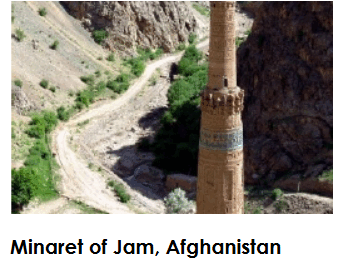
The Minaret of Jam is a fascinating structure which continues to puzzle academics around the world. Is it a minaret? Or a monument symbolising the success of war? The minaret stands 65 metres tall in Afghanistan, in isolation apart from the ruins of a mosque constructed in the 12th century. The mosque got destroyed in a terrible flood. However, the minaret was not affected. Even more surprisingly, it wasn’t destroyed during the Mongol invasion and recent military conflicts, and today it stands still even after all the events that took place in the area.
This tower ________.
Awas used as a starting point for sea voyages
Bwas badly damaged by a bolt of lightning
Chas survived a natural disaster and wars
Dwas lowered for safety reasons
Eheld a world record for about three decades
Fchanges its size due to weather conditions
Gwas used for military purposes in WWII
Hdoesn’t admit visitors in rough weather
12
1 з 32 балів
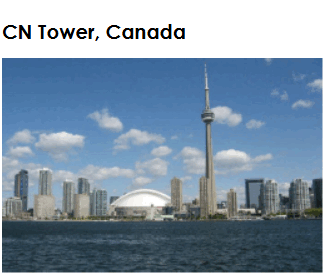
One of Canada’s most popular and most visited structures, the CN Tower in Toronto’s downtown stands amongst many skyscrapers, showcasing extraordinary beauty and brilliance. This concrete observation and communications tower was built on the former Railway Lands. Built in 1973, the 553-metre-high tower boasted of being the world’s tallest freestanding structure for 32 long years before the top spot was captured by Burj Khalifa. Interestingly, the tower survives an average of 75 lightning strikes per year!
This tower ________.
Awas used as a starting point for sea voyages
Bwas badly damaged by a bolt of lightning
Chas survived a natural disaster and wars
Dwas lowered for safety reasons
Eheld a world record for about three decades
Fchanges its size due to weather conditions
Gwas used for military purposes in WWII
Hdoesn’t admit visitors in rough weather
13
1 з 32 балів
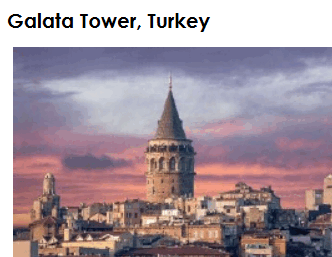
One of Istanbul’s fascinating structures is the Galata Tower, standing tall at about 220 metres. It features a conical-shaped top, making it look extremely attractive. There is an amazing restaurant as well as a café at the top, from where one can enjoy the Bosphorus Strait’s breathtaking views. The tower is closed if the wind speed reaches 40 km/h, or the temperature drops below -20 degrees Celsius, as well as whenever there is lightning. Built way back in 1348, the structure still stands strong and attracts lots of tourists every year.
This tower ________.
Awas used as a starting point for sea voyages
Bwas badly damaged by a bolt of lightning
Chas survived a natural disaster and wars
Dwas lowered for safety reasons
Eheld a world record for about three decades
Fchanges its size due to weather conditions
Gwas used for military purposes in WWII
Hdoesn’t admit visitors in rough weather
14
1 з 32 балів
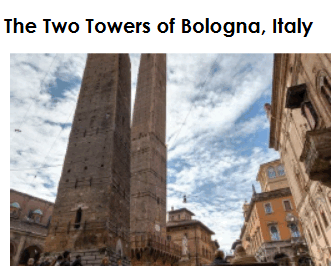
There was a time when Bologna’s skyline featured as much as 180 tall towers. But over time, the number has declined and there are only 20 towers still standing today. Out of these 20 towers, the Asinelli and Garisenda towers, both leaning, are the most famous. It’s easy to see them thanks to their height that is 97 metres for the Asinelli, and 47 metres for the Garisenda. However, originally the height of the Garisenda was about 60 metres, until it was reduced in the 14th century to avoid the danger of its collapse.
This tower ________.
Awas used as a starting point for sea voyages
Bwas badly damaged by a bolt of lightning
Chas survived a natural disaster and wars
Dwas lowered for safety reasons
Eheld a world record for about three decades
Fchanges its size due to weather conditions
Gwas used for military purposes in WWII
Hdoesn’t admit visitors in rough weather
15
1 з 32 балів
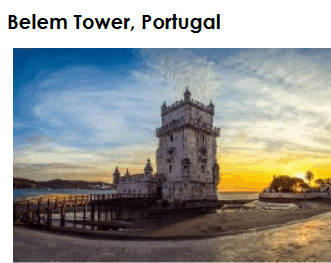
Built on the northern bank of the Tagus river in Lisbon, in the early years of the 16th century, the Belem Tower acted as a defense structure to protect the Portuguese capital. Due to an earthquake that took place in 1755, the location of the Belem Tower shifted. Several Portuguese explorers would begin their journeys of discovering new routes and lands from this tower. Also called the ‘Tower of St. Vincent’, this fortified tower is also a UNESCO World Heritage site.
This tower ________.
Awas used as a starting point for sea voyages
Bwas badly damaged by a bolt of lightning
Chas survived a natural disaster and wars
Dwas lowered for safety reasons
Eheld a world record for about three decades
Fchanges its size due to weather conditions
Gwas used for military purposes in WWII
Hdoesn’t admit visitors in rough weather
16
1 з 32 балів
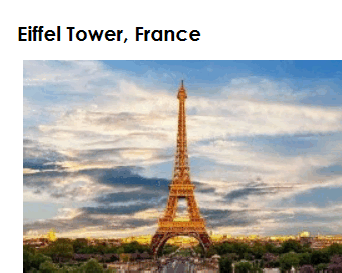
The Eiffel Tower is one of the world’s most visited landmarks. It was built to show France’s industrial strength during the 1889 World’s Fair, and the original plan was to pull it down after 20 years. That was until Eiffel cleverly incorporated a radio antenna and wireless telegraph transmitter into the tower’s design. Later on, the tower was almost destroyed during World War II. The heat of the sun causes the iron of the tower to expand, making it grow a few centimetres during the summer months. A total of around 200 million people have visited the tower since its construction.
This tower ________.
Awas used as a starting point for sea voyages
Bwas badly damaged by a bolt of lightning
Chas survived a natural disaster and wars
Dwas lowered for safety reasons
Eheld a world record for about three decades
Fchanges its size due to weather conditions
Gwas used for military purposes in WWII
Hdoesn’t admit visitors in rough weather
17
1 з 32 балів
Lessons from My Students in Peru
One of the most life-changing trips I’ve ever been on was a volunteering experience of teaching languages in the stunning city of Cuzco in Peru. I spent a month there teaching English and Italian to a group of local adults. And even though my time there was short, the travel experience was so humbling (17) ________.
My lessons took the form of active conversations, (18) ______ between me and my students. Realising just how different their lives were from mine (19) ______ – made me look at my own life with a fresh new perspective.
One person spoke about the three years he spent living in a jungle with his dad, where they fed off of animals they hunted in order to survive. Another student told me about her ultimate dream of mastering English to become a tour guide, and have a more stable future. For me, these stories were a reminder of just (20) ________, and how much we can get consumed by the small bubbles we live in.
It was impossible not to feel inspired in Cuzco because my students always had the biggest smiles on their faces, and the locals showed me again and again (21) ________. I went to Peru to teach, but ended up learning more from my students and the locals there than they did from me.
Ever since I got back from that trip, I made it a goal to slow down and not take the simple things in life for granted. Every time I get upset about something, I think about the Peruvians in Cuzco parading their streets in song and pure joy, (22) ________.
Athat simply being alive is a blessing
Bwhen hearing my students talk about their lives
Cand I tell myself to stop complaining
Dthat it changed my outlook on life
Ewhich inspired me greatly
Fhow small I am in this world
Gwhich essentially turned into a massive multilingual cultural exchange
Hthat were always ready to give a hand
18
1 з 32 балів
Lessons from My Students in Peru
One of the most life-changing trips I’ve ever been on was a volunteering experience of teaching languages in the stunning city of Cuzco in Peru. I spent a month there teaching English and Italian to a group of local adults. And even though my time there was short, the travel experience was so humbling (17) ________.
My lessons took the form of active conversations, (18) ______ between me and my students. Realising just how different their lives were from mine (19) ______ – made me look at my own life with a fresh new perspective.
One person spoke about the three years he spent living in a jungle with his dad, where they fed off of animals they hunted in order to survive. Another student told me about her ultimate dream of mastering English to become a tour guide, and have a more stable future. For me, these stories were a reminder of just (20) ________, and how much we can get consumed by the small bubbles we live in.
It was impossible not to feel inspired in Cuzco because my students always had the biggest smiles on their faces, and the locals showed me again and again (21) ________. I went to Peru to teach, but ended up learning more from my students and the locals there than they did from me.
Ever since I got back from that trip, I made it a goal to slow down and not take the simple things in life for granted. Every time I get upset about something, I think about the Peruvians in Cuzco parading their streets in song and pure joy, (22) ________.
Athat simply being alive is a blessing
Bwhen hearing my students talk about their lives
Cand I tell myself to stop complaining
Dthat it changed my outlook on life
Ewhich inspired me greatly
Fhow small I am in this world
Gwhich essentially turned into a massive multilingual cultural exchange
Hthat were always ready to give a hand
19
1 з 32 балів
Lessons from My Students in Peru
One of the most life-changing trips I’ve ever been on was a volunteering experience of teaching languages in the stunning city of Cuzco in Peru. I spent a month there teaching English and Italian to a group of local adults. And even though my time there was short, the travel experience was so humbling (17) ________.
My lessons took the form of active conversations, (18) ________ between me and my students. Realising just how different their lives were from mine (19) ________ – made me look at my own life with a fresh new perspective.
One person spoke about the three years he spent living in a jungle with his dad, where they fed off of animals they hunted in order to survive. Another student told me about her ultimate dream of mastering English to become a tour guide, and have a more stable future. For me, these stories were a reminder of just (20) ________, and how much we can get consumed by the small bubbles we live in.
It was impossible not to feel inspired in Cuzco because my students always had the biggest smiles on their faces, and the locals showed me again and again (21) ________. I went to Peru to teach, but ended up learning more from my students and the locals there than they did from me.
Ever since I got back from that trip, I made it a goal to slow down and not take the simple things in life for granted. Every time I get upset about something, I think about the Peruvians in Cuzco parading their streets in song and pure joy, (22) ________.
Athat simply being alive is a blessing
Bwhen hearing my students talk about their lives
Cand I tell myself to stop complaining
Dthat it changed my outlook on life
Ewhich inspired me greatly
Fhow small I am in this world
Gwhich essentially turned into a massive multilingual cultural exchange
Hthat were always ready to give a hand
20
1 з 32 балів
Lessons from My Students in Peru
One of the most life-changing trips I’ve ever been on was a volunteering experience of teaching languages in the stunning city of Cuzco in Peru. I spent a month there teaching English and Italian to a group of local adults. And even though my time there was short, the travel experience was so humbling (17) ________.
My lessons took the form of active conversations, (18) ______ between me and my students. Realising just how different their lives were from mine (19) ______ – made me look at my own life with a fresh new perspective.
One person spoke about the three years he spent living in a jungle with his dad, where they fed off of animals they hunted in order to survive. Another student told me about her ultimate dream of mastering English to become a tour guide, and have a more stable future. For me, these stories were a reminder of just (20) ________, and how much we can get consumed by the small bubbles we live in.
It was impossible not to feel inspired in Cuzco because my students always had the biggest smiles on their faces, and the locals showed me again and again (21) ________. I went to Peru to teach, but ended up learning more from my students and the locals there than they did from me.
Ever since I got back from that trip, I made it a goal to slow down and not take the simple things in life for granted. Every time I get upset about something, I think about the Peruvians in Cuzco parading their streets in song and pure joy, (22) ________.
Athat simply being alive is a blessing
Bwhen hearing my students talk about their lives
Cand I tell myself to stop complaining
Dthat it changed my outlook on life
Ewhich inspired me greatly
Fhow small I am in this world
Gwhich essentially turned into a massive multilingual cultural exchange
Hthat were always ready to give a hand
21
1 з 32 балів
Lessons from My Students in Peru
One of the most life-changing trips I’ve ever been on was a volunteering experience of teaching languages in the stunning city of Cuzco in Peru. I spent a month there teaching English and Italian to a group of local adults. And even though my time there was short, the travel experience was so humbling (17) ________.
My lessons took the form of active conversations, (18) ______ between me and my students. Realising just how different their lives were from mine (19) ______ – made me look at my own life with a fresh new perspective.
One person spoke about the three years he spent living in a jungle with his dad, where they fed off of animals they hunted in order to survive. Another student told me about her ultimate dream of mastering English to become a tour guide, and have a more stable future. For me, these stories were a reminder of just (20) ________, and how much we can get consumed by the small bubbles we live in.
It was impossible not to feel inspired in Cuzco because my students always had the biggest smiles on their faces, and the locals showed me again and again (21) ________. I went to Peru to teach, but ended up learning more from my students and the locals there than they did from me.
Ever since I got back from that trip, I made it a goal to slow down and not take the simple things in life for granted. Every time I get upset about something, I think about the Peruvians in Cuzco parading their streets in song and pure joy, (22) ________.
Athat simply being alive is a blessing
Bwhen hearing my students talk about their lives
Cand I tell myself to stop complaining
Dthat it changed my outlook on life
Ewhich inspired me greatly
Fhow small I am in this world
Gwhich essentially turned into a massive multilingual cultural exchange
Hthat were always ready to give a hand
22
1 з 32 балів
Lessons from My Students in Peru
One of the most life-changing trips I’ve ever been on was a volunteering experience of teaching languages in the stunning city of Cuzco in Peru. I spent a month there teaching English and Italian to a group of local adults. And even though my time there was short, the travel experience was so humbling (17) ________.
My lessons took the form of active conversations, (18) ______ between me and my students. Realising just how different their lives were from mine (19) ______ – made me look at my own life with a fresh new perspective.
One person spoke about the three years he spent living in a jungle with his dad, where they fed off of animals they hunted in order to survive. Another student told me about her ultimate dream of mastering English to become a tour guide, and have a more stable future. For me, these stories were a reminder of just (20) ________, and how much we can get consumed by the small bubbles we live in.
It was impossible not to feel inspired in Cuzco because my students always had the biggest smiles on their faces, and the locals showed me again and again (21) ________. I went to Peru to teach, but ended up learning more from my students and the locals there than they did from me.
Ever since I got back from that trip, I made it a goal to slow down and not take the simple things in life for granted. Every time I get upset about something, I think about the Peruvians in Cuzco parading their streets in song and pure joy, (22) ________.
Athat simply being alive is a blessing
Bwhen hearing my students talk about their lives
Cand I tell myself to stop complaining
Dthat it changed my outlook on life
Ewhich inspired me greatly
Fhow small I am in this world
Gwhich essentially turned into a massive multilingual cultural exchange
Hthat were always ready to give a hand
23
1 з 32 балів
Facts about the English Language
According to experts, the British accent (23) ______ every 25 miles, and it’s thought a lot of the accents have developed as a (24) ____ of geographic location, early settlers and immigration. For example, it’s been said that until the mid-1800s Liverpudlians (25) ____ similar to those from Manchester, but once the port industries boomed, the Irish and Welsh labourers (26) ____ influenced the accent to give it a different tone. It’s also thought that Anglo-Saxons (27) ______ from various parts of Europe and settling in different areas, created their own regional accent.
Amoves
Bchanges
Creaches
Dturns
24
1 з 32 балів
Facts about the English Language
According to experts, the British accent (23) ________ every 25 miles, and it’s thought a lot of the accents have developed as a (24) ______ of geographic location, early settlers and immigration. For example, it’s been said that until the mid-1800s Liverpudlians (25) ____ similar to those from Manchester, but once the port industries boomed, the Irish and Welsh labourers (26) ____ influenced the accent to give it a different tone. It’s also thought that Anglo-Saxons (27) ______ from various parts of Europe and settling in different areas, created their own regional accent.
Aresult
Breason
Creaction
Dconclusion
25
1 з 32 балів
Facts about the English Language
According to experts, the British accent (23) ______ every 25 miles, and it’s thought a lot of the accents have developed as a (24) ______ of geographic location, early settlers and immigration. For example, it’s been said that until the mid-1800s Liverpudlians (25) ______ similar to those from Manchester, but once the port industries boomed, the Irish and Welsh labourers (26) ____ influenced the accent to give it a different tone. It’s also thought that Anglo-Saxons (27) ______ from various parts of Europe and settling in different areas, created their own regional accent.
Avoiced
Bsaid
Csounded
Dpronounced
26
1 з 32 балів
Facts about the English Language
According to experts, the British accent (23) ______ every 25 miles, and it’s thought a lot of the accents have developed as a (24) ____ of geographic location, early settlers and immigration. For example, it’s been said that until the mid-1800s Liverpudlians (25) ______ similar to those from Manchester, but once the port industries boomed, the Irish and Welsh labourers (26) ______ influenced the accent to give it a different tone. It’s also thought that Anglo-Saxons (27) ______ from various parts of Europe and settling in different areas, created their own regional accent.
Agradually
Bproperly
Cperfectly
Dexactly
27
1 з 32 балів
Facts about the English Language
According to experts, the British accent (23) ______ every 25 miles, and it’s thought a lot of the accents have developed as a (24) ____ of geographic location, early settlers and immigration. For example, it’s been said that until the mid-1800s Liverpudlians (25) ____ similar to those from Manchester, but once the port industries boomed, the Irish and Welsh labourers (26) ______ influenced the accent to give it a different tone. It’s also thought that Anglo-Saxons (27) ________ from various parts of Europe and settling in different areas, created their own regional accent.
Ainhabiting
Bsetting
Cgoing
Darriving
28
1 з 32 балів
Pasta
Worldwide, pasta has become synonymous with Italian cuisine. Italian immigrants themselves brought pasta (28) ______ they went. While it is true that the most famous varieties and recipes of cooking pasta really do come from Italy, (29) ______, the actual origin of pasta lies elsewhere!
So how did pasta make its way to Italy? One of the most popular theories (30) ________ in the Macaroni Journal by the Association of Food Industries. It states that pasta was brought to Italy by Marco Polo via China. (31) ______ even some evidence of 4,000-year-old noodles (32) ______ from millet.
Aelsewhere
Botherwhere
Ceverywhere
Dsomewhere
29
1 з 32 балів
Pasta
Worldwide, pasta has become synonymous with Italian cuisine. Italian immigrants themselves brought pasta (28) ________ they went. While it is true that the most famous varieties and recipes of cooking pasta really do come from Italy, (29) ________, the actual origin of pasta lies elsewhere!
So how did pasta make its way to Italy? One of the most popular theories (30) ________ in the Macaroni Journal by the Association of Food Industries. It states that pasta was brought to Italy by Marco Polo via China. (31) ______ even some evidence of 4,000-year-old noodles (32) ______ from millet.
Asurprise
Bsurprised
Csurprising
Dsurprisingly
30
1 з 32 балів
Pasta
Worldwide, pasta has become synonymous with Italian cuisine. Italian immigrants themselves brought pasta (28) ______ they went. While it is true that the most famous varieties and recipes of cooking pasta really do come from Italy, (29) ______, the actual origin of pasta lies elsewhere!
So how did pasta make its way to Italy? One of the most popular theories (30) ________ in the Macaroni Journal by the Association of Food Industries. It states that pasta was brought to Italy by Marco Polo via China. (31) ______ even some evidence of 4,000-year-old noodles (32) ______ from millet.
Apublished
Bwas published
Chas published
Dwere published
31
1 з 32 балів
Pasta
Worldwide, pasta has become synonymous with Italian cuisine. Italian immigrants themselves brought pasta (28) ______ they went. While it is true that the most famous varieties and recipes of cooking pasta really do come from Italy, (29) ______, the actual origin of pasta lies elsewhere!
So how did pasta make its way to Italy? One of the most popular theories (30) ________ in the Macaroni Journal by the Association of Food Industries. It states that pasta was brought to Italy by Marco Polo via China. (31) ______ even some evidence of 4,000-year-old noodles (32) ______ from millet.
AIt is
BHere are
CThere is
DThere are
32
1 з 32 балів
Pasta
Worldwide, pasta has become synonymous with Italian cuisine. Italian immigrants themselves brought pasta (28) ______ they went. While it is true that the most famous varieties and recipes of cooking pasta really do come from Italy, (29) ______, the actual origin of pasta lies elsewhere!
So how did pasta make its way to Italy? One of the most popular theories (30) ________ in the Macaroni Journal by the Association of Food Industries. It states that pasta was brought to Italy by Marco Polo via China. (31) ________ even some evidence of 4,000-year-old noodles (32) ________ from millet.
Amade
Bmaking
Cmake
Dwere made
Опис, який учні побачать після проходження тестування
Таблиця переведення тестових балів з іноземної мови
(англійська/німецька/французька/іспанська)
національного мультипредметного тесту до шкали 100–200
Тестовий бал | Бал за шкалою 100–200 |
5 | 100 |
6 | 109 |
7 | 118 |
8 | 125 |
9 | 131 |
10 | 134 |
11 | 137 |
12 | 140 |
13 | 143 |
14 | 145 |
15 | 147 |
16 | 148 |
17 | 149 |
18 | 150 |
19 | 151 |
20 | 152 |
21 | 153 |
22 | 155 |
23 | 157 |
24 | 159 |
25 | 162 |
26 | 166 |
27 | 169 |
28 | 173 |
29 | 179 |
30 | 185 |
31 | 191 |
32 | 200 |
Рефлексія від 0 учнів
Сподобався:
0
Так: 0
Ні: 0
Зрозумілий:
0
Так: 0
Ні: 0
Потрібні роз'яснення:
0
Ні: 0
Так: 0