- Всеосвіта›
- Бібліотека тестів›
- Англійська мова›
- (Копія) K4 87

Тест:
(Копія) K4 87

24.12.2021
Вміст тесту:
1
2
3
4
5
6
7
8
9
10
11
12
13
14
1
12 з 168 балів
Fill in the missing letters in the words and translate the words into Ukrainian.
re sonable -
att ntive -
w ole -
whil -
go ds -
a p rchase -
a pullov r -
ba gy -
pu ple -
a cashi r -
a dis ount -
a choi e -
2
12 з 168 балів
Fill in the gaps
to a purchase - зробити покупку
a reasonable price - недорого
all time - весь час
all day - весь день
a wide choice - широкий вибір
to pay - платити за
a discount - зі знижкою
to pay cash - платити готівкою
to save smth - заощаджувати
according - згідно з
to depend - залежати від
to be made - бути виготовленим з
3
12 з 168 балів
Match the words with the pictures
1
a jumper
А

2
a raincoat
Б

3
a vest
В

4
a suit
Г

5
a jacket
Ґ

6
a nightie
Д

7
pyjamas
Е

8
a shirt
Є

9
a dress
Ж

10
a sweatshirt
З

11
a dressing gown
И

12
a fur coat
І

4
12 з 168 балів
Complete the dialogues.
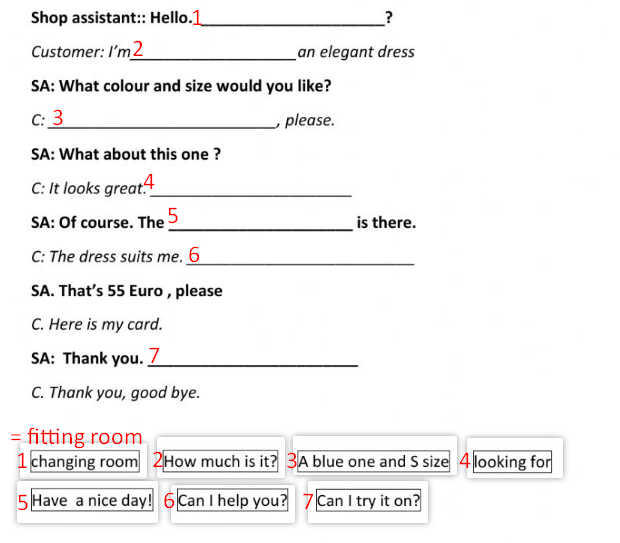
1 [1, 2, 3, 4, 5, 6, 7]
2 [1, 2, 3, 4, 5, 6, 7]
3 [1, 2, 3, 4, 5, 6, 7]
4 [1, 2, 3, 4, 5, 6, 7]
5 [1, 2, 3, 4, 5, 6, 7]
6 [1, 2, 3, 4, 5, 6, 7]
7 [1, 2, 3, 4, 5, 6, 7]
5
12 з 168 балів
Choose all tense indicators of The Past Continuous Tense
6
12 з 168 балів
Match the sentences with the tense form.
1
Bob and Nick haven't chosen a sweatshirt for their friend yet.
А
Present Simple
2
When I met Ann, she was trying a nice dress on.
Б
Present Continuous
3
My brother is choosing a dark suit in the ready-made clothes department now.
В
Past Simple
4
Sue seldom wears a dressing gown on Tuesday.
Г
Future Simple
5
My nephew bought a lot of new clothes at a reasonable price.
Ґ
Present Perfect
6
Jane will buy different goods at the department store in two days.
Д
Past Continuous
7
12 з 168 балів
Do the matching.
1
S + V (-s/-es) + SPS.
А
The Past Continuous +
2
S + to be + not + Ving + SPS.
Б
The Future Simple -
3
Did + S + V + SPS?
В
The Present Continuous -
4
S + will (shall) + not + V + SPS.
Г
The Present Perfect +
5
S + have/has + VIII + SPS.
Ґ
The Present Perfect -
6
S + have/has + not + VIII + SPS.
Д
The Present Continuous ?
7
Have/Has + S + VIII + SPS?
Е
The Past Simple ?
8
S + did + not + V + SPS.
Є
The Present Simple ?
9
S + to be (past) + Ving + SPS.
Ж
The Past Simple -
10
To be + S + Ving + SPS?
З
The Present Simple -
11
Do/Does + S + V + SPS?
И
The Present Simple +
12
S + do/does + not + V + SPS.
І
The Present Perfect ?
8
12 з 168 балів
Choose the correct form of the verb.
1. [Isn't, Wasn't, Was] Jack playing football all day long? - No, he [was not, wasnot, were not].
2. The children [is not listening, were not listening, are not listening] to music from 3 till 5.
3. When father came home, her son [wasn't playing, wasn't play, isn't playing] computer games.
4. What were you doing when your cousins [comes, come, came] home? - I [play, playing, was playing] tennis.
5. The boys [are sunbathing, was sunbathing, were sunbathing] on the beach the whole day yesterday.
6. People usually [payed for, pay for, pay in] their purchases in the cash desk.
7. My granny [prefer to buy, prefers to buy, prefers to buys] goods at a reasonable price.
8. These purle jeans [do not fit, does not fit, did not fit] you. They are baggy and old-fashioned.
9. There [were, are, is]a wide choice of raincoats, jackets, and coats in different colours in this shop.
10. We [are watching, were watching, will watch] a football match on TV the whole evening yesterday.
9
12 з 168 балів
Open the brackets into the correct form.
1. Where you (бути) at 5 o'clock yesterday? - I (бути) in the garden. I (поливати) tomatoes and cucumbers there.
2. The man (поранити) his leg when he (підніматись) the mountain.
3. How many girls (грати) tennis at this time yesterday?
4. I (не дивитися) a new film on TV at 9 o'clock yesterday.
5. While the accountants (снідати вдруге) , their manager (говорити) on the phone.
6. (Сніжити) the whole Sunday?
5. The housewife (не витирати пил) the furniture the whole morning yesterday.
8. Yesterday Kate (запізнитися) for the lesson. When she (приходити) , the pupils (читати) the text.
9. I (сидіти) at an outdoor cafe at 8 o'clock the day before yesterday.
10. The pupils (бігати та стрибати) in the school yard all day long.
11. Who (кататися на ковзанах) while we (грати в сніжки) ?
12. At 9 o'clock yesterday I (не перекладати) the story from Ukrainian into French.
10
12 з 168 балів
Correct the mistakes. (Використовуйте лише підкреслені слова)
1. I am often playing tennis on Saturdays.
2. He is believing every word she says.
3. Angela gets up at 7 o'clock and is having breakfast every day.
4. Peter is asking a lot of questions every day.
5. Jason isn't knowing the answer to this question. He is knowing the other answers.
6. She is wanting to purchase a new computer.
7. Janet has breakfast at the moment.
8. My friends works in a factory twenty miles from their apartment.
9. We was doing homework the whole evening yesterday.
10. Has you already watched the film?
11. Where are the fitting room?
12. Will you buying this fashionable shirt?
11
12 з 168 балів
Fill in the table with a lot\much more. (Посильте значення ВИЩОГО ступеня порівняння прикметника).
дешевий |
|
затишний |
|
дотепний |
|
уважний |
|
невихований |
|
серйозний |
|
тямущий |
|
знервований |
|
неуважний |
|
вічливий |
|
модний |
|
мішкуватий |
|
12
12 з 168 балів
General Test
When summer comes, the pupils [are going to have, have, will have] their holidays.
After Alice [is buying, buys, will buy] some fruit, she’ll cook a tasty salad.
What is this blouse made [of, off, in]? – It is made [in, of, off] silk.
How much [does, do, is] this leather jacket cost? – It [costed, cost, costs] 3000 hryvnias
The customers will not buy [such, such a, so a] clothes.
Sam [had already won, has always win, has just won] in the competition
The footballers will win in the competition if they [will do, do, does] more exercises every day.
What sport does your son prefer?- He [was keen at, is keen of, is keen on] boxing.
Strong sportsmen can’t stand up for weak people, [could they, cannot they, can they]? – Yes, they can.
There were not any bullies in our class, [were there, weren’t there, wasn’t there]? – No, there weren’t.
There aren’t any skillful sportsmen in their football team, are there? – Yes, [they are, they are not, they aren't].
The food in the café [is, was, were] not tasty, was it? – Yes, it was.
We [called to, call in, called in] the doctor yesterday, because our little son was ill
The doctor [have just examined, just examined, has just examined] the girl and gave her some necessary medicine.
I hope, this medicine will help me, [will it, won’t it, wasn’t it]? – Certainly.
Their child feels ill. They [may, could, must] call in the doctor.
Alex [has won, won, have won] an important competition recently. He is very proud [of, at, in] himself.
My cousin and I have vacuumed the carpets [ourself, ourselves, ourselve].
When you fill ill, you must stay [in, at, to] home.
She is [more skilful, the skilfulest, the most skilful] nurse in the hospital.
Most of the children in my son’s class are [feir-haired, fair-haired, fair-haire].
My elder brother is [the most less honest, the less honest, less honest] than me.
We are [much stronger, more stronger, much less stronger] than our friends.
Ann’s son is [the least polite, the less polite, less polite] than my daughter.
You [could see, will see, see] many tourists from Ukraine in the port tomorrow evening.
When did Ann arrive [at, in, on] the airport yesterday?
A plane is [the quicker, the quickest, the most quickest] and the most comfortable type of transport.
We [are book, were booking, are booking] the tickets for a London train now.
My father is going to take a taxi to get to the railway station. He [doesn`t want, doesn want, did not want]to miss his train.
They haven`t got [so a, such a, so] modern airport in their city.
Our last travelling to Paris was [so a, so, such a] pleasant!
I can`t climb [such a, so a, so] high mountain.
Liz likes to travel very much. She is a very active [travellor, traveller, traveler].
Kate likes to ride a horse. She is a good [raider, ridor, rider].
What kind of singer is that Englishman? – He is such a popular [siner, singer, singers].
13
12 з 168 балів
Choose the right definitions to the highlighted words in the text.
New words
1. Uganda - країна на сході Африки
2. Although - не дивлячись на
3. An orphan - сирота
4. AIDS - СНІД
5. to dig - копати
6. to lie - лежати
Make poverty history
Kay lives in Uganda. Every morning she gets up at 6 a.m., sweeps the floor, cleans her tiny house, and prepares whatever breakfast she can find for her family. She then walks four miles to school. Although Kay is an excellent pupil, there are more than 150 children in her class, and not enough books to go round [to stay in bed a bit longer, someone who has no brothers or sisters, for everyone to have, a child whose parents have died, a number of banknotes you get to spend, have a good relationship], so it’s difficult to learn.
Kay is orphan [have a good relationship, to stay in bed a bit longer, for everyone to have, someone who has no brothers or sisters, a child whose parents have died, a number of banknotes you get to spend]. Her parents and her uncle and aunt died from AIDS, so she has to look after her younger brother and sister, three cousins and her sick elderly grandmother. At weekends and in the evenings she works to feed her family. ‘I dig gardens and people give me food. If I don’t do it, we can’t eat.’
Sarah lives in England. She wakes up at 8 a.m., except at the weekends, when she likes to lie in [for everyone to have, someone who has no brothers or sisters, a number of banknotes you get to spend, to stay in bed a bit longer, a child whose parents have died, have a good relationship]. After breakfast, which her mother prepares for her, she gets dressed and gets ready for school. She doesn’t do much housework apart from tidying her room, clearing up after dinner and taking the dog for a walk.
Her father takes her and her close friend, Susan to school by car.
Her favourite subject is Computing. There is one computer for every child in her class.
Sarah is an only child
[someone who has no brothers or sisters, have a good relationship, a child whose parents have died, for everyone to have, to stay in bed a bit longer, a number of banknotes you get to spend]and she gets on very well
[to stay in bed a bit longer, for everyone to have, someone who has no brothers or sisters, a child whose parents have died, have a good relationship, a number of banknotes you get to spend] with her parents and her grandparents. She gets £10 pocket money
[who has no brothers or sisters, a number of banknotes you get to spend, have a good relationship, to stay in bed a bit longer, for everyone to have, a child whose parents have died] every week, which she usually spends on clothes. She loves shopping.
Choose True or False.
1. In Kay's school there are not any books.
[True, False]
2. Kay works to get some money for herself.
[True, False]
3. Sarah does not help about the house at all.
[True, False]
4. Kay has to do a lot of things at home, because there is no one to help her.
[True, False]
5. Both girls go to school.
[True, False]
6. At weekends the girls can sleep longer as they have no school.
[True, False]
7. Sarah has not got any brothers and sisters.
[True, False]
8. There are enough computers in Sarah's school.
[True, False]
9. Sarah likes shopping, so she earns 10 pounds every week.
[True, False]
[True, False]
10. This text was written to make people more sensitive to poverty.
[True, False]
Choose the correct variant
1. Kay lives in
[Germany, Uganda, France]
2. Every morning Kay gets up at
[5 a.m., 7 a.m., 6 a.m.]
3. Kay is an
[excellent, good, bad] pupil.
4. There are more than
[100, 150, 50] children in Kay's class.
5. At weekends and in the evenings Kay works to feed her
[pets, family, parents]
6. Sarah lives in
[England, Germany, Uganda]
7. Sarah's favourite subject is
[Maths, Art, Computing]
8. She gets
[£15, £10, £5] pocket money every week.
9. Sarah usually spends pocket money on
[food, candies, clothes].
10. She loves
[sport, travelling, shopping].
14
12 з 168 балів
Listen to the text and do the tasks.
New words:
Leicester [ˈlestə] Square - Лестер-сквер
a kiosk – кіоск
a booth [buːð] – кіоск, кабіна
screening [ˈskriːnɪŋ] - екранізація
The Royal Highmarket Theatre – театр в Лондоні
Choose the correct variant
Where is this park?
[Near Leicester Square, In Leicester square, In an entertainment centre.]Where can you buy tickets?
[There many kiosks that sell tickets, You can buy tickets in the theatres, There is one kiosk that sells tickets]Which tickets are discounted?
[Tickets for empty theatres, Tickets that you buy before the show, Tickets that people return]In Leicester square there are...
[seven cinemas, three cinemas, two 3D cinemas]5Actors often come here...
[to see their films, to sign autographs, for TV interviews]When are cinemas and theatres cheaper?
[In the evening, In the afternoon, After midnight.]What's The 39 Steps?
[A comedy, A Hitchcock film, A theatre]
Choose True or False1. This lovely park is near Leicester Square is not very popular West End. [True, False]
2. Everywhere you look there are lots of kiosks and booths selling the tickets. [True, False]
3. There are six big cinemas in Leicester Square. [True, False]
4. It's a good place to see the premiere of big films. [True, False]
5. The Royal Highmarket Theatre is the oldest theatre in London. [True, False]
6. Cinemas and theatres are cheaper if you go to the matinee at 8:00 or 12:00 in the morning. [True, False]
Рефлексія від 13 учнів
Сподобався:
0
Так: 11
Ні: 2
Зрозумілий:
0
Так: 11
Ні: 2
Потрібні роз'яснення:
0
Ні: 11
Так: 2