- Всеосвіта›
- Бібліотека тестів›
- Англійська мова›
- (Копія) К3 59

Тест:
(Копія) К3 59

05.11.2021
Вміст тесту:
1
2
3
4
5
6
7
8
9
10
11
12
1
12 з 144 балів
Fill in the missing letter or letter-combination
a ... eatre
a mus.. um
popul...
fa... ionable
o.. osite
open-... r
comf... table
to consid...
a b.. sh
a brid.. e
2
12 з 144 балів
Translate into English. Mind the ARTICLES and PARTICLE TO where necessary.
оживлений
бути популярним серед
над
на розі
готель
говорити правду
просторий
площа
каштан
вузький
3
12 з 144 балів
Correct the mistake. Write the whole word.
a musaum
wede
to considur
a fountein
lage
a bailding
smal
nise
a mountein
a sae
4
12 з 144 балів
Fill in the gaps.
Positive | Comparative | Superlative |
narrow |
| the narrowest |
popular |
|
|
|
| the busiest |
thin |
| the thinnest |
| more spacious |
|
| lower |
|
clean |
| the cleanest |
high |
|
|
|
| the widest |
interesting |
|
|
|
| the dirtiest |
comfortable |
|
|
nice |
|
|
|
| the most terrible |
| larger |
|
5
12 з 144 балів
Open the brackets and write the adjectives in the correct degree of comparison.
1. This colour is … (fashionable) in this season.
2. Paul and Simon are … (noisy) boys that I know.
3. Nick’s story is … (interesting) in our class.
4. This picture looks … (nice) in the bedroom than in the living-room.
5. My ruler is … (long) than your ruler.
6. Wide streets are … (comfortable) for cars than narrow streets.
7. That exercise was … (difficult) of all exercises in this book.
8. In my opinion, this shop assistant is … (hard-working) of them.
9. In winter days are … (short) than in summer.
10. The sportsmen in my team are … (active) than in your team.
6
12 з 144 балів
Open the brackets and translate the words into English. Put the verbs into the correct form.
There is (найгарніший) theatre in our town/city opposite my school.
My son (любить) to swim in the open-air swimming pool.
Yesterday Tom (давати) me the most interesting and popular book.
My sister(провітрювати кімнату) and watered the plants and my brother (витирати пил з меблів) when I was at school.
These are (найзручніші) rooms in our hotel.
, (на мою думку) the English language is more difficult than German.
(могти) I take your pen? I left my pen at home.
They have got (ідею) of resting in the (Карпатські гори) in spring.
(ти розповідати) your mother about that new film yesterday? – No, I did not tell her about it.
There were (тридцять вісім селищ) in your region thirty years ago.
7
12 з 144 балів
Choose the correct tense form for each sentence.
1.To tell the truth, I like to visit the most popular theatres in different cities.
[Present Simple, Present Continuous, Past Simple]
2. There was the most comfortable cinema opposite that fashionable hotel in our city many years ago. [Present Simple, Present Continuous, Past Simple]
3. My cousin is buying wonderful flowers for the party now. [Present Simple, Present Continuous, Past Simple]
4. Those children had fun in the open-air swimming pool yesterday. [Present Simple, Present Continuous, Past Simple]
6. Look! Our managers are eating in the nicest café in our town. [Present Simple, Present Continuous, Past Simple]
7. Dan is not a hard-working student. But he doesn't always get bad marks. [Present Simple, Present Continuous, Past Simple]
8. Her grandmother is reading the most popular book at the moment. [Present Simple, Present Continuous, Past Simple]
9. Many people took pictures of different animals in this wood last spring. [Present Simple, Present Continuous, Past Simple]
10. Nicol was in the open air last Saturday. [Present Simple, Present Coninuous, Past Simple]
11. My brother is telling me about the high buildings in London now. [Present Simple, Present Continuous, Past Simple]
12. Our manager works at this office every day from 8 o'clock. [Present Simple, Present Continuous, Past Simple]
8
12 з 144 балів
Choose the correct variant
Last year my cousin [was not, were not, is not] good at German and he got bad marks in this subject.
They [ends, end, ending] at about 3 o’clock.
In summer the weather [are, am, is]hot and we can swim in the sea or in the river
At the lessons children often [sit, sat, sitting] at their desks, but they also often sit on the carpet on the floor and listen to their teacher.
Last summer was [the hotest, the hottest, hottest]
[There are, There was, Thear are] many long rivers, thick forests and nice lakes where they can rest every year.
At the last Maths lesson we [does sums, did sums, do sums].
The economists [write, writing, are writing]at the office now.
That man [have to go, had to go, has to go]to another country some months ago.
The schoolchildren [are, is, am] four or five when they start school.
Our teachers [answered, answere, answer] his questions, [wrote, write, wrotes] on the blackboard and in their copy-books, and got good marks.
I [did not have, did not have to, did not to] help my parents and I went to the swimming-pool
Dan could count well when he [am, is, was]a little boy
This bridge over the Dnieper is [longest, the longest, long] in our region.
[The fourth, The four, fourth]lesson was Computing
At the English lesson we [reading, reads, read] an interesting text.
His aunt always [has some meat, have some meat, having meat] in the fridge.
Excuse me, [I short of time, I am short of time, I am short time]. I must go. Have a nice weekend!
And we often [write, writes, wrote]e-mail letters to each other.
When did your brother have [a Mathematic lesson, Mathematics lesson, a Mathematics lesson]?
That girl [is describing, describing, is describe] a wonderful picture now.
The children [dranked, drank, drink] tasty pine-apple juice at the party yesterday evening.
Look! The cat [is running, is runing, running]after the mouse.
What animals [can see, can we see, must we see] in the forest? – We can see foxes and squirrels in the forest.
The hotels in the cities are [more comfortable, comfortable, the comfortable] than in the villages.
9
12 з 144 балів
Look at the picture and choose the correct item. 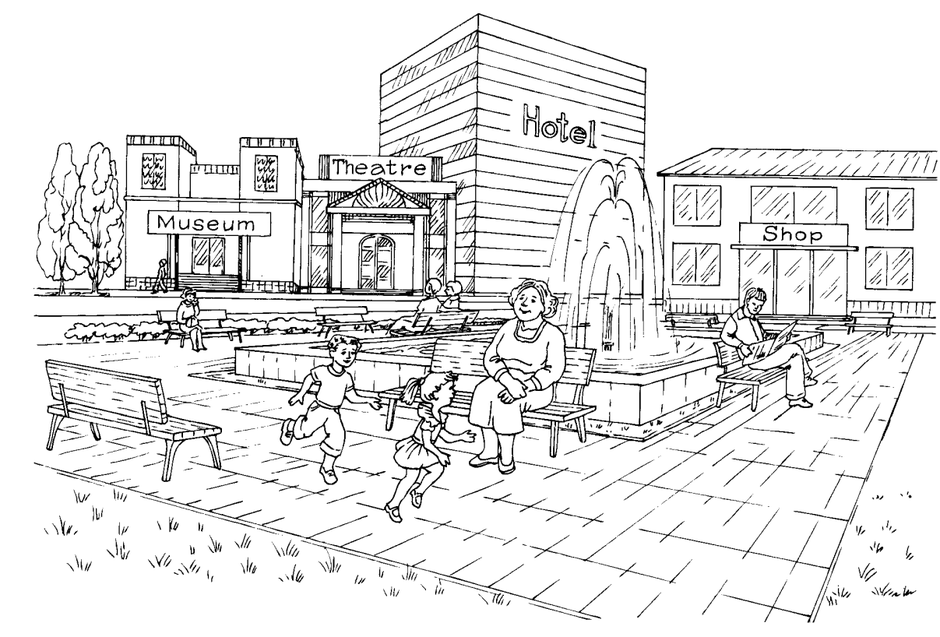
1) What is there in the middle of the square?
[a, b, c]
a) There is a museum in the middle of the square.
b) There is a hotel in the middle of the square.
c) There is a fountain in the middle of the square.
2) Is there a hotel in the square?
[a, b, c]
a) Yes, there is.
b) There are two hotels in the square.
c) There is no hotel in the square.
3) What is there on the right of the hotel?
[a, b, c]
a) There is a museum there.
b) There is a theatre there.
c) There is a shop there.
4) Where is the museum?
[a, b, c]
a) It's on the right of the theatre.
b) It's on the left of the theatre.
c) It's in the middle of the square.
5) Which of the buildings in the square is the highest?
[a, b, c]
a) The museum is.
b) The shop is.
c) The hotel is.
6) What is the man on the bench doing?
[a, b, c]
a) He is watching the fountain.
b) He is speaking on the phone.
c) He is reading.
7) What are the children doing in the square?
[a, b, c]
a) They are singing.
b) They are running.
c) They are speaking with their grandmother.
8) Where is the children's granny?
[a, b, c]
a) She is in the shop.
b) She is on the bench.
c) She is at the hotel.
10
12 з 144 балів
Reading
Finding a job
a babysitter - няня
to deliver newspapers - розносити газети
want to earn some extra money - хочете заробити додаткові гроші
lunchtime staff - персонал в обідній час
A
Babysitter needed
We need a babysitter to look after our two boys aged 5 and 7 after school from 4 p.m. – 6 p.m., Mon – Fri.
£40 a week.
Call Mary on 678345211
B
Newspaper round before school
We need young people to deliver newspapers on Mon, Wed and Fri mornings. The paper round takes 30 minutes in the village of Clanbrook. Papers must be delivered before 8 a.m. and you must have your own bike.
Interested? Ask for more info at Clanbrook post office.
C
CITY MUSEUM
Holiday job
Do you want to earn some extra money this summer? Do you speak another language?
We need French, Spanish or German speakers to work for us in the City Museum shop Tuesday – Saturday.
Send your CV to citymuseum@shopjob.lkj
D
PART-TIME WORK
Munchies Café
We are looking for breakfast and lunchtime staff to work in our café on Saturdays.
Come in (8 a.m. – 4 p.m.) or call Bella on 612398745 (after 4 p.m.)
Match the adverts with the job descriptions.(Поєднайте реклами з описом роботи) (A, B, C ,D)
Working in a small restaurant [A, B, C, D]
Looking after the children [A, B, C, D]
Delivering newspapers [A, B, C, D]
Working in the museum [A, B, C, D]
Read the questions and choose the correct job advert.(A, B, C ,D)
In which job do you have to work after school? [A, B, C, D]
In which job do you have to start work before (перед) 8 a.m.? [A, B, C, D]
In which job do you only (лише) need(потрібно) to work on Saturdays? [A, B, C, D]
In which job do you need a bicycle? [A, B, C, D]
In which job do you need to speak a foreign language? [A, B, C, D]
In which job do you only work during the summer holidays? [A, B, C, D]
In which job do you need to work from Tuesday to Saturday? [A, B, C, D]
Are the sentences true or false?
In advert A, the babysitter can get more than £40 a week [F, T]
In advert D, you don't need to work in the evenings. [T, F]
In advert C, you have to work five days a week. [T, F]
In advert D, you must call Bella in the morning. [F, T]
In advert C, you need to contact the museum by telephone. [T, F]
11
12 з 144 балів
My native town
a tourist ['tuərɪst] – турист
by the way – крім того
a quiet park – тихий парк
a public garden – сквер
My name is Polina and I’m thirteen years old. I live in Lviv. It is one of the biggest cities of our country. My city is very beautiful. All tourists of our city always want to visit many places of interest here. The main street is wide and busy; by the way, we can see many fashionable shops along the main street. Many people think that Lviv is a noisy city but there are a lot of quiet parks and public gardens in it.
There are many museums and theatres in Lviv as well, and sometimes I visit them with my parents and our family friends. One of our friends has got a comfortable café at the city square. People like to meet their friends and have rest there. They can listen to different kinds of music there, too.
There is one more place for rest not far from Lviv. There are some little but nice houses there, and we can see high trees among those houses. There is a little pond between the trees with a small bridge over it. We like to feed fish and take pictures there.
I’m proud of my city and I’m happy that I live here.
1. The girl’s name is Alina. [true, false]
2. Lvivis one of the biggest cities of our country. [true, false]
3. We can’t see many fashionable shops along the main street. [true, false]
4. There are no public gardens in this noisy city. [true, false]
5. The main street is wide and busy. [true, false]
6. My parents and I sometimes visit the museums and theatres of Lviv. [true, false]
7. One of our friends has got a comfortable hotel at the city square. [true, false]
8. People like to meet their friends, have rest and listen to different kinds of music at our friend’s cafe. [true, false]
9. A place with little and nice houses is far from Lviv. [true, false]
10. There is a small bridge over the pond. [true, false]
11. We like to catch fish and take pictures with it. [true, false]
12. I’m proud of my city and I’m happy that I live here. [true, false]
12
12 з 144 балів
Listening
Listen to the conversation and do the tasks.
Introducing a friend
What do people normally say when they first meet? Choose the correct option.
What do people normally say when they first meet? Choose the correct option [Hi, it’s Pablo., Hi, I'm Pablo.]
What do people normally say when they first meet? [Hi. How are you?, Hi. Who are you?]
What do people normally say when they first meet? [Where are you?, Where are you from?]
Fill the gaps with the correct name.
introduces Greta to Pablo. [Pablo, Sumi, Greta]
is German. [Pablo, Sumi, Greta]
is Argentinian. [Pablo, Sumi, Greta]Choose the words to fill the gaps.
Sumi: Hi, Pablo. How are you?
Pablo: Hi, Sumi. [I'm fine, I'm] , thanks.
Sumi: Pablo, this is Greta.
Pablo: Hi, Greta, [I'm, I' fine]Pablo.
Greta: Hi. How are you?
Pablo: I’m fine, thanks. [Where are you, What are you] from, Greta?
Greta: I’m from Germany. Where are you from?
Pablo: I’m from Argentina. [Good to meet, Nice to meet]you.
Greta: Nice to meet you too.
Рефлексія від 7 учнів
Сподобався:
0
Так: 6
Ні: 1
Зрозумілий:
0
Так: 7
Ні: 0
Потрібні роз'яснення:
0
Ні: 5
Так: 2