Тест:
K4 95

21.01.2022
Вміст тесту:
1
2
3
4
5
6
7
8
9
10
11
12
13
Тест містить питання скопійовані з: К4 89.
1
12 з 156 балів
Write the words without any mistakes. Don't forget about the article or the particle "to".
risonable
a parchise
to do a perchise
a goods
a siut
inatentive
pygama
to chuse
a jymer
a pallower
a switshirt
a nighty
2
12 з 156 балів
Connect the words with their translation.
1
to pay in cash
А
дощовик
2
to pay by credit card
Б
пурпурний
3
purple
В
платити готівкою
4
a raincoat
Г
каса
5
to offer
Ґ
платити кредиткою
6
baggy
Д
пропонувати
7
a cash desk
Е
обмінюватися
8
to pay for
Є
пропонувати
9
to connect
Ж
мішкуватий
10
to exchange
З
платити за
3
12 з 156 балів
Translate the words.
поки, в той час як
цілий, повний
вчора цілий день
весь чай
весь день
залежати від
заробляти
витрата
згідно з
роздавати
заощаджувати
аксесуари
4
12 з 156 балів
Connect the words with their definitions.
1
to be the right size or shape for someone or something
А
a size
2
one of the standard measures according to which goods are made or sold
Б
on sale
3
a style that is popular at a particular time, especially in clothes, hair, make-up, etc
В
to fit
4
available to buy in a shop
Г
fashion
5
a person who buys goods or a service
Ґ
a customer
6
the amount of money for which something is sold
Д
silk
7
the soft, thick hair that grows on the bodies of sheep and some other animals
Е
leather
8
a delicate, soft type of cloth made from a thread produced by silkworms, or the thread itself
Є
to try on
9
animal skin treated in order to preserve it, and used to make shoes, bags, clothes, equipment, etc.
Ж
wool
10
to put on a piece of clothing to discover if it fits you or if you like it
З
a price
5
12 з 156 балів
Match the tenses and the formulae for the different types of sentences.
1
The Present Simple / affirmative
А
What … + am/is/are + Subject + Main Verb+ing + SPS
2
The Past Simple / interrogative (general question)
Б
Will + Subject + Main Verb + SPS
3
The Present Continuous / negative
В
Was/Were + Subject + Main Verb + ing + SPS
4
The Past Continuous / special question
Г
Subject + did + not + MainVerb + SPS
5
The Past Simple / question to the subject
Ґ
Do/Does + Subject + Main Verb + SPS
6
The Past Continuous / interrogative (general question)
Д
What … + was/were + Subject + Main Verb+ing + SPS
7
The Present Simple / question to the subject
Е
What … + have/has + Subject + Main Verb3/-ed + SPS
8
The Present Perfect / affirmative
Є
Subject + am/is/are + not + MainVerb + ing + SPS
9
The Present Continuous / special question
Ж
Subject + MainVerb 2/-ed + SPS
10
The Past Simple / negative
З
Did + Subject + Main Verb + SPS
11
The Past Continuous / affirmative
И
Subject + have/has + MainVerb3/-ed + SPS
12
The Past Simple / affirmative
І
Who … + MainVerb 2/-ed + SPS?
13
The Present Perfect / special question
К
Subject + Main Verb(s/-es)+ SPS
14
The Present Simple / interrogative (general question)
Л
Subject + was/were + MainVerb + ing + SPS.
15
The Future Simple / interrogative (general question)
М
Who … + Main Verb (s/-es) + SPS
6
12 з 156 балів
Fill in the blanks with the present continuous or present simple or past simple.
1. Sarah (watch) a film at this moment.
2. I (study) English every day.
3. We (play) the guitar on Mondays.
4. My brother (read) the newspaper now.
5. They (go) to the cinema every Saturday.
6. Peter (clean) the house at this moment.
7. My sister (speak) with her friend now.
8. We (eat) an apple every morning.
9. Sarah (watch) a film every night.
10. I (study) english the last year.
11. We (play) guitar a week ago.
12. Peter (clean) the house yesterday.
7
12 з 156 балів
Choose the correct variant.
I [have finish, has finished, did finished, haven't finished] my homework yet.
My father is on the way. He [haven't arrived, hasn't arrived, didn't arrive, arrived] home yet.
I am not hungry. I have [yet, now, just, ever] eaten.
I have never [been, went, go, was] to Paris.
[Are, Were, Do, Have] you ever been to New York?
I am still working. I haven't finished my work
[already, yet, still, never].
I am looking for my pen. I
[have lost, lost, did lost, was lost] it.
During the two years David [has has, has had, have had, have has] ten different jobs.
I [was, have be, have been, had been] a teacher since 2002.
My friend [haven't seen, didn't see, hasn't see, hasn't seen] my new dress yet.
They [knew, known, have known, has known] each other since last year.
I know what happened there. I
[haven't heard, heard, have heard, hear] about it.
8
12 з 156 балів
Complete the disjunctive questions. ВІДПОВІДАТИ ОСЬ ТАК: Yes, I am. No, he isn't і так далі. (ДОТРИМУЙТЕСЬ ПРАВИЛ ВЖИВАННЯ КОМИ ТА КРАПКИ)
You are a student, ? (Так)
It isn't too cold today, ? (Так, не холодно)
He was at the concert, ? (Так, був)
You like chocolate, ? (Так)
She arrived too late, ? (Ні)
Tom couldn't find the place, ? (Ні, змогла)
Henry and Juliet have just arrived, ? (Ні)
Your little Angie can't walk yet, ? (Так, не може)
9
12 з 156 балів
1. After the conference, I ___ that a man ___ the walls of the building. [a, b, c]
a. was seeing / was painting
b. saw / was painting
c. was seeing / painted
2. He was so angry that he ___ and ___. [a, b, c]
a. was getting up / left
b. got up / was leaving
c. got up / left
3. I ___ the vase while I ___ the bookshelf.
[a, b, c]
a.broke / was cleaning
b.broke / cleaned
c.was breaking / was cleaning
4. As soon as we walked into the room, we ___ a noise. Someone ____ my computer. [a, b, c]
a.heard / used
b.were hearing / used
c.heard / was using
5. The bus in which the football team ____ had an accident, but nobody ____. [a, b, c]
a.were travelling / died
b.travelled / died
c.were travelling / were dying
6. I ___ the party, but Sonia ___ to leave. [a, b, c]
a.was enjoying / was wanting
b.enjoyed / was wanting
c.was enjoying / wanted
7.
The police ___ him while he ____ to escape.
[a, b, c]
a.caught / tried
b.caught / was trying
c.were catching / was trying
8. We ___ what to do, so we just called the police and ____. [a, b, c]
a.didn't know / waited
b.weren't knowing / waited
c.didn't know / were waiting
9. When I last ___ her she ____ high-heeled shoes. [a, b, c]
a.saw / wore
b.was seeing / was wearing
c.saw / was wearing
10. The sun _____, so we ___ our clothes and got into the water. [a, b, c]
a.was shining / took off
b.shone / took off
c.shone / were taking off
10
12 з 156 балів
Fill in the gaps with the correct past continuous and past simple forms of the verbs in brackets.
When I (arrive) at the station, Raimond (wait) for me. He (wear) a nice black suit and he (hold) a red rose in his right hand. When I 5 (get off) the train, he 6 (run) up to me and (kiss) me.
It (rain) heavily so he (take off) his jacket and 10 (put) it over my head. I 1 (tell) Raimond to go to a café so that we could talk, but he 2 (want) to go to another place.
While he 3 (drive), I 4 (look) at him. He 1 (smile), but he also 1 6 (look) nervous.
He finally 7 (stop) his car on the top of a hill with fantastic views. It was so wonderful. We (get out) of the car, and he 1 9 (kneel - ставати на коліно) in front of me and (take) a ring out of his pocket. “Kathy, will you...” he said. “Listen, Raimond, I want to break up with you,” I told him.
11
12 з 156 балів
1. A- Hello, what ______ your name? [a, b, c, d]
A) is B) are C) am D) be
2. ______ name is John. And my ______ is Johnson. [a, b, c, d]
A) Your / surname B) My / surname C) I / surname D) I / name
3. My name is Lisa. _____Lisa Peterson. [a, b, c, d]
A) My am B) I is C) I am D) I
4. ________ are you from? Japan. [a, b, c, d]
A) When B) What C) Where D) Why
5. “_____ her name Eliza?” “No, _____ .” [a, b, c, d]
A) What / it isn’t B) Is / she isn’t C) Is / it is not D) Is / it isn’t
6. He _____ his car every weekend. [a, b, c, d]
A) wash B) washes C) washing D) washed
7. Rosemary _____ three languages. [a, b, c, d]
A) speaks B) talks C) tells D) know
8. My dad _____ at 7 o’clock everyday. [a, b, c, d]
A) stands up B) looks up C) gets up D) jumps up
9. Isabel is a flight attendant. She _____ passengers. [a, b, c, d]
A) serve B) to serve C) serves D) serving
10. Their son _____ in this hospital. [a, b, c, d]
A) works B) begins C) starts D) likes
In winter Sheila _____ skiing and in summer _____ tennis. [a, b, c, d]
A) makes / plays B) goes / plays C) does / plays D) starts / *
11. My friend’s son _____ Turkish and English at university. [a, b, c, d]
A) has B) plays C) studies D) goes
12. A: _____ does Tony Blair live? B: In Great Britain. [a, b, c, d]
A) When B) Where C) What time D) How
13. _____ does your father do in his free time? [a, b, c, d]
A) Why B) What kind C) How many D) What
14. _____ _____ looks after money. [a, b, c, d]
A) A nurse B) A postman C) An accountant D) A dentist
15. __________ designs buildings. [a, b, c, d]
A) A pilot B) An architect C) An interpreter D) An engineer
16. He _____ listening _____ music. [a, b, c, d]
A) like / to B) likes / to C) likes / of D) likes / with
17. “How _____ he _____ to work?” “By car.” [a, b, c, d]
A) do / go B) does / goes C) does / go D) does / play
18. Philippe _____ in London. [a, b, c, d]
A) work B) starts C) comes D) lives
19. “_____ he married?” “No, he _____.” [a, b, c, d]
A) Is / doesn’t B) Does / isn’t C) Is / isn’t D) Does / is
20. “What _____ she do?” “She is an interpreter.” [a, b, c, d]
A) is B) do C) does D) are
21. _____ he sleep well? [a, b, c, d]
A) Has B) Have C) Do D) Does
22. It is half past eight. [a, b, c, d]
A) 8:30 B) 7:30 C) 18:30 D) 17:30
23. It is quarter past eight. [a, b, c, d]
A) 8:30 B) 7:30 C) 8:15 D) 17:15
24. It is five to nine. [a, b, c, d]
A) 9:55 B) 9:35 C) 8:55 D) 9:05
25. It is five past nine.
A) 9:55 B) 9:35 C) 8:55 D) 9:05
26. A friend of mine likes _____ on picnic at weekends. [a, b, c, d]
A) to go B) went C) goes D) go
27. I _____ my teeth every morning. [a, b, c, d]
A) brushing B) brush C) brushes D) to brush
28. _____ Kate live near Jane?
A) Is B) Are C) Do D) Does
29. His father _____ , but Bill’s father _____ smoke. [a, b, c, d]
A) smokes / don’t B) smokes / doesn’t C) smoke / don’t D) smokes / isn’t
30. My father _____ driving. [a, b, c, d]
A) doesn’t likes B) don’t likes C) doesn’t like D) don’t like
31. She _____ a bus to university. [a, b, c, d]
A) always takes B) always take C) takes always D) take always
32. I _____ to a football match every Sunday but my father _____ . [a, b, c, d]
A) go / don’t B) goes / doesn’t C) go / doesn’t D) goes / don’t
33. Every year millions of people _____ The London Museum.
A) visit B) go C) come D) want
34. A: _____ languages do they speak? B: Just one. [a, b, c, d]
A) What B) How many C) How D) Which
35. Visitors _____ to India ‘s Independence Day from all over the world. [a, b, c, d]
A) visit B) come C) leave D) goes
12
12 з 156 балів
Listen to the recording and do the task.
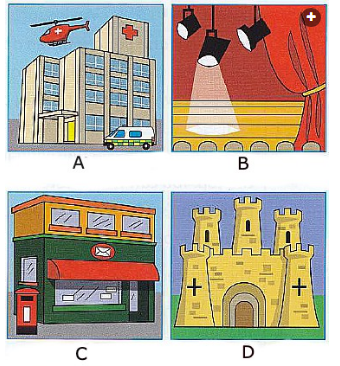
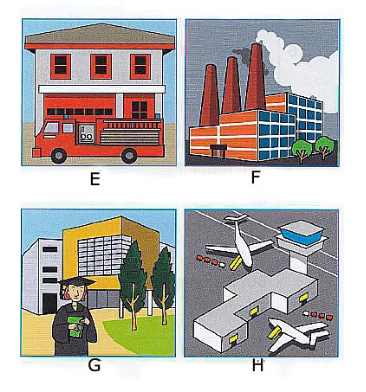

Betty's mother [A, B, C, D, E, F, G, H]
Cousin Robert [A, B, C, D, E, F, G, H]
Uncle Richard [A, B, C, D, E, F, G, H]
Betty's father [A, B, C, D, E, F, G, H]
Aunt Susan [A, B, C, D, E, F, G, H]
TASK 2
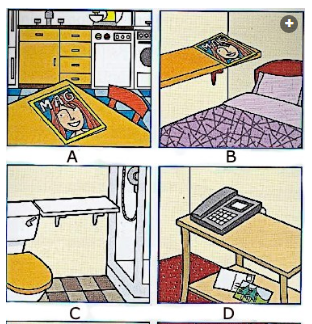
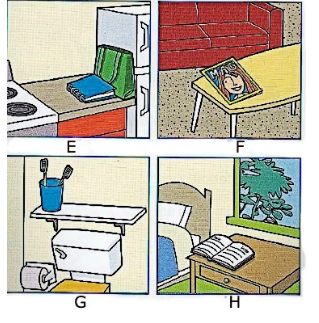

stamps [A, B, C, D, E, F, G, H]
soap [A, B, C, D, E, F, G, H]
sandwiches [A, B, C, D, E, F, G, H]
necklace [A, B, C, D, E, F, G, H]
keys [A, B, C, D, E, F, G, H]
13
12 з 156 балів
Read the dialogue and choose the correct item.
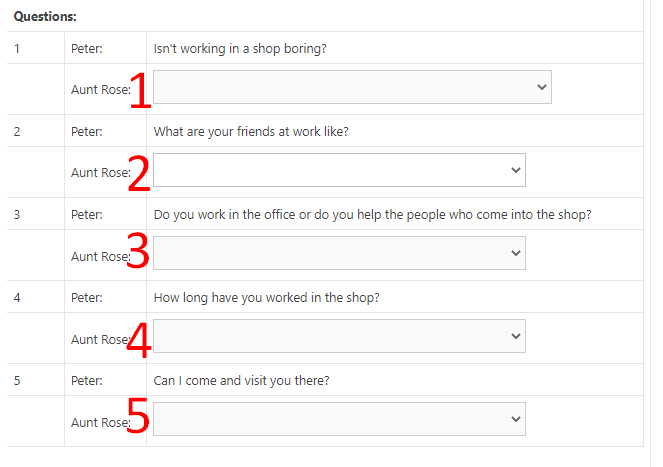
A I have to do both things because it's only a small shop.
B Just in the afternoon.
C Yes, I do. I really enjoy it.
D Most of them are very nice and work hard.
E I do. You must have friends too.
F No, because you meet lots of different people every day.
G Of course. You can come tomorrow.
H I started there three and a half years ago.
1 [A, B, C, D, E, F, G, H]
2 [A, B, C, D, E, F, G, H]
3 [A, B, C, D, E, F, G, H]
4 [A, B, C, D, E, F, G, H]
5 [A, B, C, D, E, F, G, H]
Read the text and answer the questions below.
to realise - усвідомлювати
accommodation - розміщення
exactly - саме, точно
a cave - печера
mud - багнюка
Hi, my name is Jack. A month ago I had no idea that on Sunday afternoon in July I'd be 50 metres above the ground and enjoying it. Now I looked down at the river far below me, and realised why people love rock climbing.
My friend Will and I arrived at the Activity Centre on Saturday evening. The accommodation wasn't great, but we had everything we need; beds, blankets and some food plus we were happy to be out of the city and in the fresh air.
On Sunday morning we met the other ten members of our groups. James came along with two friends, Harry and George, while sisters Maria and Sara came with Isabella. We came from many different places, so none of us knew the area.
We knew we were going to spend some time outdoors, but none of us was sure exactly how. Half of us spent the morning caving while the others went rock-climbing and then we changed at lunchtime. Will and I went to the caves first. Climbing out was harder than going in, but after a good deal of pushing, we went out at last - covered in mud, but pleased and excited by what I did.
1. What is the writer trying to do in the text? [A, B, C, D]
A advertise the Activity Centre
B describe some people she met
C explain how to do outdoor sports
D say how she spent some free time
2. What can the reader learn from the text? [A, B, C, D]
A when to depend on other people at the Centre
B how to apply for a place at the Centre
C what activities you can do at the Centre
D which time of year is best to attend the Centre
3. How do you think the writer might describe the weekend? [A, B, C, D]
A interesting
B relaxing
C horrible
D unpleasant
4. What do we learn about the group? [A, B, C, D]
A Some of them were there before.
B They have already chosen their most favourite activities.
C Some of them already knew each other.
D They came from the same city.
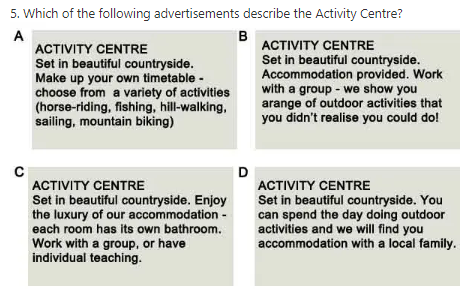
5. Which of the following advertisements describe the Activity Centre? [A, B, C, D]
Choose True of False.
1. Jack didn't like the activities at the Activity Centre. [true, false]
2. Jack came to the Centre on Wednesday. [true, false]
3. The name of Jack's friend is William. [true, false]
4. The place where he lived was great. [true, false]
5. Maria and Sara are sisters. [true, false]
6. William and Jack visited the caves. [true, false]
Рефлексія від 8 учнів
Сподобався:
0
Так: 7
Ні: 1
Зрозумілий:
0
Так: 7
Ні: 1
Потрібні роз'яснення:
0
Ні: 8
Так: 0