Тест:
К4 76

12.11.2021

Вміст тесту:
1
2
3
4
5
1
12 з 60 балів
Read the texts 1-6. What does each text say? Choose the correct letter A, B or C.

1. [A, B, C]
A. This place offers the best frozen seafood in the area.
B. You can’t book a table.
C. Tully’s Fish Place is open every day
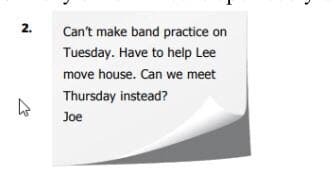
2. [A, B, C]
A. Joe is moving house.
B. Joe can’t make band practice this week.
C. Joe wants to change the band practice to a different day.
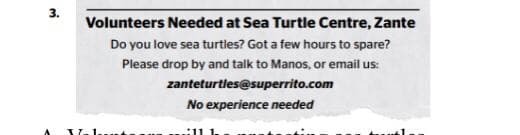
3. [A, B, C]
A. Volunteers will be protecting sea turtles.
B. Volunteers will have to work all day.
C. Manos will email the volunteers.
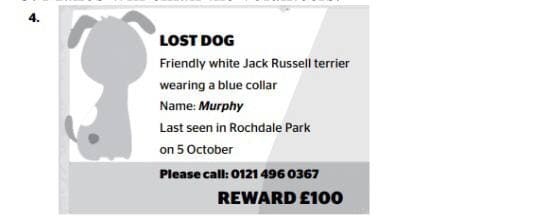
4. The person who placed this ad [A, B, C]
A. will pay £100 to buy a terrier.
B. was lost in Rochdale Park.
C. is looking for their pet.

5. [A, B, C]
A. You mustn’t leave children alone in the pool.
B. You must take a shower after swimming in the pool.
C. You can dive into the pool if you are over 12.

6. Why has Lucy written this postcard? [A, B, C]
A. to ask how Fiona is
B. to invite Fiona to join her and Martin
C. to tell Fiona how she’s spending her time away

Doctor, doctor...
Did you know that we forget about 80% of the medical information a doctor might give us? This interesting finding came to light as a result of a study carried out by Utrecht University. What is even more interesting is that almost half of what we think we remember is wrong. Why do you think this happens? Well, going to the doctor can make most people nervous, and when we are stressed we are more likely to concentrate on the diagnosis rather than on the treatment. Therefore, we know what is wrong with us but have no idea what to do about it. Here are some good tips to keep in mind when seeing a doctor. Always bring along a notepad to write down important pieces of information, such as how to take prescribed medication or how to prepare for any medical tests you might need.
What would be even better is if your doctor agreed to let you record him. In this way, you could replay his advice at home, where you are more likely to be able to understand it. If you believe the situation is serious or you’re really worried, get a family member or a close friend to come with you to listen in. Regardless of what you choose to do, there is one golden rule which you need to take into account. To communicate effectively, you need to ask the right questions. The Partnership for Clear Health Communication (PCHC) recommends you ask three questions every time you talk to a medical professional: ‘What is my main problem?’, ‘What do I need to do?’ and ‘Why is it important for me to do this?’ These will help you identify the problem and deal with it in a rational way.
7. Patients remember most of the medical information a doctor gives them. [A, B]
8. If patients feel nervous, it is likely they will forget the diagnosis. [A, B]
9. Patients should give the doctor a notepad so he can note down what he says. [A, B]
10. It may be easier for patients to make sense of a doctor’s advice if they listen to it at home. [A, B]
11. Friends or relatives should always accompany patients to the doctor. [A, B]
12. The PCHC suggests asking specific questions when visiting a doctor. [A, B]
2
12 з 60 балів
Read the texts 1-6. What does each text say? Choose the correct letter A, B or C.
1. [A, B, C]
A. This place offers the best frozen seafood in the area.
B. You can’t book a table.
C. Tully’s Fish Place is open every day
2. [A, B, C]
A. Joe is moving house.
B. Joe can’t make band practice this week.
C. Joe wants to change the band practice to a different day.
3. [A, B, C]
A. Volunteers will be protecting sea turtles.
B. Volunteers will have to work all day.
C. Manos will email the volunteers.
4. The person who placed this ad [A, B, C]
A. will pay £100 to buy a terrier.
B. was lost in Rochdale Park.
C. is looking for their pet.
5. [A, B, C]
A. You mustn’t leave children alone in the pool.
B. You must take a shower after swimming in the pool.
C. You can dive into the pool if you are over 12.
6. Why has Lucy written this postcard? [A, B, C]
A. to ask how Fiona is
B. to invite Fiona to join her and Martin
C. to tell Fiona how she’s spending her time away
Doctor, doctor...
Did you know that we forget about 80% of the medical information a doctor might give us? This interesting finding came to light as a result of a study carried out by Utrecht University. What is even more interesting is that almost half of what we think we remember is wrong. Why do you think this happens? Well, going to the doctor can make most people nervous, and when we are stressed we are more likely to concentrate on the diagnosis rather than on the treatment. Therefore, we know what is wrong with us but have no idea what to do about it. Here are some good tips to keep in mind when seeing a doctor. Always bring along a notepad to write down important pieces of information, such as how to take prescribed medication or how to prepare for any medical tests you might need.
What would be even better is if your doctor agreed to let you record him. In this way, you could replay his advice at home, where you are more likely to be able to understand it. If you believe the situation is serious or you’re really worried, get a family member or a close friend to come with you to listen in. Regardless of what you choose to do, there is one golden rule which you need to take into account. To communicate effectively, you need to ask the right questions. The Partnership for Clear Health Communication (PCHC) recommends you ask three questions every time you talk to a medical professional: ‘What is my main problem?’, ‘What do I need to do?’ and ‘Why is it important for me to do this?’ These will help you identify the problem and deal with it in a rational way.
7. Patients remember most of the medical information a doctor gives them. [A, B]
8. If patients feel nervous, it is likely they will forget the diagnosis. [A, B]
9. Patients should give the doctor a notepad so he can note down what he says. [A, B]
10. It may be easier for patients to make sense of a doctor’s advice if they listen to it at home. [A, B]
11. Friends or relatives should always accompany patients to the doctor. [A, B]
12. The PCHC suggests asking specific questions when visiting a doctor. [A, B]
3
12 з 60 балів
Read the texts 1-6. What does each text say? Choose the correct letter A, B or C.
1. [A, B, C]
A. This place offers the best frozen seafood in the area.
B. You can’t book a table.
C. Tully’s Fish Place is open every day
2. [A, B, C]
A. Joe is moving house.
B. Joe can’t make band practice this week.
C. Joe wants to change the band practice to a different day.
3. [A, B, C]
A. Volunteers will be protecting sea turtles.
B. Volunteers will have to work all day.
C. Manos will email the volunteers.
4. The person who placed this ad [A, B, C]
A. will pay £100 to buy a terrier.
B. was lost in Rochdale Park.
C. is looking for their pet.
5. [A, B, C]
A. You mustn’t leave children alone in the pool.
B. You must take a shower after swimming in the pool.
C. You can dive into the pool if you are over 12.
6. Why has Lucy written this postcard? [A, B, C]
A. to ask how Fiona is
B. to invite Fiona to join her and Martin
C. to tell Fiona how she’s spending her time away
Doctor, doctor...
Did you know that we forget about 80% of the medical information a doctor might give us? This interesting finding came to light as a result of a study carried out by Utrecht University. What is even more interesting is that almost half of what we think we remember is wrong. Why do you think this happens? Well, going to the doctor can make most people nervous, and when we are stressed we are more likely to concentrate on the diagnosis rather than on the treatment. Therefore, we know what is wrong with us but have no idea what to do about it. Here are some good tips to keep in mind when seeing a doctor. Always bring along a notepad to write down important pieces of information, such as how to take prescribed medication or how to prepare for any medical tests you might need.
What would be even better is if your doctor agreed to let you record him. In this way, you could replay his advice at home, where you are more likely to be able to understand it. If you believe the situation is serious or you’re really worried, get a family member or a close friend to come with you to listen in. Regardless of what you choose to do, there is one golden rule which you need to take into account. To communicate effectively, you need to ask the right questions. The Partnership for Clear Health Communication (PCHC) recommends you ask three questions every time you talk to a medical professional: ‘What is my main problem?’, ‘What do I need to do?’ and ‘Why is it important for me to do this?’ These will help you identify the problem and deal with it in a rational way.
7. Patients remember most of the medical information a doctor gives them. [A, B]
8. If patients feel nervous, it is likely they will forget the diagnosis. [A, B]
9. Patients should give the doctor a notepad so he can note down what he says. [A, B]
10. It may be easier for patients to make sense of a doctor’s advice if they listen to it at home. [A, B]
11. Friends or relatives should always accompany patients to the doctor. [A, B]
12. The PCHC suggests asking specific questions when visiting a doctor. [A, B]
4
12 з 60 балів
Read the texts 1-6. What does each text say? Choose the correct letter A, B or C.
1. [A, B, C]
A. This place offers the best frozen seafood in the area.
B. You can’t book a table.
C. Tully’s Fish Place is open every day
2. [A, B, C]
A. Joe is moving house.
B. Joe can’t make band practice this week.
C. Joe wants to change the band practice to a different day.
3. [A, B, C]
A. Volunteers will be protecting sea turtles.
B. Volunteers will have to work all day.
C. Manos will email the volunteers.
4. The person who placed this ad [A, B, C]
A. will pay £100 to buy a terrier.
B. was lost in Rochdale Park.
C. is looking for their pet.
5. [A, B, C]
A. You mustn’t leave children alone in the pool.
B. You must take a shower after swimming in the pool.
C. You can dive into the pool if you are over 12.
6. Why has Lucy written this postcard? [A, B, C]
A. to ask how Fiona is
B. to invite Fiona to join her and Martin
C. to tell Fiona how she’s spending her time away
Doctor, doctor...
Did you know that we forget about 80% of the medical information a doctor might give us? This interesting finding came to light as a result of a study carried out by Utrecht University. What is even more interesting is that almost half of what we think we remember is wrong. Why do you think this happens? Well, going to the doctor can make most people nervous, and when we are stressed we are more likely to concentrate on the diagnosis rather than on the treatment. Therefore, we know what is wrong with us but have no idea what to do about it. Here are some good tips to keep in mind when seeing a doctor. Always bring along a notepad to write down important pieces of information, such as how to take prescribed medication or how to prepare for any medical tests you might need.
What would be even better is if your doctor agreed to let you record him. In this way, you could replay his advice at home, where you are more likely to be able to understand it. If you believe the situation is serious or you’re really worried, get a family member or a close friend to come with you to listen in. Regardless of what you choose to do, there is one golden rule which you need to take into account. To communicate effectively, you need to ask the right questions. The Partnership for Clear Health Communication (PCHC) recommends you ask three questions every time you talk to a medical professional: ‘What is my main problem?’, ‘What do I need to do?’ and ‘Why is it important for me to do this?’ These will help you identify the problem and deal with it in a rational way.
7. Patients remember most of the medical information a doctor gives them. [A, B]
8. If patients feel nervous, it is likely they will forget the diagnosis. [A, B]
9. Patients should give the doctor a notepad so he can note down what he says. [A, B]
10. It may be easier for patients to make sense of a doctor’s advice if they listen to it at home. [A, B]
11. Friends or relatives should always accompany patients to the doctor. [A, B]
12. The PCHC suggests asking specific questions when visiting a doctor. [A, B]
5
12 з 60 балів
Read the texts 1-6. What does each text say? Choose the correct letter A, B or C.
1. [A, B, C]
A. This place offers the best frozen seafood in the area.
B. You can’t book a table.
C. Tully’s Fish Place is open every day
2. [A, B, C]
A. Joe is moving house.
B. Joe can’t make band practice this week.
C. Joe wants to change the band practice to a different day.
3. [A, B, C]
A. Volunteers will be protecting sea turtles.
B. Volunteers will have to work all day.
C. Manos will email the volunteers.
4. The person who placed this ad [A, B, C]
A. will pay £100 to buy a terrier.
B. was lost in Rochdale Park.
C. is looking for their pet.
5. [A, B, C]
A. You mustn’t leave children alone in the pool.
B. You must take a shower after swimming in the pool.
C. You can dive into the pool if you are over 12.
6. Why has Lucy written this postcard? [A, B, C]
A. to ask how Fiona is
B. to invite Fiona to join her and Martin
C. to tell Fiona how she’s spending her time away
Doctor, doctor...
Did you know that we forget about 80% of the medical information a doctor might give us? This interesting finding came to light as a result of a study carried out by Utrecht University. What is even more interesting is that almost half of what we think we remember is wrong. Why do you think this happens? Well, going to the doctor can make most people nervous, and when we are stressed we are more likely to concentrate on the diagnosis rather than on the treatment. Therefore, we know what is wrong with us but have no idea what to do about it. Here are some good tips to keep in mind when seeing a doctor. Always bring along a notepad to write down important pieces of information, such as how to take prescribed medication or how to prepare for any medical tests you might need.
What would be even better is if your doctor agreed to let you record him. In this way, you could replay his advice at home, where you are more likely to be able to understand it. If you believe the situation is serious or you’re really worried, get a family member or a close friend to come with you to listen in. Regardless of what you choose to do, there is one golden rule which you need to take into account. To communicate effectively, you need to ask the right questions. The Partnership for Clear Health Communication (PCHC) recommends you ask three questions every time you talk to a medical professional: ‘What is my main problem?’, ‘What do I need to do?’ and ‘Why is it important for me to do this?’ These will help you identify the problem and deal with it in a rational way.
7. Patients remember most of the medical information a doctor gives them. [A, B]
8. If patients feel nervous, it is likely they will forget the diagnosis. [A, B]
9. Patients should give the doctor a notepad so he can note down what he says. [A, B]
10. It may be easier for patients to make sense of a doctor’s advice if they listen to it at home. [A, B]
11. Friends or relatives should always accompany patients to the doctor. [A, B]
12. The PCHC suggests asking specific questions when visiting a doctor. [A, B]
Рефлексія від 2 учнів
Сподобався:
0
Так: 1
Ні: 1
Зрозумілий:
0
Так: 1
Ні: 1
Потрібні роз'яснення:
0
Ні: 1
Так: 1