Тест:
К4 28

06.10.2021

Вміст тесту:
1
2
3
4
5
6
7
8
9
10
11
Тест містить питання скопійовані з: К4 27.
1
12 з 132 балів
Look at the pictures and name the containers. 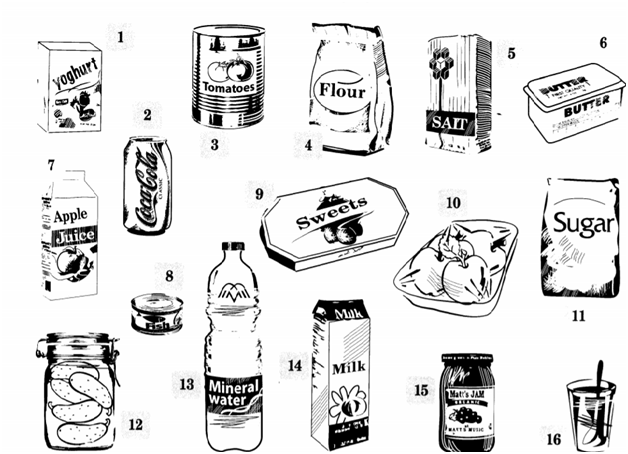
1.
2.
3.
4.
5.
6.
7.
8.
9.
10.
11.
12.
13.
14.
15.
16.
2
12 з 132 балів
Unscramble the words. Mind the articles and particle to.
1. Usidtam
2. cecikrt
3. ezodragin
4. ehahlyt
5. asownnm
6. demartesinetv
7. monuta
8. cesarh
9. motiieptcno
10. renusovi
3
12 з 132 балів
Complete the sentences with the words from the box.

Last week we went for… to the forest. We had a big… with food. We had three… of fish, … bread, … tomatoes, green cucumbers, some cheese, … meat, a … of ketchup and a… cake. Willy took … , dishes, and forks. We spent our time… in the forest. It was an… picnic.
4
12 з 132 балів
Complete the sentences using since or for.
My parents have not seen my brother last Tuesday.
Ann’s friends haven’t played hockey four months.
Her husband hasn’t been to London 2015.
The pupils haven’t travelled 3 years.
I haven’t watched TV a long time.
These people haven’ttaken part in the competition last year.
Your daughter hasn’t taken the dog for a walk morning.
5
12 з 132 балів
Write down the third form of the verb
1) to be, was/were –
2) to do – did –
3) to go – went –
4) to have – had –
5) to know – knew –
6) to see – saw –
7) to read – read –
8) to write – wrote -
6
12 з 132 балів
Open the brackets. Write only the predicate.
1. Her daughter ( not to take)
a dog for a walk yet.
2. Tom`s father (to pay\alreday) for the ticket.
3. My parents (not to decide) to go to the USA yet.
4. We (not to travel) first class yet.
5. Kate’s sister (just to arrive) at the airport .
6. Your husband (to book) a room at the hotel recently.
7. I (not to walk) along these streets yet.
8. Bob (to take)
part in this competition lately.
9. Mary's husband (alreday to come)
home.
10. The pupils (just to see) a new film.
11. I (to write) a letter to my grandparents lately.
12. Ann Smith (not to be) to Ukraine lately.
7
12 з 132 балів
General Test (K4 28)
1.What ... [a, b, c, d] you do yesterday? – I cleaned my room.
a) do b) did c) does d) will
2. I want to see my old Granny. She ... [a, b, c, d] not far from me. It takes me fifteen minutes to get there.
a) lives b) lives c) will live d) live
3. My parents ... [a, b, c, d] the flat.
a) has just cleaned b)has already cleaned c) cleans d) have just cleaned
4. We have watched an interesting film ... [a, b, c, d] TV recently.
a) by b) on c) in d) at
5. My friend aired the room, vacuumed the carpet, watered the plants ... [a, b, c, d].
a) yesterday b) every day c) recently d)next week
6. I`ll go to the theatre tomorrow. I ... [a, b, c, d] a gallery the day before yesterday.
a) visit b) visited c) visits d) have visited
7. What are you doing now? – I am waiting for my friend. She will come ... [a, b, c, d] an hour.
a) on b)ago c) in d)next
8. Lily has ... [a, b, c, d] done her homework. It wasn`t very difficult for her.
a) recently b) lately c) already d)always
9.Tim has returned ... [a, b, c, d] England lately. He has brought us a lot of different souvenirs.
a) to b) in c) at d) from
10.... [a, b, c, d] been to Kyiv this week. We visited popular museums, theatres and galleries there.
a) We're b) We`ve c)We's d) We
11.Liz has just read a new story. ... [a, b, c, d], it`s very boring.
a) To her mind b) In her mind c) In my opinion d) To her opinion
12.Their parent`s friend has just translated two English books ... [a, b, c, d] Ukrainian recently.
a) in b) into c)on d)at
13.My grandfather ... [a, b, c, d] watch TV for many hours.
a) have to b) has to c) must d) can
14.Tom has been ... [a, b, c, d] his native village this week.
a) in b)to c) at d) along
15.My mother has stewed meat with vegetables ... [a, b, c, d] morning.
a) last b) next c) this d) these
16.I have already ... [a, b, c, d] this film, but my friends will go to the cinema tomorrow.
a) see b)saw c) seed d)seen
17.I`ve known my friend for ages. He ... [a, b, c, d] a friendly and kind man.
a) has been b) is c)were d)be
18.They have to buy a packet of flour, two fish ... [a, b, c, d], and a box of sweets.
a) jars b) packets c) tins d) boxes
19.I`ve read a book ... [a, b, c, d] Peter Pen lately.
a) about b)already c) among d) with
20.My ... [a, b, c, d] sister has just baked a meat pie.
a) older b)oldester c)elder d)elderest
21.I`m so thirsty. ... [a, b, c, d] a glass of water, please.
a) Give me b) Gives me c) Gave me d) Gaves me
22.The woman often … [a, b, c, d] pies with stewed carrots.
a)has baked b)baked c)bakes d) bake
23. Paul … [a, b, c, d]to Moscow this week.
a)isn`t been b)hasn`t been c)will be d) is being
24. He … [a, b, c, d] theatres since last year.
a)hasn`t visited b)isn`t visited c)visits d)vist
25. I … [a, b, c, d] her for ages.
a)haven`t written b)hasn`t written c)wrote d)write
26. Lily … [a, b, c, d] any letter to her pen-friend for a long time.
a)haven`t written b)hasn`t written c)wrote d)didn't write
27. My father … [a, b, c, d] a lot of fish soon.
a)has smoked b)is smoking c)will smoke d)smoked
28. I … [a, b, c, d] never to this expensive fashionable restaurant.
a)will be b)have been c)was d)been
29. My friend … [a, b, c, d] this new article yet.
a) reads b)is reading c)hasn`t read d)has read
30. Jack … [a, b, c, d] never his friends off. He is always short of time.
a)has seen b)saw c)will seen d)see
31. You won`t go for a walk, because you … [a, b, c, d] a composition yet.
a)wrote b)writes c)haven`t written d)written
8
12 з 132 балів
Complete the sentences using the notes. Listen to the dialogue and check yourself.
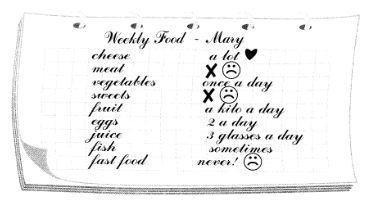
Ted: Hello, Mary. Can you answer some questions about food? cheese ?
Mary: Oh, ! I it very much.
Ted: And do you like ?
Mary: Yuck! I at all! I`m .
Ted: And what do you prefer to eat?
Mary: I prefer to eat . To tell the truth. I can eat of different fruits a day!
Ted: Wow! I can't believe it! And what about vegetables? How often do you eat them?
Mary: Not so often as fruit. But I try to eat them .
Ted: As far as I know vegetarians eat . Is it true?
Mary: You are right. Sometimes I eat and sometimes I eat .
And I eat two boiled a day.
Ted: How often do you eat ?
Mary: Oh! What are you talking about? Are you crazy? I never eat ! To my mind such food is terrible food!
Ted: And what about your favourite drinks? What do you drink?
Mary: I drink a day. I prefer tomato or pine-apple juice. But sometimes I drink tea with milk.
Ted: Thank you, Mary! I`m sure you`re healthy!
9
12 з 132 балів
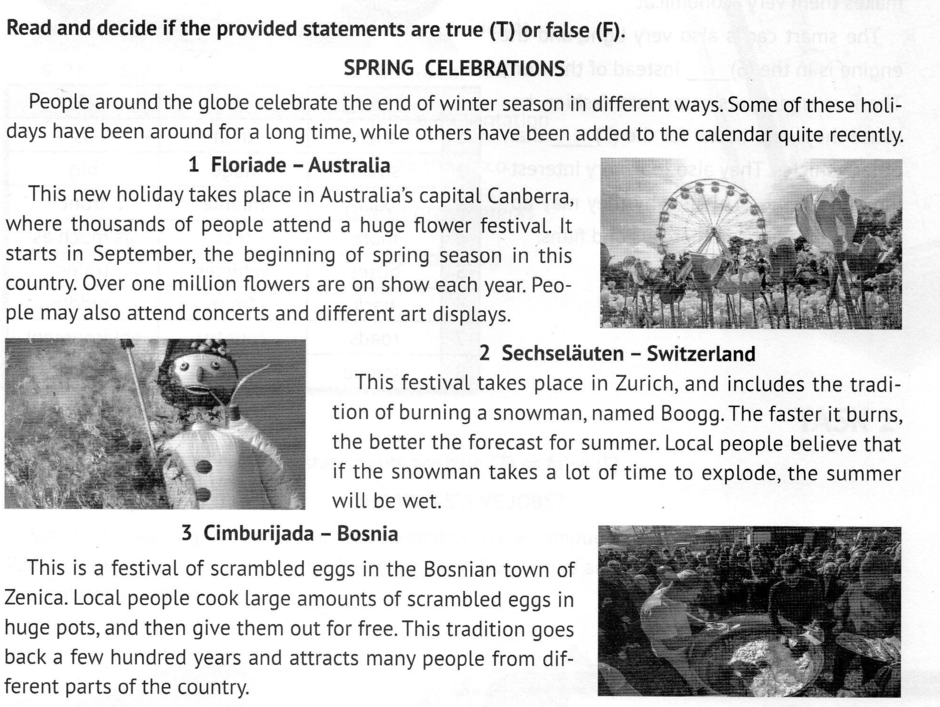
| [true, false] |
| [true, false] |
| [true, false] |
| [true, false] |




10
12 з 132 балів
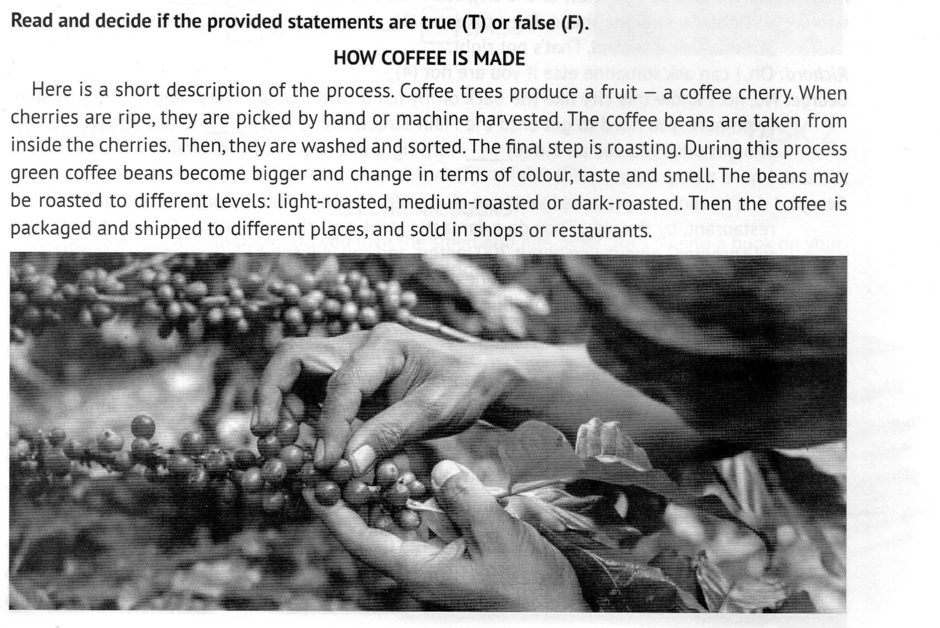
| [true, false] |
| [true, false] |
| [true, false] |
| [true, false] |



11
12 з 132 балів
Reading
Tips for travelling alone
Travelling alone seems scary if it’s the first time you are going to leave the comfort of home. You will probably think about the potential risks or difficult situations. What happens if I get ill, or have an accident? Isn’t it dangerous to go out alone at night? What happens if I get attacked? Isn’t it strange to eat at restaurants alone all the time?
Most travellers have these worries and more before their first trip alone, but all these fears disappear when they see all the benefits of this great experience. Here I’m going to give you 3 tips on how to travel alone and have a good time.
Speak the language
Humans are sociable creatures. We all need to talk to other people. If you are travelling alone, it’s a good idea to go somewhere you speak the language.
Sleep with the locals
Hotels are comfortable but very lonely, and hostels are perfect for people who travel alone, but you will only speak with other tourists. Try to rent a room in an apartment. This will give you a connection with local residents and they can give you a lot of tips on what you can do.
Don’t be shy
Don’t be afraid of asking. Ask for directions in the street, or ask about the place, the culture or the customs to the local people that you find in bars, parks, etc. You will be surprised how much people like to talk about their town or their culture. Remember you are alone. Asking can be an effective way to start a conversation and meet new people.
Choose the correct variant
1) The writer thinks that travelling alone is... [a, b, c]
a.worse than staying at your comfortable home.
b.dangerous.
c.a good idea.
2) The writer wants to... [a, b, c]
a.help people who want to travel alone.
b.talk about the possible risks of travelling alone.
c.talk about his or her experiences travelling.
3) If you travel alone, it’s a good idea... [a, b, c]
a.to learn the language of the place before you go there.
b.to go to a place where you can speak their language.
c.to speak to other tourists.
4) The writer thinks that if you travel alone, hostels are... [a, b, c]
a.the best option.
b.very good but not the best option.
c.worse than hotels.
5) The local residents can help you... [a, b, c]
a.to find a good hotel or hostel.
b.giving you ideas for your trip.
c.to find a cheap room that you can rent.
6) The best thing about asking is that... [a, b, c]
a.you get the information you need.
b.you can find the places where you are going.
c.you can talk to the local people.
Рефлексія від 16 учнів
Сподобався:
0
Так: 13
Ні: 3
Зрозумілий:
0
Так: 9
Ні: 7
Потрібні роз'яснення:
0
Ні: 14
Так: 2