- Всеосвіта›
- Бібліотека тестів›
- Англійська мова›
- HS2 2019 unit9 p168 act6

Тест:
HS2 2019 unit9 p168 act6

23.05.2022
Вміст тесту:
1
2
3
4
5
6
7
8
9
10
11
Тест містить питання скопійовані з: HS2 2019 unit9 p168 act6.
1
12 з 132 балів
Reading 1
Read the text below. Match choices (A-H) to (17-21). There are three choices you don't need to use.
What is the purpose of the pieces of writing above?
A To give instructions.
B To recommend not to do something and explain the reasons.
C To keep somebody informed about weather conditions.
D To invite a friend.
E To offer a meal.
F To inform about working hours.
G To warn about an unfavourable situation on the road.
H To order not to do something.
17. [A, B, C, D, E, F, G, H]

18. [A, B, C, D, E, F, G, H]
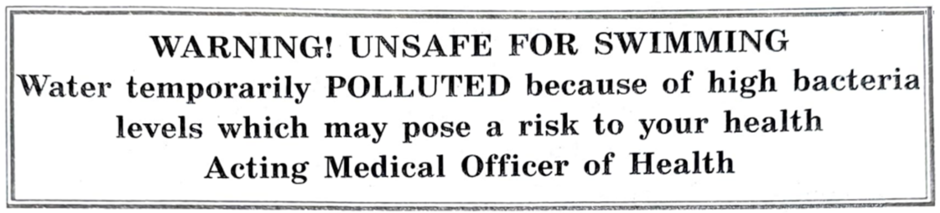
19. [A, B, C, D, E, F, G, H]
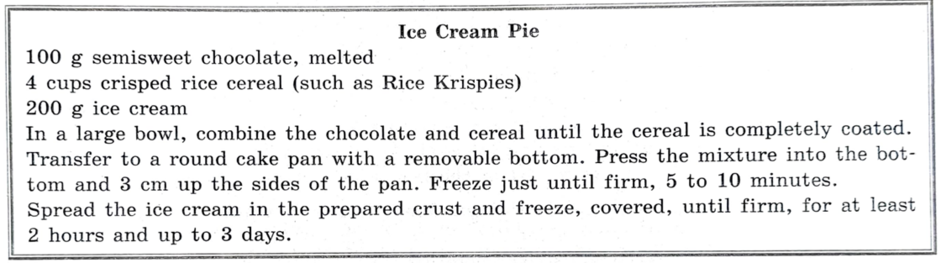
20. [A, B, C, D, E, F, G, H]
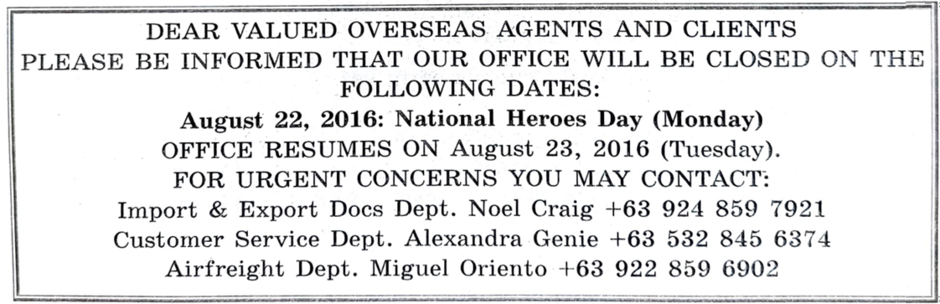
21. [A, B, C, D, E, F, G, H]

Reading 2
Read the text below. For questions (22-26) choose the correct answer (A, B, C or D).
When you think about various constructions like railways, steamships and bridges, it's a little bit complicated to realize that they were designed by one person. However, it's true. The person responsible for building all these was Isambard Kingdom Brunel, a British engineer, who played a key role in the early industrial revolution. He built one of the first major railway routes - the Great Western Railway (GWR) between London and Bristol. He also designed and built steamships and important bridges.
Though they were not always successful, his projects often contained innovative solutions to long-standing engineering problems. He generated much publicity for his endeavours and his achievements are still widely celebrated today.
Brunel was born in 1806 in the family of a successful engineer, Marc Isambard, and at the age of fourteen he was sent to France to be educated at the Lycee Henri IV and the University of Caen.
In 1833, Brunel was made chief engineer of the Great Western Railway, and he created a broad-gauge track that was seven feet wide. Not only could the wheels be accommodated in this fashion, but it also became possible to carry passengers. Brunel is perhaps best remembered for designing the Clifton Suspension Bridge in Bristol. Spanning over 700 ft (210 m), and nominally 200 ft (61 m) above the River Avon, it was the longest bridge in the world at the time of construction. Besides he improved the design for the bridge over the Tamar river near Plymouth.
In 1843 he built the world's first metal ship. This was a forerunner of modern ships around the world.
In fact it won't be an exaggeration to say that the works of Isambard Brunel are still very much with us, and still very much a part of the landscape that we live in!
22 Which of the following is stated in the text about Isambard Brunel? [a, b, c, d]
A His projects were always successful.
B His inventions caused the industrial revolution.
C He is credited with developing very important and innovative constructions.
D He is believed to design all the bridges in the UK.
23 What do we know about Isambard Brunel's early years? [a, b, c, d]
A He was born in France.
B He followed a family dynasty of engineers.
C He didn't study until the age of fourteen.
D His parents sent him to the University, however, he didn't want to go there.
24 He designed lots of things except [a, b, c, d]
A the first metal ship.
B a seven-foot-wide railway track.
C the bridge over the Tamar river.
D one of the first major railway routes.
25 Which of the following can be inferred from the text? [a, b, c, d]
A The Clifton Suspension Bridge in Bristol has the longest span in the world.
B Brunel's first metal ship was a prototype of modern ships around the world.
C The Great Western Railway was designed for railways but not for passengers.
D Brunel was credited with a submarine design.
26 Which of the following information is not presented in the text? [a, b, c, d]
A His father's name.
B The year of his birth.
C Some of his greatest inventions.
D The name of the place where he was born.
Reading 3
Read the text below. For questions (49-58) choose the correct answer (A, B, C or D).
This is a real story that (49) [a, b, c, d] in Washington DC. One cold January morning a young man at a metro station started playing the violin. He was playing musical pieces by Bach for about 45 minutes. (50) [a, b, c, d] it was a rush hour and many people were (51) [a, b, c, d] their way to work, hardly anybody paid much attention to his musical performance - only 6 people stopped and stayed for a while.
No one knew this but the violinist was Joshua Bell, one of the best musicians in the world. Joshua Bell playing incognito in the metro station as part of a social experiment that aimed at (52) [a, b, c, d] if people could recognize the talent in an unexpected situation.
This experiment makes us (53) [a, b, c, d] ourselves a question: if we do not have a minute to stop and listen to one of the best musicians in the world playing the best music ever written, how many other things are we missing in our life?
A | B | C | D | |
49 | happen | happened | had happened | is happening |
50 | Although | However | Besides | Since |
51 | at | in | on | into |
52 | discover | discovers | to discover | discovering |
53 | ask | asks | asking | to ask |
The American company RealNetworks offers to provide schools with free facial (54) [a, b, c, d] software that can be downloaded via the company website. The software is called SAFR, and it claims (55) [a, b, c, d] specially designed hardware to «recognize staff, students, and visitors in real time to help improve school (56) [a, b, c, d] ». It also promises to «streamline entry, record keeping, campus monitoring, and guest check-in».
The tech is at present being tested at a school in Seattle (57) [a, b, c, d] kids can unlock a gate with just a smile at a surveillance camera.
In the absence of reasonable gun control laws, the program (58) [a, b, c, d] to improve safety in schools by allowing for real-time monitoring.
A | B | C | D | |
54 | definition | recognition | awareness | finding |
55 | use | uses | to use | used |
56 | save | safe | saving | safety |
57 | where | what | who | whatever |
58 | mean | means | meaning | is meant |
2
12 з 132 балів
Listening 1
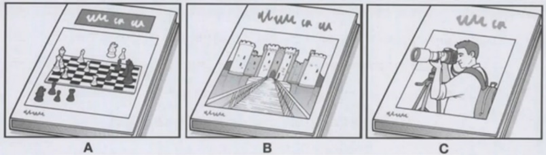
1. Which book does the girl recommend to the boy? [a, b, c]
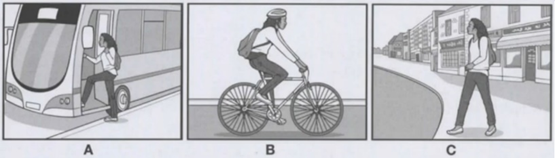
2. How does the girl usually get to school? [a, b, c]
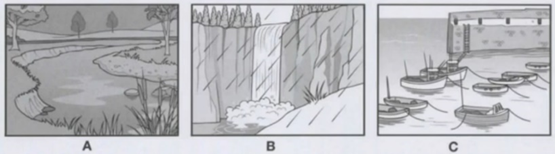
3. Which is the girl’s favourite photo? [a, b, c]
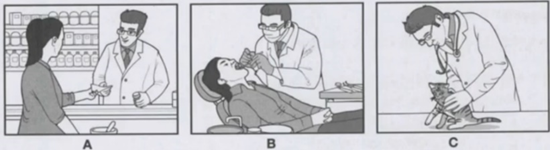
4. Who will be on the TV programme today? [a, b, c]
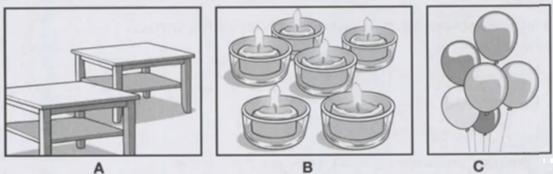
5. What are the brother and sister going to put in the room? [a, b, c]
6. When will the school be able to use the pool? [a, b, c]
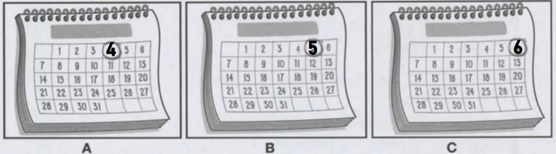
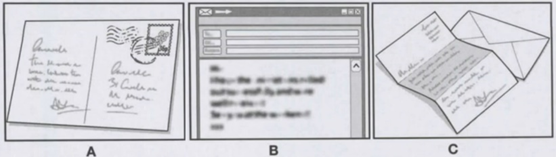
7. What will the girl send to her aunt? [a, b, c]
Listening 2
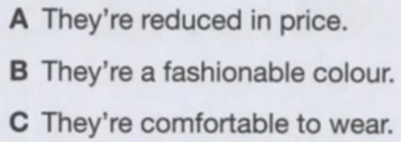
8. You will hear two friends talking in a shoe shop. What does the boy like best about the trainers he wants to buy? [a, b, c]
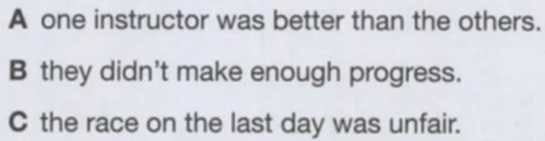
9. You will hear two friends talking about a sailing course they went on. The girl thinks that [a, b, c]
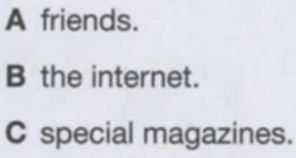
10. You will hear two friends talking about a new computer game. They agree that the best way of finding out about new games is through [a, b, c]
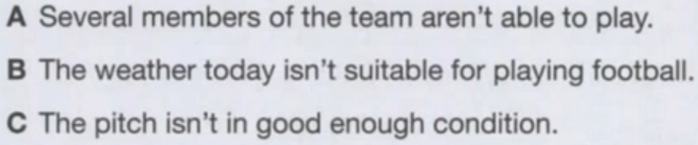
11. You will hear a boy telling his friend about a football match. Why is it postponed? [a, b, c]
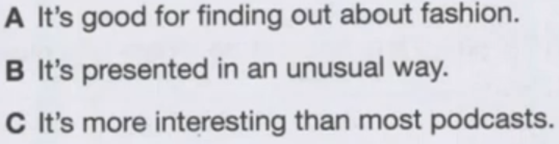
12. You will hear two friends talking about a new podcast. What do they agree about it? [a, b, c]
13. You will hear two friends talking about their holidays. They agree that [a, b, c]

Listening 3
You will hear an interview with a boy called Noah Kelly, who is talking about his love of horse riding.
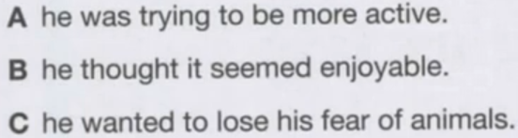
20. Noah started horse riding because [a, b, c]
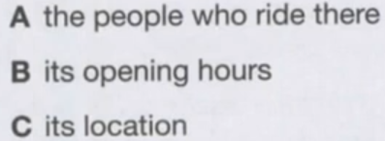
21. What is unusual about the horse-riding club that Noah goes to? [a, b, c]
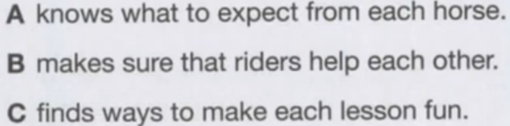
22. Noah says that his riding teacher [a, b, c]
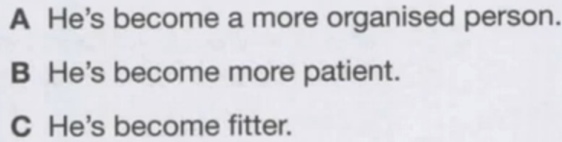
23. How has Noah benefitted from horse riding? [a, b, c]
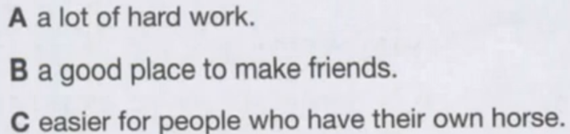
24. Noah says that horse-riding competitions are [a, b, c]
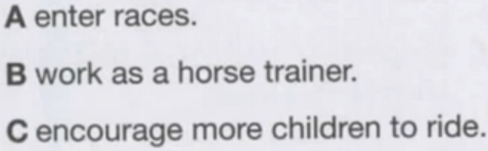
25. When he’s older, Noah would like to [a, b, c]
3
12 з 132 балів
Words 1
Tick the skills that refer to successful career as a chef.

Запитання №4 На встановлення відповідності
Запитання №5 На встановлення відповідності
Запитання №6 На встановлення відповідності
Запитання №7 На встановлення відповідності
Запитання №8 Із заповненням пропусків у тексті
Запитання №9 Із заповненням пропусків у тексті
Запитання №10 Із заповненням пропусків у тексті
Запитання №11 З вибором правильної відповіді у тексті
Рефлексія від 0 учнів
Сподобався:
0
Так: 0
Ні: 0
Зрозумілий:
0
Так: 0
Ні: 0
Потрібні роз'яснення:
0
Ні: 0
Так: 0