- Всеосвіта›
- Бібліотека тестів›
- Англійська мова›
- HS2 2019 Unit7 act5 p124

Тест:
HS2 2019 Unit7 act5 p124

13.06.2022
Вміст тесту:
1
2
3
4
5
6
7
Тест містить питання скопійовані з: HS2 2019 Unit7 act5 p124.
1
12 з 84 балів
Reading 1
Culture Shock
What is culture shock?
Culture shock refers to the feeling of disorientation experienced by people when they move to an unfamiliar cultural environment or when they are suddenly exposed to a different way of life or set of attitudes. This can be the result of immigration or a visit to a new country, a move between social environments, or simply a transition to another type of life.
Culture shock stages
Culture shock consists of four distinct stages: honeymoon, negotiation, adjustment, and adaptation. The honeymoon stage occurs when the individual sees the differences between the old and new culture in a romantic light. In the negotiation stage, the differences between the old and new culture become apparent and may create anxiety. The adjustment stage refers to the period when the individual grows accustomed to the new culture and develops routines. Finally, in the adaptation stage, individuals are able to participate fully and comfortably in the host culture. Adaptation or acceptance does not mean total conversion; people often keep many traits from their earlier culture, such as accents and languages. It is often referred to as the bicultural stage.
Homesickness
Culture shock may cause homesickness. This refers to the feeling of longing for one's home. People suffering from culture shock typically experience a combination of depressive and anxious symptoms related to homesickness. Ways of coping with homesickness include developing a hobby, thinking positively and feeling grateful about what one has, and building new relationships.
Cultural shock is a natural phenomenon that occurs when one has a cross-cultural experience. Going through the different stages can take weeks, months or years. But ultimately, the experience can be enriching and may end up with either adaptation with the new culture or a return home. true false
1. Culture shock occurs only as a result of immigration. [true, false]
2. The adaptation stage means that there is a complete change of personality. [true, false]
3. Homesickness and culture shock refer to the same thing. [true, false]
4. Culture shock has also positive effects on people experiencing it. [true, false]
Reading 2
Read the text below. Match choices (A-H) to (5-10), There are two choices you do not need to use.
This malware ___
A gets facts about a computer user without informing him/her.
B is usually hidden deep inside your computer.
C functions with the user's informed permission.
D can easily copy itself.
E is usually hidden within another program.
F runs automated tasks.
G refers to an ancient myth.
H limits your opportunity to use your computer.
Malware is a type of a computer code that includes viruses, worms, and Trojans horses that are potential threats to computer systems today. Let's look at some of them.
5 [A, B, C, D, E, F, G, H]Worms are designed to replicate themselves quickly to spread to other computers, often through a computer network. Most worms are only designed to spread as quickly as possible, so they do not usually try to change the computer systems they pass through. However, worms can create threat to the security, deleting files or even sending files via email. This is a common method for spam senders to spread junk email quickly, as the more computers are infected, the faster the spam mail will spread.
6 [A, B, C, D, E, F, G, H]Trojan Horses, or Trojans for short, are different from worms because they don't replicate themselves. Rather, Trojans are designed to trick you into downloading them to cause data loss and sometimes total-system harm. Just as in the ancient Greek story of the wooden horse that was to deceive the soldiers of Troy, Trojans present themselves as useful, interesting or routine programs to trick you into installing them on your computer.
7 [A, B, C, D, E, F, G, H]Spyware is designed to gather information about you without your knowledge. This information can be sent to another party without your consent, and it can even be used to take control over a computer. Spyware is capable of collecting any type of data, including your Internet history and banking information. Some forms of spyware can even install additional software or change your Internet settings, which can be a mere annoyance, or a problem that can take days to fix.
8 [A, B, C, D, E, F, G, H]Ransomware infects your computer with the aim to restrict access to your computer system, perhaps preventing you from surfing the Internet or accessing the hard drive, and then demanding a payment to the malware creators. Some of the trickiest ransomware designers have acquired millions of dollars from unsuspecting users.
9 [A, B, C, D, E, F, G, H]Rootkits are secret types of malware that tries to gain administrator access on your computer and then hide itself so you don't know it is in your system. This type of malware is generally difficult to detect and remove.
Malware is not limited to these five examples, fortunately, antivirus software is designed to combat these threats by preventing the programs from entering your system.
10 [A, B, C, D, E, F, G, H]Bots are the type of software designed so as to automatically do certain tasks. Although some bots are created for relatively harmless purposes, bots can be also used for placing advertisements on websites, DDoS attacks, or malware distributing.
Reading 3
Read the text below. For questions (11-20) choose the correct answer (A, B, C or D).
As Chinese scientists (11) [A, B, C, D]recently discovered, eating too (12) [A, B, C, D]fat may be bad for your health.
Two hundred young, healthy people (13) [A, B, C, D]took part in the 6-month experiment were supposed (14) [A, B, C, D]either a low, moderate or high-fat food. Those in the high-fat diet group saw «negative changes» in the way they (15) [A, B, C, D].
A | B | C | D | |
11 | have | has | had | having |
12 | many | more | much | few |
13 | what | when | whose | who |
14 | eat | to eat | eating | ate |
15 | feel | felt | feeling | feeled |
WHAT ARE DONGLES?
Dongles (16) [A, B, C, D]by millions of people on their daily basis. They are also known (17) [A, B, C, D]USB dongles. Dongles are used by plugging into a USB port of a device (18) [A, B, C, D]as PC, laptop, or even a television or Blu-ray player. Dongles come in different variations; what their functions are and how to use them often depends (19) [A, B, C, D]the dongle type and on the manufacturer's software. The (20) [A, B, C, D]common dongles are memory or Wi-Fi dongles.
A | B | C | D | |
16 | is used | are used | used | are using |
17 | as | like | when | called |
18 | such | so | that | same |
19 | in | at | on | from |
20 | many | much | most | more |
Reading 4
Read the text below. For questions (21-26) choose the correct answer (A, B, C or D).
Maria Montessori lived between 1870 and 1952. She was an Italian educator who has left her mark on education today. Her Montessori method of education is widely used all round the world. Many educationalists say it is the best system for child education. Montessori was also a doctor, philosopher and philanthropist. She was nominated for the Nobel Peace Prize three times for her work.
Montessori was the first woman to graduate from University of Rome Medical School. She trained as a psychiatrist and was interested in educating the «mentally retarded» and others with learning difficulties. She had great success when her class of «problematic» 8-year-olds had above-average scores in state reading and writing tests. This was described as «the first Montessori miracle».
Hearing about Maria's achievements, the government of Rome asked her to start her own children's school. In 1907, the Casa dei Bambini opened in a poor neighbourhood of Rome. Montessori experimented with a philosophy she called «spontaneous self-development», which meant letting children develop and learn at their own pace. Her methods once again met with great success. More schools opened and she gained worldwide fame.
Montessori was exiled from Italy because she refused to allow her schools to turn children into Soldiers. She lived in Spain until the Spanish Civil War broke out in 1936. In 1939 she moved to India and spent ten years working on training courses, which are still seen as innovative today. She travelled around the world lecturing until her death in 1952.
21 Maria Montessori is famous for [A, B, C, D]
A developing an original teaching method.
B creating a unique system of medical treatment.
C winning the Nobel Peace Prize.
D contribution into charity.
22 Which of the following was not Maria Montessori's occupation? [A, B, C, D]
A Doctor.
B Educationalist.
C Philosopher.
D Scientist.
23 Montessori was the first woman to [A, B, C, D]
A teach children.
B be nominated for the Nobel Peace Prize.
C receive a University of Rome Medical School diploma.
D study at University of Rome Medical School.
24 What phenomenon was described as «the first Montessori miracle»? [A, B, C, D]
A Educating the «mentally retarded» children.
B Teaching children with learning difficulties.
C Achieving above-average test results from the class of «problematic» children.
D Teaching 8-year-olds to read and write.
25 What does the method of «spontaneous self-development» mean? [A, B, C, D]
A Letting children develop and learn at their own tempo.
B Letting children develop and learn following their own programme.
C Letting children develop and learn at their own homes.
D Letting children develop and learn on their own.
26 Why was Móntessori exiled from Italy? [A, B, C, D]
A Her method turned out to be not really good.
B She didn't let her schools turn children into soldiers.
C She worked on training courses all over the world.
D She preferred to live in Spain.
2
12 з 84 балів
Listening 1
1. What has the woman received for her birthday? [a, b, c]
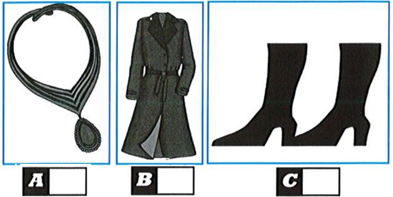
2. What did the boy forget to buy? [a, b, c]
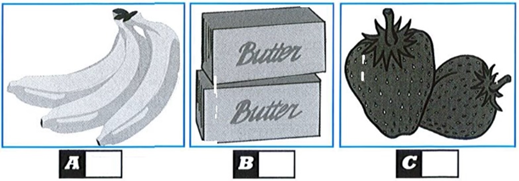
3. What is the date of the party? [a, b, c]

4. What’s the weather like now? [a, b, c]
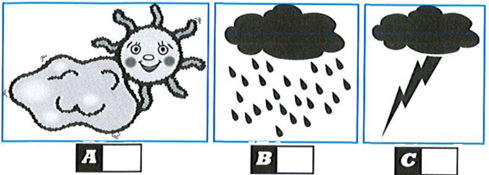
5. What form of transport is unaffected? [a, b, c]
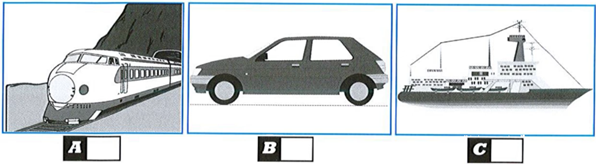
6. What is the man’s job? [a, b, c]
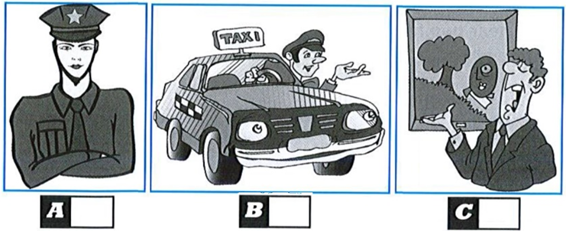
7. Where is Billy now? [a, b, c]
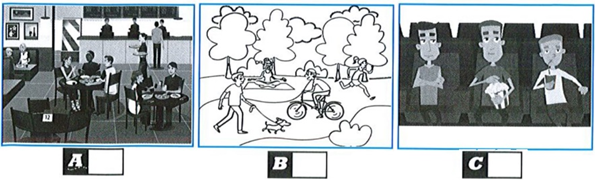
Listening 2
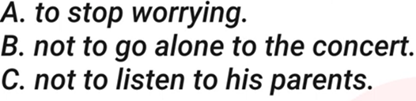
8. You will hear a boy telling his friend about his problem. The girl advises the boy [a, b, c]
9. You will hear two friends talking about a school trip they went on. What did the boy like best about it? [a, b, c]
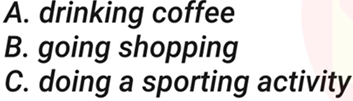
10. You will hear a girl telling her friend about her accident. They agree that [a, b, c]
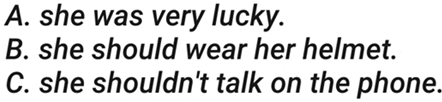
11. You will hear two friends talking about an invitation. [a, b, c]
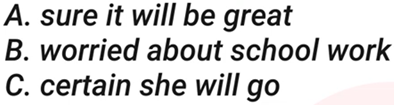
12. You hear a girl telling her friend about her smart phone. What does the boy think about it? [a, b, c]

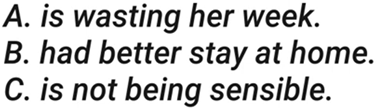
13. You will hear two friends talking about a TV series. The boy feels that the girl [a, b, c]
Listening 3
20. Where did Anna first learn a language? [a, b, c]
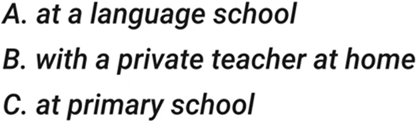
21. What were Anna’s French lessons like? [a, b, c]

22. What does Anna say you should do when learning new words? [a, b, c]
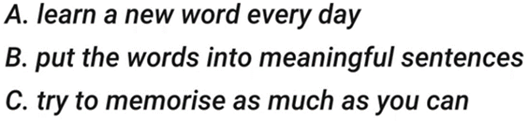
23. Anna says that in order to learn new words, you should [a, b, c]
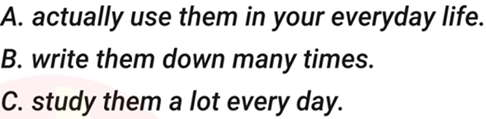
24. What does Anna say about language learning? [a, b, c]

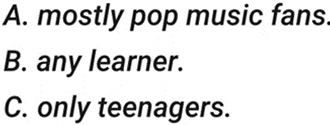
25. Listening to songs in a foreign language can help [a, b, c]
3
12 з 84 балів
Translate into English:
гуркіт сміху
зв'язок з предками
шанувати традиції
розмови дорослих
просте відкриття
втратити підгрунтя
вічна таємниця
учасник
коронувати
потрапляти під захист
передбачуваний результат
спогад
Запитання №4 Із заповненням пропусків у тексті
Запитання №5 Із заповненням пропусків у тексті
Запитання №6 Із заповненням пропусків у тексті
Запитання №7 З вибором правильної відповіді у тексті
Рефлексія від 0 учнів
Сподобався:
0
Так: 0
Ні: 0
Зрозумілий:
0
Так: 0
Ні: 0
Потрібні роз'яснення:
0
Ні: 0
Так: 0