- Всеосвіта›
- Бібліотека тестів›
- Англійська мова›
- HS2 2019 unit5 p94 act3

Тест:
HS2 2019 unit5 p94 act3

24.10.2021
Вміст тесту:
1
2
3
4
5
6
7
8
9
10
11
1
12 з 132 балів
British English and American English, match the equivalents.
1
caravan
А
motor, engine
2
clothes peg
Б
allowance
3
dustman
В
crazy, insane
4
engine
Г
trailer
5
handbag
Ґ
railroad
6
mad
Д
motorcycle
7
main road
Е
garbage collector
8
motorbike
Є
gas, gasoline
9
pavement
Ж
windshield
10
petrol
З
purse, shoulder bag
11
pocket money
И
mailbox
12
postbox
І
flashlight
13
railway
К
clothespin
14
torch
Л
highway
15
windscreen
М
sidewalk
2
12 з 132 балів
Decide whether the sentence is written in British or American English.
1. What about another chocolate biscuit? [British English, American English]
2. We'll have to stop at the next gas station. [British English, American English]
3. I got this book at the new bookstore. [British English, American English]
4. He loves travelling by train. [British English, American English]
5. There has been an accident on the sidewalk. [British English, American English]
6. Put this box into the garbage can, please. [British English, American English]
7. Ronny is in the eighth grade, not in seventh. [British English, American English]
8. Let's meet at the weekend. [British English, American English]
9. His billfold is pure leather. [British English, American English]
10. The lift is out of order. [British English, American English]
3
12 з 132 балів
American and British English
Read and Complete
1. A film is also called .
2. Americans call a lift .
3. In the USA pedestrians walk on the , not the pavement.
4. In New York, the underground is known as the .
5. The American word for football is .
6. In an American restaurant a starter is called .
7. Trucks are known as in England.
8. Fall is the American word for .
9. Brits don’t have parking lots; they have .
10. The gas Americans put in their cars is called in the UK.
11. The Brits don’t use cell phones; they use .
12. In the UK you never go on vocation; you go on .
4
12 з 132 балів
Read the text. Choose the correct words in American English.
A busy day
Mrs Fisher was very busy today. She drove to a [butcher's shop, butchers' shop] for some ham. Then she went to the supermarket to get some [icing sugar, powdered sugar] and [mashed potato, mashed potatoes] . She needed [diapers, nappies] for her baby and some [clothespins, clothes pegs] . Then her daughter Sally saw the [candy store, sweet shop] and Mrs Fisher bought her some [candy floss, cotton candy] . At home she put everything into the [closet, cupboard] . Then she opened the [faucet, tap] , filled water into a pot and put it on the [stove, cooker] .
5
12 з 132 балів
Grammar Test
1. I don’t know much but he knows [a, b, c, d] than I do.
a) even little
b) less
c) even less
d) most
2. Are you any good at tennis? – I am [a, b, c, d] tennis player in the world.
a) the worst
b) bad
c) worse
d) the better
3. Let’s not go by train. Going by bus is [a, b, c, d] .
a) the most cheap
b) cheap
c) little cheap
d) a lot cheaper
4. You … six cakes since we … . [a, b, c, d]
a) had / had come
b) have had / came
c) have / come
d) have had / have come
5. The English … of sports and … themselves as good sportsmen. [a, b, c, d]
a) were fond / regards
b) was fond / regards
c) are fond / regard
d) are fond / are regarding
6. The children … their hands and they … lunch now. [a, b, c, d]
a) have washed / are having
b) are washing / are having
c) washed / are having
d) wash / have had
7. Don’t go out. It … . It … since morning. [a, b, c, d]
a) is raining / has been raining
b) has rained / rains
c) was raining / had been raining
d) is raining / had rained
8. I … you the book after I … it. [a, b, c, d]
a) shall give / had read
b) have given / shall read
c) am giving / read
d) shall give / have read
9. Pay attention to your work … you will not make mistakes. [a, b, c, d]
a) unless
b) so that
c) or
d) until
10. It’s … going to rain … snow tonight. [a, b, c, d]
a) as / if
b) as / as
c) either / or
d) both / and
11. Do you like chocolate … vanilla ice cream better? [a, b, c, d]
a) or
b) nor
c) and
d) but
12. She has an incredible voice; … , she will go far in her music career. [a, b, c, d]
a) similarly
b) otherwise
c) however
d) undoubtedly
13. We had hoped to go to Spain; … , we ended up in France. [a, b, c, d]
a) otherwise
b) again
c) meanwhile
d) instead
14. The teacher said the pupils … so much noise during the breaks. [a, b, c, d]
a) didn’t make
b) don’t have to make
c) mustn’t make
d) will not make
15. Mary said she was worried that her son … very well that year. [a, b, c, d]
a) hadn’t been studying
b) wasn’t studying
c) isn’t studying
d) hasn’t been studying
16. In my interview I asked Jessica Young why … another romantic novel. [a, b, c, d]
a) she had written
b) she wrote
c) she has written
d) she is writing
17. Mark replied he didn’t think Jane … by the following Sunday yet. [a, b, c, d]
a) had arrived
b) would have arrived
c) would arrive
d) will have arrived
18. Mark told Nancy that he … his dog at last, and the worried expression began to disappear from his face. [a, b, c, d]
a) must find
b) found
c) had found
d) has found
19. Burt loves islands. He has been to … Cuba, … Bali, … Bahamas, and … Philippines. And next year, he wants to go to … Madagascar. [a, b, c, d]
a) the / the / the / the / -
b) a / a / the / the / a
c) the / the / - / - / the
d) - / - / the / the / -
20. Every year, … Smiths go camping in … Yellowstone National Park. But … next year, they are going to visit Mr. Smith's mother in … South instead. [a, b, c, d]
a) the / - / - / the
b) - / - / - / the
c) the / the / - / the
d) the / - / - / a
21. Wow, … cheese is getting so expensive! Look, that cheese costs more than $50 … pound. [a, b, c, d]
a) - / -
b) the / the
c) - / a
d) the / a
22. We spent the whole day today at … Venice Beach, and then we had dinner at … little restaurant on … Hollywood Boulevard. [a, b, c, d]
a) the / a / the
b) - / a / -
c) a / the / a
d) the / - / a
23. He’d done that before, … he? [a, b, c, d]
a) wouldn’t
b) hadn’t
c) didn’t
d) had
24. They won’t do that, …? [a, b, c, d]
a) won’t they
b) will they
c) will they not
d) did they
25. They’ve got too much luggage, …? [a, b, c, d]
a) isn’t it
b) got they not
c) haven’t they
d) don’t they
26. The … of this book made some unforgivable mistakes, because he didn't take into consideration the differences between the source text and the target text. [a, b, c, d]
a) author
b) narrator
c) poet
d) translator
27. The … is the main food of the fast food culture and is nowadays very popular throughout the world. [a, b, c, d]
a) sandwich
b) meatball
c) hamburger
d) coke
28. His conversation is full of … ideas; he should be clearer and more compact. [a, b, c, d]
a) differ
b) diffuse
c) obvious
d) difficulties
29. He … leaves the lights open when he goes out at night in order that thieves won't break into his house. [a, b, c, d]
a) definitely
b) unwisely
c) delightfully
d) deliberately
30. No one in the world is capable of knowing another person's …, so all fortune tellers are liars in my eyes. [a, b, c, d]
a) concern
b) appreciate
c) testimony
d) destiny
31. I was thinking of buying a pregnancy dress … , but … was given one as a present by my husband. [a, b, c, d]
a) it / she
b) myself / I
c) me / mine
d) itself / me
32. One of the … things the warring factions have in common is … opposition to the US. [a, b, c, d]
a) few / their
b) little / its
c) many / yours
d) number of / theirs
33. A very close relative … has just arrived from a trip during which he experienced many interesting adventures. [a, b, c, d]
a) for my own
b) to myself
c) of mine
d) of me
34. American Indians often sold … land to white people or gave it away without realizing that it would no longer be … . [a, b, c, d]
a) their / theirs
b) theirs / them
c) its / them
d) their / themselves
35. The truth is, I'm not … pleased with Mike's grades this year. [a, b, c, d]
a) at all
b) a little
c) a lot
d) at least
36. Can our minds grasp the individual object as … stands by …? [a, b, c, d]
a) theirs / ourselves
b) them / themselves
c) it / itself
d) ours / theirs
37. Monkeys are famous for … eagerness to approach people and playfully interact with … especially in the circus. [a, b, c, d]
a) themselves / us
b) their / them
c) its / you
d) our / theirs
38. According to the schedule, the teachers have to come together … week to discuss the problems of their students. [a, b, c, d]
a) all
b) some
c) any
d) every
39. … researchers have demonstrated that global warming tends to result from greenhouse gases. [a, b, c, d]
a) A number of
b) Much more
c) Most of
d) The least
40. Most of our traditions are … practised because they're regarded as obsolete. [a, b, c, d]
a) any more
b) no longer
c) any longer
d) some more
41. We went on a two week VOCATION last month. [a, b]
a) British
b) American
42. Could you pass me an eraser? I need to erase this mistake. [a, b]
a) British
b) American
43. Why is there so much rubbish in here? [a, b]
a) British
b) American
44. Excuse me, where is the REST ROOM? [a, b]
a) British
b) American
45. Did you see the new PROGRAMME last night? (Spelling ‘programme’) [a, b]
a) British
b) American
6
12 з 132 балів
Reading 1
Read the text below. Match choices (A-H) to (1-5). There are three choices you don't need to use.
IT'S TIME TO STOP WORRYING AND START LIVING
A Crowd worry out of your mind by keeping yourself busy.
B Don't fuss about little things that don't really matter.
C If you are a habitual worrier, don't fight it.
D Remind yourself of the very high price you can pay for worrying in terms of your health.
E Live one day at a time.
F Use the law of averages to outlaw your worries.
G Cooperate with the inevitable.
H After carefully weighing all the facts, come to a decision.
Worrying can be helpful when it encourages you to take action and solve a problem. But if you're preoccupied with «what ifs» and worst-case scenarios, worrying becomes a problem of its own. Unrelenting doubts and fears are paralysing, not motivating or productive. They sap your emotional energy, send your anxiety levels soaring, and interfere with your day-to-day life - all this with no positive pay-off! The good news is that chronic worrying is a mental habit you can learn how to break. You can train your brain to stay calm and collected and to look at life from a more positive perspective.
(1) [A, B, C, D, E, F, G, H]You can't change what happened yesterday. You can make tomorrow better by living well today. So concentrate on doing your best today and put yesterday out of your mind. As for tomorrow, think of only the best that can happen.
(2) [A, B, C, D, E, F, G]A study was made of the kinds of things people worry about. It showed that 40 per cent were things that never came about, 35 per cent were things that couldn't be changed, 15 per cent turned out better than expected, 8 per cent were petty, useless worries, and only 2 per cent were justifiable worries.
(3) [A, B, C, D, E, F, G, H]Some people, when they fly, worry that the plane will crash. The law of averages indicates that it is not very likely to happen.
(4) [A, B, C, D, E, F, G, H]Deliberately make the best of every bad situation. It is a profitable way to defeat worrying. Someone has said, «If life hands you a lemon, make lemonade out of it».
(5) [A, B, C, D, E, F, G, H]Instead cooperate with your habit. Schedule a certain amount of time, say twenty minutes, for worrying everyday. Then spend that time alone worrying. When you start to worry at any other time, remind yourself that you have scheduled a time for worrying and save your worry. And you will find your scheduled worry sessions getting shorter and shorter as you have less and less to worry about.
More likely is that when using this technique you will simply forget your original worries they will never have bothered you.
7
12 з 132 балів
Reading 2
Read the text below. For questions (6-11) choose the correct answer (A, B, C or D).
THE MILLIONTH WORD IN THE ENGLISH LANGUAGE
It is being claimed that the millionth word in the English language is about to be created. A US company which follows the use of language on the Internet has made the prediction. However, traditional dictionary makers aren't so sure. The idea of the millionth word entering the English language is a brilliant bit of public relations for Texas-based Global Language Monitor (GLM). GLM runs a powerful search service which monitors web traffic. They make their money telling organisations how often their name is mentioned in new media, such as the Internet.
What they can also do is search for newly coined words. Once a word has been used 25,000 times on social networking sites and such like, GLM declares it to be a new word.
By their calculations a new word is created in English every 98 1minutes, hence they estimate that the millionth word is about to be created.
If you talk to lexicographers, however, dictionary professionals, they tell a slightly different story. Dictionaries have tighter criteria about what constitutes a new word, for example, it has to be used over a certain period of time.
Lexicographers will tell you that the exact size of English vocabulary is impossible to quantify, but if you accept every technical term or obscure specialist word then we're already way beyond a million.
And if you restrict inclusion of specialist slang, then there are possibly three quarters of a million words in English. All of which is way beyond the 20-40,000 words that a fluent speaker would use, or the few thousand you could get by with in English. Basically, with 1.5 billion people speaking some version of the language, it's small wonder English is the fastest growing tongue in the world.
6 The text focuses on [A, B, C, D]
A the languages which have more than a million words.
B the meaning and usage of the millionth word in the English language.
C the process of calculation and registration of words in a language.
D the monitoring web traffic.
7 According to the text [A, B, C, D]
A the millionth word in the English language was registered by GLM service.
B the millionth word in the English language is about to be created.
C there are less than a million words in the English language.
D there are different points of view on the number of words in the English language.
8 Global Language Monitor does not [A, B, C, D]
A run a powerful search service which monitors web traffic.
B make up dictionaries.
C tell organisations how often their name is mentioned in new media.
D search for newly coined words.
9 GLM declares a word to be a new one after it [A, B, C, D]
A has been used over a certain period of time.
B has been used by 25,000 people.
C has been used 25,000 times on social networking sites.
D has appeared in dictionaries.
10 The researchers from Global Language Monitor calculated that a new word is created in English every [A, B, C, D]
A 20-40 minutes.
B 25 minutes.
C 98 minutes.
D 1.5 minutes.
11 Lexicographers claim that [A, B, C, D]
A it's just amazing that English is the fastest growing tongue in the world.
B the exact size of English vocabulary is impossible to quantify.
C there are obviously more than three quarters of a million words in English.
D a fluent speaker would use 20-40,000 words.
8
12 з 132 балів
Reading 3
Read the text below. Choose from (A-H) the one which fits each space (1-6) best. There are two choices you do not need to use.
SUCCESS OF BRITISH MOVIES
A support for Slumdog Millionaire
B at this year's ceremony
C to remain calm and to be realistic
D Best Director and Best Picture
E but added
F with our funding for The Duchess
G won no less than 11 awards
H of the British film industry
The cast and crew of British movies will no longer be hailed as the underdogs at awards ceremonies. At the recent 81st Oscars ceremony, British actors and movies (1) [A, B, C, D, E, F, G, H].
The list of Oscar winners is usually dominated by American films and actors but 2009 has seen a more international flavour to the ceremony. British actors and actresses have awaited such a global recognition for a long time. Kate Winslet was nominated for an Oscar six times before she eventually won the Best Actress award (2) [A, B, C, D, E, F, G, H].
Slumdog Millionaire lived up to its status as a global success and movie phenomenon. The low-budget movie swept the board winning eight Oscars, including (3) [A, B, C, D, E, F, G, H]. The movie, which documents the life of a young Indian boy after he wins a TV game show, has definitely helped to raise the profile (4) [A, B, C, D, E, F, G, H].
Summarising the national feeling, British Prime Minister, Gordon Brown, issued a statement saying: «Britain is showing it has the talent to lead the world».
A spokesman for the UK Film Council agreed with Mr Brown's comments (5) [A, B, C, D, E, F, G, H] that many of this year's movie winners have benefited from national funding. «Last night proved that government support for film can deliver success on a global scale», he said.
Addressing the growing fervour for British film, Slumdog director Danny Boyle has recommended people (6) [A, B, C, D, E, F, G, H] after his remarkable Oscar success. « You' ve got to be careful of claiming that this marks the renaissance of the British film industry. It is one film», he said.
9
12 з 132 балів
Listening 1
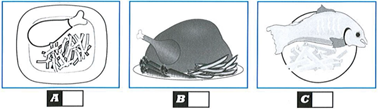
1. What will they eat? [A, B, C]
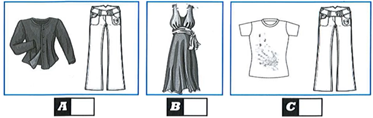
2. What will the girl wear to the party? [A, B, C]
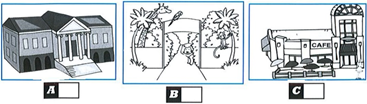
3. Where will the student’s tour of the city centre end? [A, B, C]
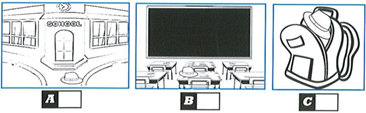
4. Where was the boy’s hat? [A, B, C]
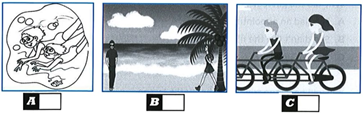
5. What will they do on Friday? [A, B, C]
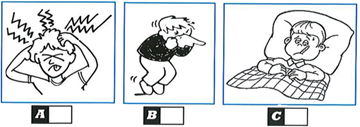
6. What was wrong with the boy? [A, B, C]
7. What is on special offer today? [A, B, C]

10
12 з 132 балів
Listening 2
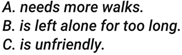
8. You will hear two friends talking about a neighbour’s dog. The boy thinks the dog [A, B, C]
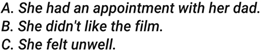
9. You will hear two friends talking about a film. Why did the girl leave the cinema early? [A, B, C]
10. You will hear two friends talking about the maths lesson. What do they agree on? [A, B, C]
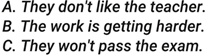
11. You will hear two friends talking about a school trip they went on. What happened? [A, B, C]
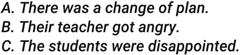
12. You will hear two friends talking about a football match. Who was the boy angry with? [A, B, C]

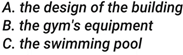
13. You will hear two friends talking about a new leisure centre. What did the boy like most about it? [A, B, C]
11
12 з 132 балів
Listening 3
20. Who inspired Carol to become a teacher? [A, B, C]
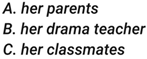
21. What is the most important thing about being a teacher, according to Carol? [A, B, C]
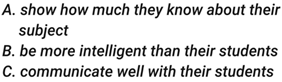
22. What does Carol have her students do if they aren’t working well? [A, B, C]
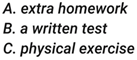
23. How does Carol feel about her career as a teacher? [A, B, C]
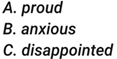
24. Carol’s parents [A, B, C]
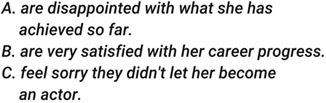
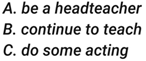
25. What does Carol want to do in the future? [A, B, C]
Рефлексія від 13 учнів
Сподобався:
0
Так: 13
Ні: 0
Зрозумілий:
0
Так: 11
Ні: 2
Потрібні роз'яснення:
0
Ні: 8
Так: 5