- Всеосвіта›
- Бібліотека тестів›
- Англійська мова›
- HS2 2019 unit4 p66

Тест:
HS2 2019 unit4 p66

08.11.2021

Вміст тесту:
1
2
3
4
5
6
7
8
9
10
11
12
Тест містить питання скопійовані з: HS2 2019 unit4 p66.
1
12 з 144 балів
1.Listen to the speakers. For questions 1 -6 choose the correct answer A, B or C. You will hear each recording twice.
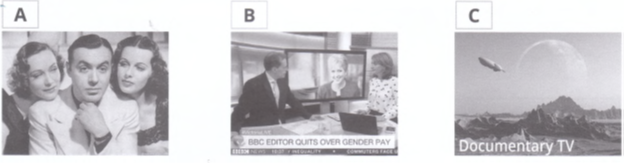
1 What would Malcolm prefer to watch? [A, B, C]
2 Where will Robert spend this evening? [A, B, C]
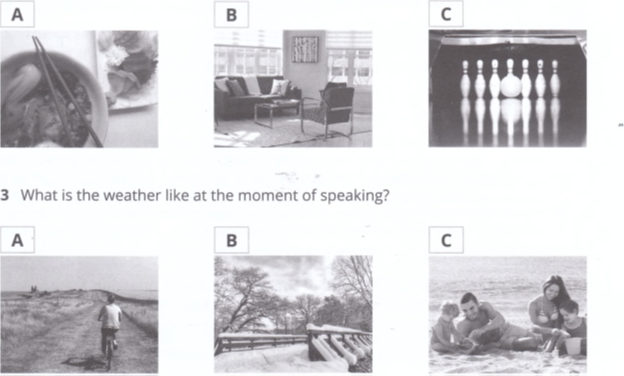
3. [A, B, C]
4 Why didn't Ben do well in his final exams? [A, B, C]
A The exams were too hard for him.
B He felt too tired during the exams.
C He hadn't prepared for the exams.
5 What is the boys' problem? [A, B, C]
A The air-conditioner needs repairing.
B The electric fan has not been fixed yet.
C The roof has been damaged by heat.
6 Why is Bob late today? [A, B, C]
A He was held up in a traffic jam.
B He got injured while riding a bike.
C He had a bad pain while walking.
2. Listen to the text. For statements 1 -5 choose T if the statement is true according to the text or F if it is false. You will hear the recording twice.
1 London schools gave the world's largest history lesson. [T, F]
2 The record lesson lasted for one hour. [T, F]
3 Michael Morpurgo feels very proud of his connection with the record. [T, F]
4 Some pupils of a primary school got a chance to go to the theatre for free. [T, F]
5 The record for the largest reading lesson was encouraged by the local press. [T, F]
2
12 з 144 балів
1.Read the notices below. Match the choices (A-H) to (1-6). There are two choices you do not need.
Where can you see these notices?
A In a bathroom of a hotel or airport.
B On a campsite
C In a bathroom
D In a bank
E In a shop
F In a school
G At the airport
H In a town
1. Closed for vocation. Lessons start on the 11th of January [A, B, C, D, E, F, G, H]
2. Please check in your baggage one hour before boarding time [A, B, C, D, E, F, G, H]
3. Price per night: $5 a person, $10 a car [A, B, C, D, E, F, G, H]
4. Discounts available. Casual outfits. Sale 50 % [A, B, C, D, E, F, G, H]
5. USE THE HAND DRYER [A, B, C, D, E, F, G, H]
6. You mustn`t cross the street here [A, B, C, D, E, F, G, H]
2.Read the text below. Fill in gaps 1-6 with choices A-H. There are two choices you do not need to use.
British men change careers
More and more British men are getting out of office jobs and retraining as teachers. According to a study by the Training and Development Agency for Schools (TDA), many of these men have female partners (1) [A, B, C, D, E, F, G, H], which makes it easier for men to change careers.
The TDA reports (2) [A, B, C, D, E, F, G, H], followed by science research, engineering, retail, social work and the police. The agency said (3) [A, B, C, D, E, F, G, H], while 31 percent did not enjoy sitting at a desk. Men also said that turning 30 or becoming a father had influenced their decisions.
Mike Watkins, director of teacher recruitment at the TDA, told The Guardian (4) [A, B, C, D, E, F, G, H], where teachers are needed. "It's easy to see why teaching is the top choice for a career change," Watkins said. He also added that (5) [A, B, C, D, E, F, G, H], working with children creates a dynamic, vibrant environment (6) [A, B, C, D, E, F, G, H].
A. that many new teachers choose mathematics and science
B. as well as demanding jobs of their female colleagues
C. that 41 percent of men questioned were tired of office politics
D. in which no two days are the same
E. in which teaching had never been easy
F. who earn as much as or more than they do
G. as well as providing attractive financial and lifestyle benefits
H. that teaching is the most popular profession for retraining
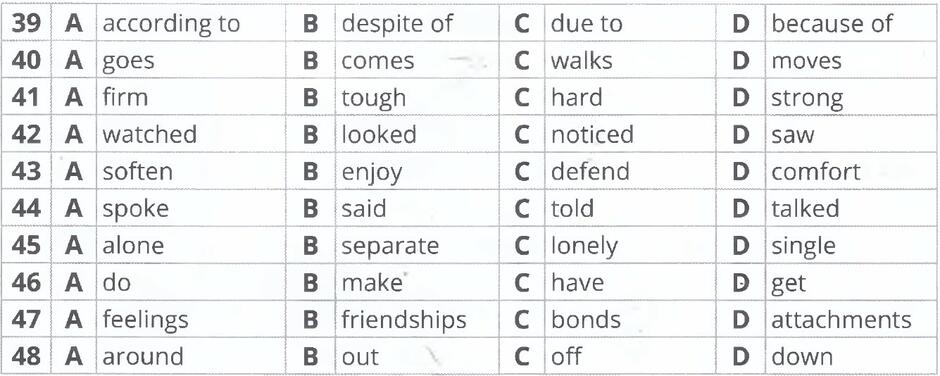
3. Read the text below. For gaps 39-48 choose the correct answer A, B, C or D.
Just like us? Elephants comfort each other when they are stressed out
Elephants have long had a reputation for good memories. Now, (39) [A, B, C, D] a new study from Emory University and Think Elephants International, the giant animals are also pretty good when it (40) [A, B, C, D]to empathy.
The researchers observed 26 elephants held in an elephant camp in northern Thailand for over a year. They did not try (41) [A, B, C, D]to stress out the elephants but rather waited for something stressful to naturally occur (a surprising sound, for example) and then (42) [A, B, C, D]what happened next. In short, the elephants were more likely to sympathise during stressful times than during other periods.
Researchers found that elephants are able to sense when other elephants are stressed and will often (43) [A, B, C, D]them with a vocal response or physical contact such as a trunk touch.
Lead researcher Joshua Plotnik of Emory University (44) [A, B, C, D]Discovery News that the physical gestures "may be sending a signal of'I'm here to help you, not hurt you.'"
As for the vocal calls, Plotnik told Discovery, "I've never heard that vocalization when elephants are (45) [A, B, C, D]." He continued, "It may be a signal like, 'Sshhhh, it's OK,' the sort of sounds a human adult might (46) [A, B, C, D]to console a baby."
Co-author Frans de Waal said, "With their strong social (47) [A, B, C, D], it's not surprising that elephants show concern for others. This study demonstrates that elephants get distressed when they see others in distress, reaching out to calm them (48) [A, B, C, D], the same way as chimpanzees or humans embrace someone who is upset."
3
12 з 144 балів
Complete the phrases:
1. goods
2. to a fuss
3. to buy smth a shop
4. to work
5. quality
6. be fit for the
7. a refund
8. to be entitled to some
9. to come
10. to a reasonable settlement
11. that were out to you
12. to be
Запитання №4 На встановлення відповідності
Запитання №5 На встановлення відповідності
Запитання №6 Із заповненням пропусків у тексті
Запитання №7 З вибором правильної відповіді у тексті
Запитання №8 З вибором правильної відповіді у тексті
Запитання №9 З вибором правильної відповіді у тексті
Запитання №10 Із заповненням пропусків у тексті
Запитання №11 З вибором правильної відповіді у тексті
Запитання №12 Із заповненням пропусків у тексті
Рефлексія від 14 учнів
Сподобався:
0
Так: 10
Ні: 4
Зрозумілий:
0
Так: 10
Ні: 4
Потрібні роз'яснення:
0
Ні: 9
Так: 5
