- Всеосвіта›
- Бібліотека тестів›
- Англійська мова›
- HS1 2021 Unit3 p40 act20

Тест:
HS1 2021 Unit3 p40 act20

13.11.2021
Вміст тесту:
1
2
3
4
5
6
7
8
1
12 з 96 балів
Read the definition and write down the words. Use aritcles and particles to where necessary.
1.a person who plays the drums
2.a person who controls an orchestra
3.a person who composes music, usually classical music
4.a singer who supports the lead singer and is usually placed in the back
5.a kind of song or a tune that gets stuck in one's head
6.the main singer in a band or a group
7.a part of the concert hall where artists perform
8.in perfect health
9.very clear or easy to understand
10.to talk or chatter
11.something pleasing to hear about
12.to receive punishment
13.everything included
14.to change the behaviour or attitude
15.to boast of your achievements and abilities
2
12 з 96 балів
Listen to the audio and put the musical instruments in order of their appearance.
A flute
A violin
A drum
A guitar and a harmonica
a saxophone
A piano
A cello
3
12 з 96 балів
Choose the correct tense indicators to the following tense forms of the verb:
Present Simple [Yesterday, Usually, Soon]
Past Simple [Recently, The other day, Lately]
Future Simple [Every week, A week ago, In a week]
Present Continuous [At that moment, At the moment, A moment ago]
Past Continuous [The whole day yesterday, Yesterday, The day before yesterday]
Present Perfect [Recently, The other day, Soon]
Past Continuous [While, As soon as, If]
Present Perfect Negative [Recently, Just, Yet]
Future Simple [The day after tomorrow, The day before tomorrow, The day in tomorrow]
Present Continuous [Still, Soon, So]
Past Simple [The day after yesterday, The day before yesterday, The day in yesterday]
Present Simple [Still, Seldom, Soon]
Present Perfect [Every week, This week, Last week, Next week]
Present Perfect [Always, At that moment, It's the second time...]
4
12 з 96 балів
1. Our uncle is fit as a fiddle. He (to run) on the playground the whole evening yesterday. I can’t imagine anybody who can be so strong.
2. Our little brother (to play) the drums the whole day yesterday and (to face) the music for that. He cried a bit and (go) for a walk somewhere.
3. We have just listened to the lecture about old-fashioned guitars, but everything (to be) clear as a bell. Nobody asked any questions.
4. Next weekend our little cousin (to play) the piano at the concert and it (to be) music to our ears to listen to her.
5. Their aunt always (to blow) her own trumpet. She says that she plays the harp greatly but no one has ever heard how she plays.
6. If you (not to change) your tune, you’ll be punished.
7. While Tom (to look) for his cello, his mother (to make) chin music with somebody.
8. Nobody (to be) intrested in that film, so everyone started to speak, to browse the Internet and all that jazz.
5
12 з 96 балів
Complete the sentences. Choose one of the words in the box
everybody somebody anybody nobody
everything something anything nothing
everywhere somewhere anywhere nowhere
1. This bag is empty, there isn’t ___ in it.
2. I’m lonely. I have __ to talk to.
3. I lost my watch. I’ve looked for it _ .
4. She said ___ , but I didn’t understand her.
5. Did you go __ interesting for your vacation?
6. I like the people here. __ is very friendly.
7. ’What are you doing here? ’ ’I’m waiting for __ .’
8. It’s a secret. Don’t tell __ .
9. We don’t go out very much, because there’s __ to go.
10. ’How much does it cost to visit the museum?’ ’__ . Why?’
11. They live __ in the south of France.
12. It’s a nice hotel. It’s comfortable and __ is clean.
6
12 з 96 балів
Choose the correct variant:
1. In some countries today there’s only one party at elections. No … [a, b, c, d]at all!
a) choose b) chose c) chosen d) choice
2. - Do you think we’re created equal? – No, not … [a, b, c, d] all.
a) in b) over c) at d) to
3. Your explanation … [a, b, c, d]reasonable.
a) is not sound
b) does not sound
c) is not sounded
d) is not sounding
4.Jupiter spins faster than … [a, b, c, d]planet.
a) any
b) any other
c) any others
d) any other’s
5. – I thought you bought a new pen yesterday. – Yes, I did but I’ve left it at home. Can I borrow … [a, b, c, d]for a moment?
a) the one of you
b) one of yours
c) one pen of your
d) the one of your pens
6. She cannot swim, and I can’t … [a, b, c, d] .
a) too b) neither c) either d) also
7. Put … [a, b, c, d] money in your pocket.
a) this b) those c) there d) these
8. I went to Madrid and stayed … [a, b, c, d] friends.
a) in house of b) by c) at d) with
9. I told them about it, but … [a, b, c, d] listened.
a) somebody
b) anybody
c) nobody
d) anyone
10.When I see Barbara in the street, she always … [a, b, c, d] at me.
a) smiled
b) has smiled
c) was smiling
d) smiles
11. Your friends won’t be here for long, ... [a, b, c, d]?
a) do they
b) will they
c) would they
d) won’t they
12. What’s … [a, b, c, d] the radio this morning?
a) about b) at c) on d) with
13.What’s her job? - … [a, b, c, d] nurse.
a) She’s
b) She’s a
c) Her jobs
d) Hers a
14. Some people … [a, b, c, d] eat meat.
a) do never
b) ever
c) don’t ever
d) never
15. I can wear the blue socks or the … [a, b, c, d] .
a) greys
b) grey ones
c) my grey ones
d) grey one
16. How … ? [a, b, c, d]
a) much tall are you
b) tall you are
c) you are tall
d) tall are you
17.Close the door … [a, b, c, d] : it’s cold here.
a) - b) up c) to d) on
18. I … [a, b, c, d]the Prime Minister’s speech very carefully.
a) heard to
b) heard
c) listened to
d) overheard
19. Don’t … [a, b, c, d] slowly.
a) walks b) walk c) to walk d) walking
20.The police haven’t ... [a, b, c, d] the car yet.
a) found b) find c) finded d) faund
21. Ask the girl … [a, b, c, d]sitting over there.
a) who’s
b) whose
c) who are
d) who
22. They’ve got three children, but I can’t remember … [a, b, c, d] names.
a) its b) them c) there d) their
23. TV programmes and records usually … [a, b, c, d] singers very popular.
a) makes b) making c) make d) is making
24. This man has a … [a, b, c, d] .
a) beard b) barber c) brows d) facehair
25. Laura got a … [a, b, c, d] new stereo for Christmas.
a) young b) kind c) feel d) brand
26. I live about twenty km … [a, b, c, d]here.
a) away of
b) away from
c) away for
d) near
27. Don’t talk to me now because I … [a, b, c, d]to understand what I am reading.
a) to try
b) try
c) am trying
d) trying
28. When do you usually arrive … [a, b, c, d] the office?
a) in b) to c) on d) at
29. - Have you got a lighter? - … [a, b, c, d] .
a) Yes, I have
b) Yes, I have got
c) That’s all right
d) Yes, I has.
30. … [a, b, c, d] class rushed into the dining room.
a) The all b) Whole c) The every d) The whole
31. He owes you a lot of money, … [a, b, c, d]?
a) isn’t it
b) doesn’t he
c) hasn’t he
d) has he
32.Friday is the … [a, b, c, d] day of the week.
a) five
b) fivth
c) fiveth
d) fifth
33. Have you read … [a, b, c, d] paper?
a) today
b) today’s
c) of today
d) in today
34. David has lived in Peru for ten years. – Yes, but he … [a, b, c, d] doesn’t understand Spanish.
a) already b) yet c) still d) anymore
35.Our people began this flight … [a, b, c, d] 1973.
a) from b) at c) since d) in
36.One of the windows of my car is very hard… [a, b, c, d] .
a) open b) to open c) opened d) opener
37. What did you want to talk about, Bill? – I’m considering … [a, b, c, d] home.
a) go
b) going
c) to go
d) about going
38.The nations of the world desire … [a, b, c, d] .
a) peace b) a peace c) piece d) a piece
39. Listen! The telephone … [a, b, c, d] .
a) ring b) rings c) is ringing d) ringing
40.They moved to Manchester… [a, b, c, d] May 17.
a) on b) at c) in d) with
41. … [a, b, c, d] loves her, she is so sweet.
a) All people
b) All the people
c) Everybody
d) Nobody
42.I … [a, b, c, d] old clothes when I’m working in the garden.
a) wear b) carry c) dress d) do on
43. We usually go there once … [a, b, c, d] .
a) the week
b) a week
c) all weeks
d) in the week
44. Have you been to New York? - … [a, b, c, d] .
a) Until now not
b) Not yet
c) Still not
d) Yet not
45. Don’t ask me for information: I haven’t got … [a, b, c, d] .
a) one b) any c) some d) them
7
12 з 96 балів
Reading
Task 1.
Read the texts below. Match choices (A-H) to (1-5). There are three choices you do not need to use.
1. [A, B, C, D, E, F, G, H]This is a ninety minutes cartoon, which is entertaining for both adults and children over six. There's romance, action, comedy, music and lots of fantastic songs and dances.
2. [A, B, C, D, E, F, G, H]This is a full-blooded magnificently written portrait of history's most fascinating woman. The novel is full of dramatic twists and turns of Elizabeth I - her tragic childhood, her confrontation with Mary, Queen of Scots, and her brilliant reign.
3. [A, B, C, D, E, F, G, H]The young woman is shown in a "shepherdess" hat and white dress, recalling a classical chiton. The painters colour range is based upon subtle plays of gray and green, light blue and pink.
4. [A, B, C, D, E, F, G, H]In this picture one is struck by the artist's absolute mastery in portraying natural details, whether the dry, sandy soil of the forest, the clear stream of water in the foreground, the yellow bark and fluffy needles or the pines. The artist managed to create an image familiar to anyone who has seen a Ukrainian forest.
5. [A, B, C, D, E, F, G, H]Have a good time on the most lively and exciting island in the Caribbean. Relax under a palm tree on the white sandy beaches. Swim in the clear, blue sea. Listen to the bands playing Calypso music. Join in the many cultural celebrations we offer, for example, the sugar harvest festival.
A Musical Performance
B Attractive Landscape
C Perfect Holidays
D Portrait of a Girl
E Film for All Ages
F Exciting Hobby
G Colourful Festival
H Interesting Book
Task 2
Read the text below. For questions (1-5) choose the correct answer (A, B, C or D).
Every week, Dr Doppit goes round the wards at the children's hospital. But instead of a white coat and a stethoscope, Dr Doppit has a red nose and carries balloons. She is the hospitals "clown doctor” and her real name is Hilary Day.
After studying drama at university, Hilary saw an advert for a clown doctor at the hospital. "The job was perfect for me, she says. "My mother and grandmother were both nurses, so caring for people is in my blood. Also, I love doing children's theatre"
Before she started, Hilary did four weeks training, where she learnt how to do magic tricks and make balloons into funny shapes. She also had to study child psychology and basic medicine.
Her visits to the hospital start with a meeting with the nursing stuff to find out which patients a visit will be most useful for. Most children are delighted to see a clown, but there are some who are too ill, or are afraid of clowns. Hilary always checks first. Then she does some magic, makes balloon animals or tells them a story.
We know that laughing can have a positive effect on a person's health, says Hilary. "It produces chemicals in the brain that make you relax and feel better. Everyone agrees that regular visits from Dr Doppit can make a big difference to a child's recovery. "Children in hospital miss their everyday life at home and at school, says one hospital manager. "As well as possibly being frightened and homesick they are often bored. The clown doctor gives them something to look forward to and happy memories to take home afterwards.”
1.What is the writer's aim in this text? [A, B, C, D]
A To describe a typical day in a children's hospital.
B To explain a method of helping young patients.
C To encourage doctors to learn some circus skills.
D To show students how to get a job in a hospital.
2.Why was Hilary particularly suitable for the job of a clown doctor? [A, B, C, D]
A She had studied medicine at university.
B She already knew how to do magic.
C She enjoyed working with children.
D She had been a nurse in a hospital.
3.Before Hilary starts, the stuff tell her which children [A, B, C, D]
A have asked to see her.
B are going to leave the hospital soon.
C want to hear a particular story.
D will benefit most from her visit.
4.The hospital manager thinks that Dr Doppit's visits [A, B, C, D]
A are useful if the parents can’t visit.
B help children get better more quickly.
C might be frightening for some children.
D help the children forget they stay in hospital
5.What can Dr Doppit influence? [A, B, C, D]
A Parents behavior
B Nurses' work.
C Kids getting better.
D Hospital manager’s decisions.
Task 3. Read the texts below. Match choices (A-H) to (1-6). There are two choices you do not need to use.
1. [A, B, C, D, E, F, G, H]Rooked in the monolithic hierarchy of caste, poverty remains a harsh fact of life for around forty per cent of India’s inhabitants. No other nation on earth has slum settlements on the scale of those in Delhi, Mumbai and Calcutta.
2. [A, B, C, D, E, F, G, H]Urban Australians celebrate the typical New World values of material self-improvement through hard work and hard play, with an easy-going vitality that visitors, especially Europeans, often find refreshingly hedonistic.
3. [A, B, C, D, E, F, G, H]Industrialized at lightning speed, Japan shed its feudal trappings to become the most powerful and outwardly aggressive country in Asia in a matter of decades.
4. [A, B, C, D, E, F, G, H]After trekking and rural relaxation, most visitors want to head for the beach - and Thailand's eastern and southern coasts are lined with gorgeous white-sand shores, aquamarine seas and kaleidoscopic reefs. The most popular of these are the east coast backpackers' resorts of Ko Samet and Ko Chang.
5. [A, B, C, D, E, F, G, H]Brunei is more expensive than neighbouring Malaysia or even Singapore- hotel prices in the capital are at least double those in nearby Kota Kimabalu or Miri. Most travellers end up in Brunei either because of an enforced stopover on a Royal Brunei Airlines flight, or as a stepping stone to either Sabah or Sarawak.
6. [A, B, C, D, E, F, G, H]The original Banana Republic, a byword for corruption and poverty, Honduras is all too often overlooked by foreign tourists. Many of those who do make it here head straight for the ruins of Copin, one of the finest Maya sites in the region.
In which place can tourists ______?
A relax on the white-sand shores
B see the most powerful and industrialized country
C visit the ruins of Copin
D see slum settlements
E meet people appreciating typical New World values
F enjoy the land of volcanic islands
G find the life very expensive
H buy everything from perfume to furniture
8
12 з 96 балів
Listening
Task 1. You will hear five short conversations. For questions 1-5 choose a, b,or c.
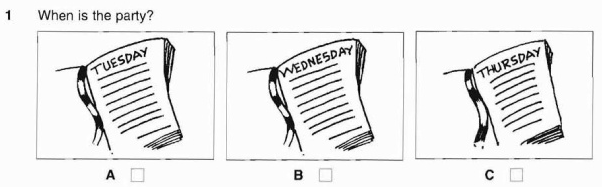 [a, b, c]
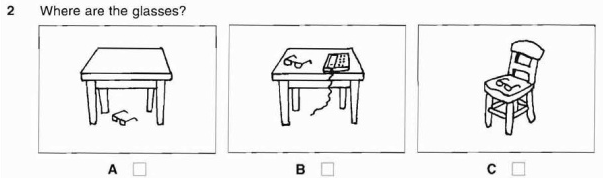 [a, b, c]
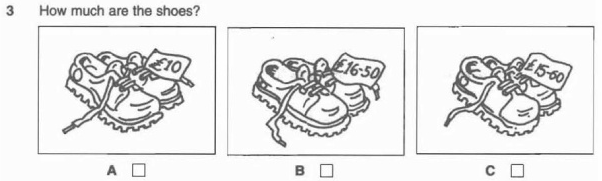 [a, b, c]
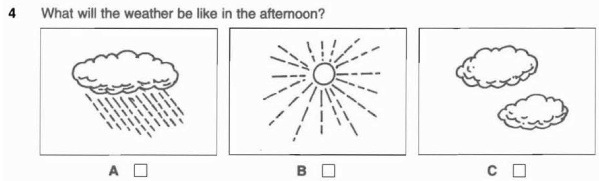 [a, b, c]
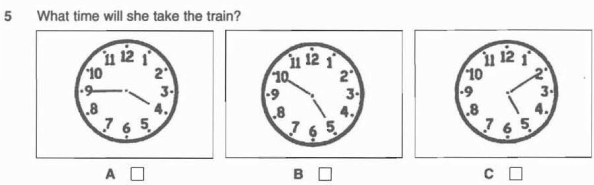 [a, b, c]
Task 2. Listen to Teresa talking to Paul about presents for his family. What is she going to buy for each person?
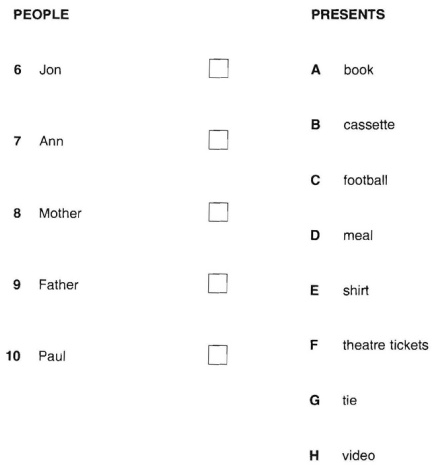
6. [a, b, c, d, e, f, g, h]
7. [a, b, c, d, e, f, g, h]
8. [a, b, c, d, e, f, g, h]
9. [a, b, c, d, e, f, g, h]
10. [a, b, c, d, e, f, g, h]
Task 3. Listen to Carlos asking for information about a library. For questions 11-15 choose a, b or c.
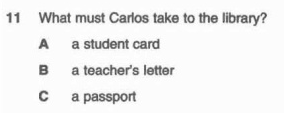 [a, b, c]
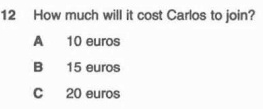 [a, b, c]
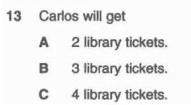 [a, b, c]
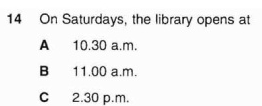 [a, b, c]
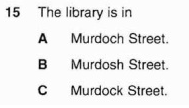 [a, b, c]
Рефлексія від 0 учнів
Сподобався:
0
Так: 0
Ні: 0
Зрозумілий:
0
Так: 0
Ні: 0
Потрібні роз'яснення:
0
Ні: 0
Так: 0