- Всеосвіта›
- Бібліотека тестів›
- Англійська мова›
- HS1 2021 unit10 p220 act63(summary test)

Тест:
HS1 2021 unit10 p220 act63(summary test)

14.06.2022
Вміст тесту:
1
2
3
4
5
6
7
8
9
10
11
12
13
Тест містить питання скопійовані з: HS1 2021 unit10 p199 act8, HS1 2021 unit10 p201 act14, HS1 2021 unit10 p205 act23, HS1 2021 unit10 p213 act47 , HS1 2021 unit10 act57 p217 , Listening+phrasal verbs.
1
12 з 156 балів
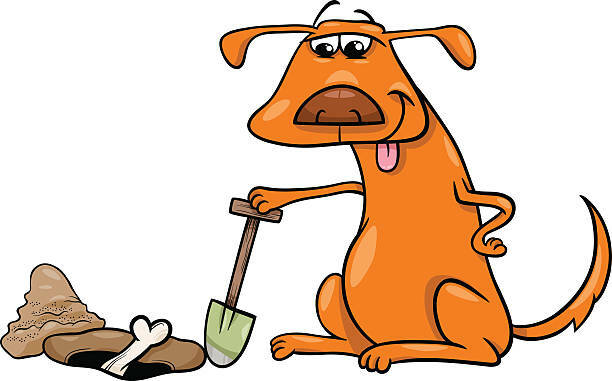
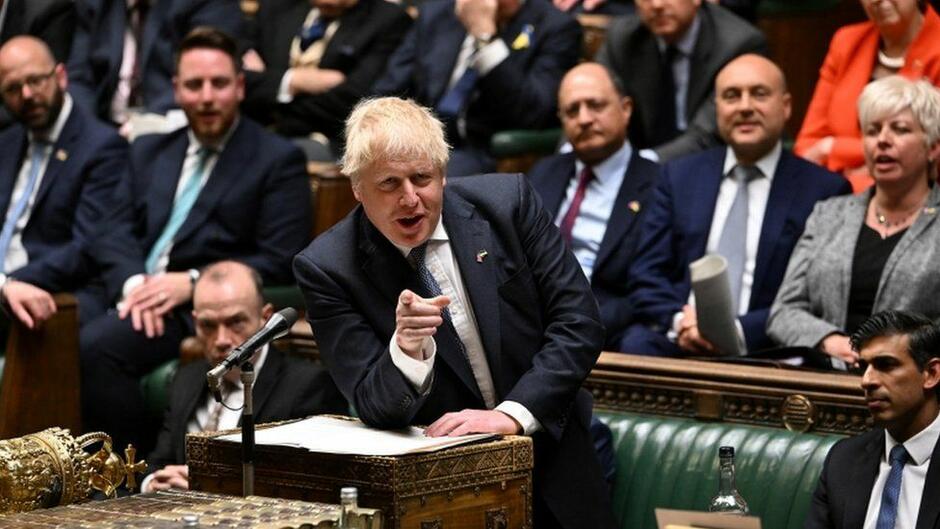
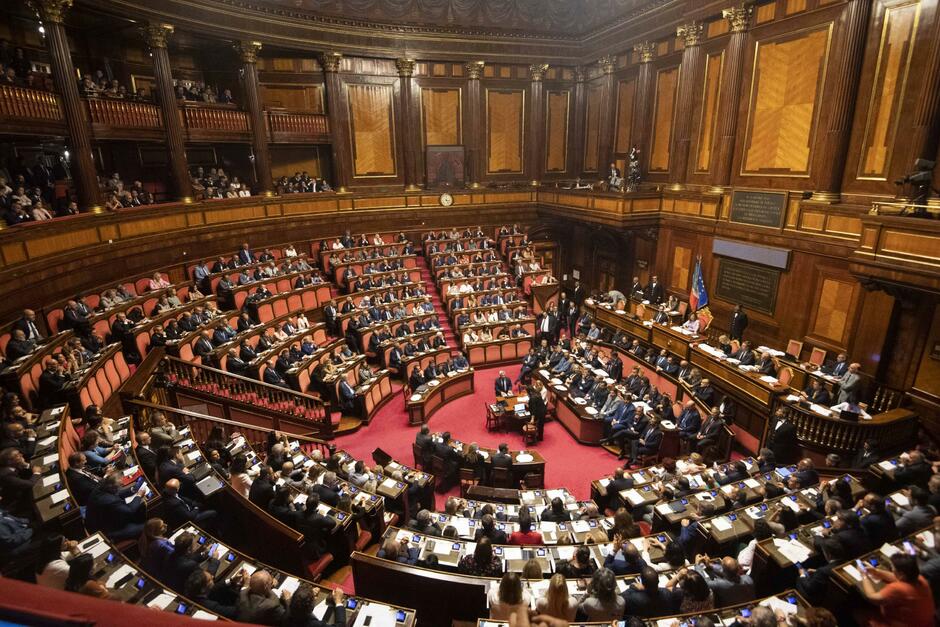
Match the word and the picture.
1
to surround
А

2
a thistle
Б
3
a fortress
В
4
to bury
Г

5
to separate
Ґ

6
leek
Д
7
daffodil
Е

8
shamrock
Є

9
a politician
Ж

10
an election
З

11
a government
И

12
сuisine
І

2
12 з 156 балів
Translate
1.будяк
2.нарцис
3.цибуля-порей
4.трилисник
5.кухня
6.більшість
7.уряд
8.згадувати
9.відділяти, відокремлювати
10.оточувати
11.хоронити, заривати
12.вибори
3
12 з 156 балів
Complete the sentences with the words from the box.
a cuisine | leek | majority |
government | honour | election |
to bury | surrounded | separate |
to mention | a thistle | a daffodil |
1. At this time of year, one walks into a village and sees blooming under an oak. What a beautiful yellow flower!
2. A large of the employees have university degrees.
3. The English, they do not have , my friend. I am not sure of their favourite dish.
4. I wanted to tell you about my boyfriend at home, it is better not him here at the party.
5. You must her the Queen of England! If you don't, it is highly disrespectful.
6. President Trump won the once. Hopefully, it will never happen again.
7. You should meat from other food in the fridge.
8. The house is by trees, so it's not overlooked at all.
9. is the national emblem of Scotland.
10. I never add any to my salad. It is disgusting to me.
11. The dog was running all around, it clearly wanted the bone somewhere.
12. The is spending millions of dollars in its attempt to combat drug abuse.
4
12 з 156 балів
Word formation.Choose the appropriate word from the box and fill in the gaps in the sentences:
1) A [politics, political, politician]works in politics, especially as an elected member of the government.
2) People in a [social, society, sociable]live together and share the same customs, laws, etc.
3) A [national, nationality, nation]is a large group of people of the same race and language.
4) Being [sociable, social, unsociable]means disliking to meet people or to spend time with them.
5) People who work in the government and public affairs of a country are connected with [multinational, political, politics]sphere.
6) Someone who is [sociable, social, unsociable]is friendly and enjoys being with other people.
7) Companies that involve people from different countries are called [multicultural, national, international].
8) Companies need to invest in [social, sociable, unsociable]networks such as Facebook and Twitter to make them work for them.
9) London is a truly [international, multinational, national]city, there you can meet people from all over the world.
10) If you have the [national, nation, nationality]of a particular country, you were born there or have the legal right to be a citizen.
5
12 з 156 балів
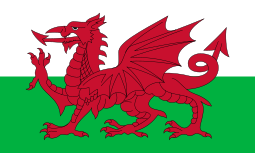
Match
1
А
the flag of Scotland
2

Б
the floral symbol of Nothern Irelend
3

В
the capital of Wales
4
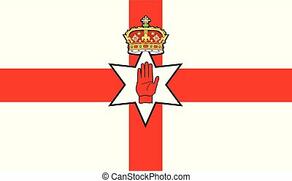
Г
the floral symbol of England
5

Ґ
the capital of England
6
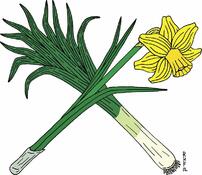
Д
the flag of Wales
7

Е
the capital of Scotland
8
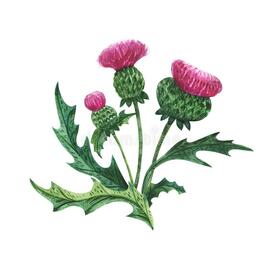
Є
the floral symbol of Scotland
9
Belfast
Ж
the flag of England
10
Ediburgh

З
the flag of Nothern Ireland
11
London

И
the capital of Nothern Ireland
12

І
the floral symbol of Wales
6
12 з 156 балів
Checking the knowledge of all the parts of Great Britain.
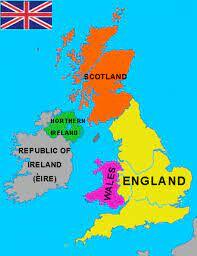

1.A country where the filming of "Drakula Untold" and "Game of Thrones" took place [England, Scotland, Wales, Nothern Ireland]
2.A unicorn is a symbol of [England, Scotland, Wales, Nothern Ireland]
3.A lion is a symbol of [England, Scotland, Wales, Nothern Ireland]
4. A kilt and a bagpipe are national symbols of [England, Scotland, Wales, Nothern Ireland]
5.The legend of Loch Ness monster is told in [England, Scotland, Wales, Nothern Ireland]
6.Saint Patrick is the patron saint in [England, Scotland, Wales, Nothern Ireland]
7.This country was a place of conflict and a dangerous place for a long time [England, Scotland, Wales, Nothern Ireland]
8.A shamrock is the floral symbol of [England, Scotland, Wales, Nothern Ireland]
9.Choir singing is very popular in [England, Scotland, Wales, Nothern Ireland]
10.Choose that place which The Tower of London has never been [a fortress, a library, a palace, a prison, a museum]
11.Fish and chips is a traditional [English, Scottish, Welsh, Irish]food
12.People eat a lot of lamb in [England, Scotland, Wales, Nothern Ireland]
7
12 з 156 балів
Match the words to their translation
1
suggestion
А
дозвіл
2
permision
Б
заборона
3
obligation
В
відсутність
4
request
Г
пропозиція
5
prohibition
Ґ
уряд
6
ability
Д
вибори
7
absence
Е
більшість
8
necessity
Є
ймовірність
9
probability
Ж
обов'язок
10
an election
З
здатність, спроможність
11
a government
И
необхідність
12
majority
І
прохання
8
12 з 156 балів
Choose the function of the modal verb according to the sentence.
1,You must watch this marvelous fantasy film! I`m sure you will enjoy it! [advice, strong advice, reproach]
2.You should have done the washing up better. Look! It is still dirty enough [advice, strong advice, reproach]
3. Steven could have helped his wife with that amount of housework. [advice, strong advice, reproach]
4. I can`t find Simon. He must have already gone home. [reproach, ability, probability(very probable)]
5.I think your daughter ought to study more. [probability, reproach, advice]
6.Mag shouldn`t have bought those awful tight overalls! Look at her! They don`t fit her at all! [advice, strong advice, reproach]
7.We needn`t buy milk and sugar. We have enough of them. [prohibition, advice, absence of necessity]
8.Visitors mustn`t walk on the flower beds and pick flowers in the park. [prohibition, mild prohibition, strict prohibition]
9.The editor says that we won`t have to do this work. [absence of necessity, lack of obligation, prohibition]
10.Can I use your phone? - No, you can`t. [lack of obligation, prohibition, strict prohibition]
11.Shall I repeat it for you? [friendly offer, reproach, ability]
12.We couldn`t do this work yesterday, that`s why we have to do it today. [absence of necessity, obligation due to the situation, reproach]
9
12 з 156 балів
Choose the appropriate modal verb.
1. You … [can, may, must]go and watch this magnificent drama at the theatre.
2. Your blouse is dirty. You … [must, should, shouldn`t] have poured your coffee when you were drinking.
3. If you want to get a good mark at the exam, you …. [should, ought, must]to study hard.
4. It was terribly difficult to clean the whole attick. Rick… [can, may, could]have helped me
5. Their cat has got lost. It … [must, could, shouldn`t]have got out when they were leaving for work and opened the door.
6. I didn`t know that there were tickets for the concert of my favourite group. You … [must, could, can] have told me about it.
7. Children …. [oughtn`t, mustn`t, don`t have to]drink coffee.
8. If you wanted to be dressed to kill, you … [must, should, can`t]have chosen your accessories more carefully.
9. I think Megan … [can, should, must]wear a red leather belt to the dress and a red handbag to match her high-heeled shoes.
10. Tim … [should, shouldn`t, must, can`t]have put on that awful polka-dot tie. It looks awful!
11. Susan always wears those extremely short dresses and high-heeled shoes. I think she … [may, has to, can, should] be more modest.
12. You have been at home the whole day and the flat is so untidy. You … [can, must, could] have done at least the washing up.
10
12 з 156 балів
Match the definition to the appropriate phrasal verb
1
to become well again after an illness or deal with something
А
to get through
2
to manage to do or complete something
Б
to get through to
3
to remove or throw away something unwanted
В
to get over
4
to succeed in talking to someone on the phone
Г
to get on with
5
to finally start doing something that needs a lot of time or energy
Ґ
to get rid of
6
to not be caught or punished when you have done something wrong
Д
to get away with
7
to have a friendly relationship
Е
to get down to
11
12 з 156 балів
Choose the correct preposition.
1. You will get [over, through, away with] the illness more quickly if you relax.
2. Everyone thinks he's guilty of the robbery, but it looks like he's going to get [down to, away with, through to] it.
3. I've got a lot of work to do, so let's get [down to, away with, rid of] it.
4. I don't really get [through, down to, along with] my sister's husband.
5. Can you get [away with, through to, over] our boss? I have an important message for him.
6. She got [through to, rid of, through] her exams without too much trouble.
7. It's time to get [rid of, down to, over] this old sweater.
8. It took him years to get [along with, away with, over] the shock of his wife`s dying.
9. The meeting's not due to start for another five minutes but we're all here, so let's get [rid of, down to, over] business.
10. She doesn’t get [on with, through to, away with] ____ her father.
11. He has got [down to, rid of, through] his exams successfully.
12. Governments should be encouraged to get [through to, rid of, along with] all nuclear weapons.
12
12 з 156 балів
Listening
Part I
Questions 1-7
There are seven questions in this part.
For each question, there are three pictures and a short recording.
Choose the correct letter with the correct picture to it.
Example: What will the girl buy from the shop?
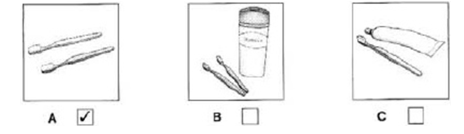
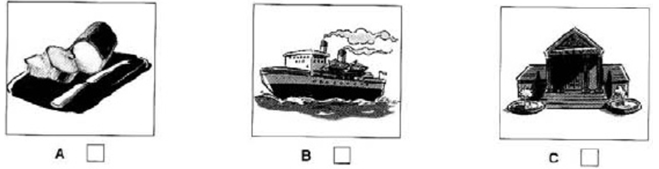
1. What will the boy do first? [A, B, C]
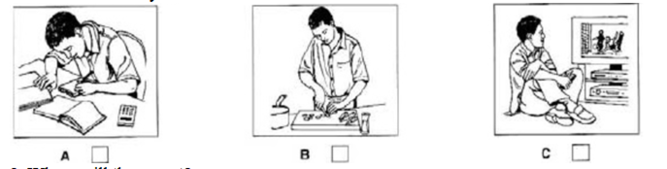
2. Where will they meet? [A, B, C]
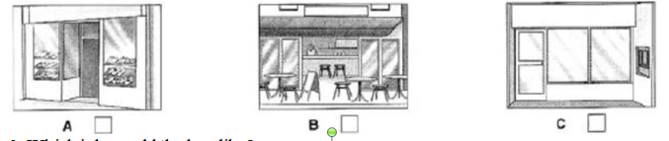
3. Which job would the boy like? [A, B, C]
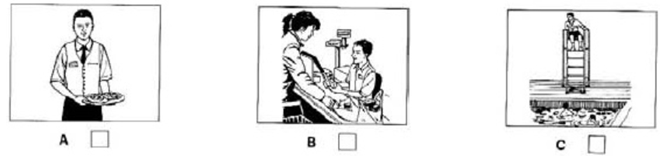
4. On which date will the boy have his next guitar lesson? [A, B, C]

5. What did the girl like best about her school trip? [A, B, C]
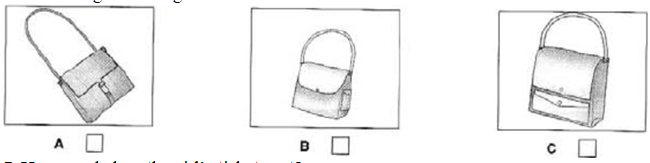
6. Which bag does the girl borrow? [A, B, C]
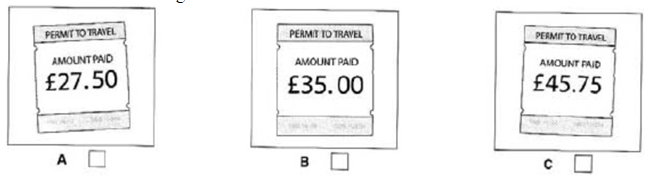
7. How much does the girl’s ticket cost? [A, B, C]
Part II
Questions 8-13
You will hear a teenager called Ella Subiotto talking on the radio about her life as a young violin player.
For each question, choose the correct answer A, B, or C.
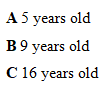
8. Ella won a music competition when she was [A, B, C]
9. Who persuades Ella to practice as much as possible? [A, B, C]
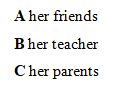
10. What does Ella do to improve her playing? [A, B, C]
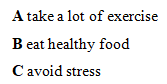
11. Ella would like other teenagers to [A, B, C]
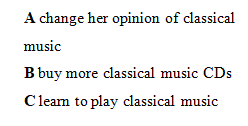
12. What does Ella enjoy doing most in her free time? [A, B, C]
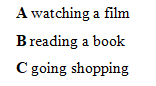
13. What other career is Ella interested in having? [A, B, C]

13
12 з 156 балів
Reading
Read the text below. Choose from (A-H) the one which best fits each space (33-38). There are two choices you do not need to use.
For some, the advent of television marked the beginning of the end of civilized society. More and more, people have watched TV at the cost of playing cards or board games, or other communal pastimes. Many fear that the Internet too will further limit social interaction.
That may be true but, as researchers at Stanford University in the USA are the first to say, further study is needed. In a recent survey they found that the Internet and the use of e-mail (33)_____________ [A, B, C, D, E, F, G, H]. What's more, people who go online are likely to watch less television than others.
The study makes two things clear. Contrary to all the fuss in the media, the Internet's popularity is still in its infancy. More than half of US households are not connected yet, but (34)___________ [A, B, C, D, E, F, G, H].
Workers may be using the Web on the job for such personal ends as checking sports scores but, according to the study, (35)________ [A, B, C, D, E, F, G, H] . Just 4 per cent of the surveyed Internet users said they had cut back on their working hours since getting connected to the Internet.
But will the Internet make us more isolated socially? While a fourth of the Internet users say they spend less time talking on the telephone with friends and relatives, (36)____________ [A, B, C, D, E, F, G, H] to stay in touch, regardless of distance. Since e-mail is free and can be sent and received at any hour of the day, it has many built-in advantages. For some, it has actually revived the highly social art of letter writing. As for spending less time on the telephone, (37) ______________ [A, B, C, D, E, F, G, H] makes an overall decrease less and less likely.
Few would argue that the Internet has had a profound effect on the lives of many in its first decade of common use. But assessing its long-term impact is difficult. That's why for all the questions they raise, (38)_________________ [A, B, C, D, E, F, G, H]. If we don’t pay close attention to how we use the Internet, it will change our lives not just for better, but for worse.
A they also use the Internet to work from home
B the continuing boom in mobile phone use
C they also use it to buy and pay for
D studies such as Stanford's are so useful
E the Internet's potential impact on how we live and interact is enormous
F e-mail allows them
G have actually increased some forms of human interaction
H their phone bills are
Рефлексія від 4 учнів
Сподобався:
0
Так: 4
Ні: 0
Зрозумілий:
0
Так: 4
Ні: 0
Потрібні роз'яснення:
0
Ні: 3
Так: 1