- Всеосвіта›
- Бібліотека тестів›
- Англійська мова›
- HS1 2021 unit1 p10 act26

Тест:
HS1 2021 unit1 p10 act26

16.12.2021

Вміст тесту:
1
2
3
4
5
6
7
8
9
10
11
12
13
14
Тест містить питання скопійовані з: HS1 2021 unit1 act26 p10.
1
12 з 168 балів
Unscramble the words and words combinations. Mind the usage of article and particle "to".
1. prtcpt -
2. ttnd -
3. cmmn -
4. vrldd -
5. hctc schdl -
6. spr tm -
7. skp lssns -
8. cmbn wth -
2
12 з 168 балів
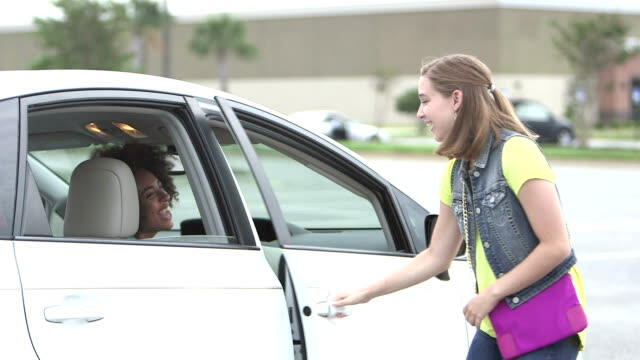
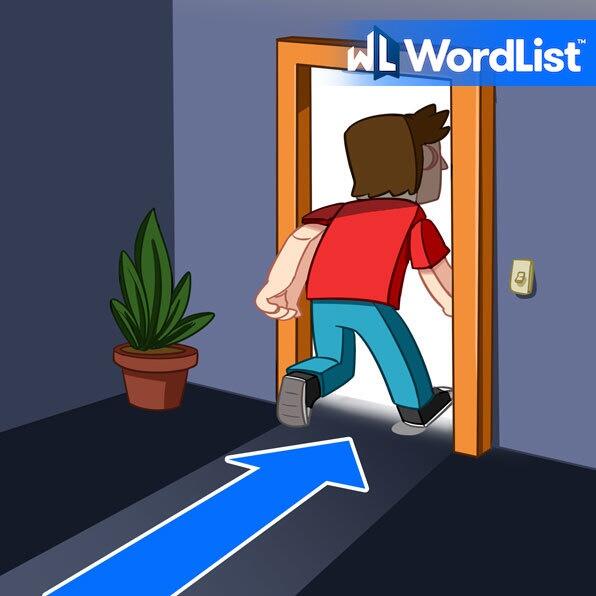
Match the pictures with the following word combinations.
1
To fully concentrate on smth
А

2
to sleep in/to oversleep
Б
3
to hang out with peers
В
4
to work on
Г

5
to go out
Ґ

6
to eat out
Д

7
to pick smb up
Е

8
to give up
Є

3
12 з 168 балів
Translate into English using the phrasal verb "to look" .
1. Наглядати за -
2. З нетерпінням чекати на -
3. Зневажати -
4. Шукати у словнику -
5. Проглядати -
6. Спостерігати -
7. Повторно оглядати -
8. Дивитися на -
9. Згадувати -
10. Шукати -
4
12 з 168 балів
Choose the correct variant
1. Can you look .... my pet goldfish for a few days while I am away on holiday? [after, for, on]
2. Children often look .... to Christmas from November onwards. [at, forward to, down on]
3. If I try to read an English book, I get frustrated because I have to look .... oo many words in the dictionary. [over, for, up]
4. She's always losing her keys and looking ...... them [at, for, after]
5. I look ....... on my childhood as the happiest part of my life [back, through, over]
6. She thinks they look .... her because she doesn't have a job. [up, after, down]
7. You may look .... the standard contract to learn more. [on, at, through]
8. When I'm camping, I look my shoes .... before I put them on. [over, down, up]
9. You know I've always dreamt of not having to look .... price tags. [on, at, down]
10. Billy didn't take part in the fight. He just looked .... . [through, down, on]
5
12 з 168 балів
Fill in the gaps with the prepositions in, on, at.
1. See you ..... Friday.
2. I brush my teeth .... the morning.
3. The match is .... 4 o'clock.
4. We have lunch .... midday.
5. My parents always visit me .... my birthday.
6. He usually goes on holiday .... July.
7. They always get together .... Christmas.
8. My birthday is .... the 6th of May.
9. I will meet her .... two months.
10. Come and see us .... Christmas Day.
11. My dream is to have breakfast at the seaside .... sunrise.
12. I will meet her .... two months.
6
12 з 168 балів
Choose the correct variant.
1. She has been sleeping .... 10 hours. [while, for, during]
2. I lived in London ... over two years. [for, while, during]
3. I met George .... my trip to Barcelona. [for, while, during]
4. The singer fell ill .... they were on tour. [while, for, during]
5. She gets up at 6 and meditates .... an hour before going to work. [for, while, during]
6. He scored a goal .... the second half of the match. [for, while, during]
7. She fell asleep .... the exam. [while, for, during]
8. Paul has been in a wheelchair .... most of his life. [for, during, while]
9. I met Sally .... I was on holiday in Scotland. [during, for, while]
10. We should travel .... we are still young. [while, for, during]
7
12 з 168 балів
Match the following question words with the appropriate answer
1
What
А
my cousin
2
Where
Б
a lot of accountants
3
When
В
the laptop
4
Who
Г
intelligent and helpful
5
Whose
Ґ
five times a month
6
How often
Д
at the concert
7
How many
Е
the famous singer
8
What time
Є
with our cashier
9
With whom
Ж
after the lesson at music school
10
Why
З
this talented teacher's students
11
What kind of
И
because they always make a wrong choice
12
Which of your relatives
І
at 7 o’clock every day
8
12 з 168 балів
Match the tenses and the formulae for the different types of the sentences.
1
Present Simple/affirmative
А
Shall/Will+S+V+SPS?
2
Present Simple/negative
Б
S+ have/has+ V(-ed/3d form)+ SPS.
3
Present Simple/interrogative
В
Have/has+S+V(-ed/3d form)+SPS?
4
Present Perfect/affirmative
Г
S+V(-s/-es)+SPS.
5
Past Simple/negative
Ґ
Did+S+V+SPS?
6
Past Simple/interrogative
Д
S+shall/will+V+SPS.
7
Future Simple/affirmative
Е
S+am/is/are+V+ing+SPS.
8
Present Perfect/negative
Є
S+did+not+V+SPS.
9
Future Simple/interrogative
Ж
Am/Is/Are+S+V+ing+SPS?
10
Present Continuous/affirmative
З
Do/Does+S+V+SPS?
11
Present Perfect/interrogative
И
S+has/have+not+V (-ed/3d form)+SPS.
12
Present Continuous/interrogative
І
S+do/does+not+V+SPS.
9
12 з 168 балів
Tick all the tense indicators of Past Continuous.
10
12 з 168 балів
Change the predicate of each sentence according to the tense indicator. Use the same verb!
1. The teacher wears a grey suit at school every day.
- The teacher a grey suit at school yesterday.
- The teacher a grey suit at school when I saw her.
- The teacher a grey suit at school tomorrow.
- The teacher a grey suit at school today.
- The teacher a grey suit at school now.
2. The tourists made a tour of Paris yesterday.
- The tourists a tour of Paris from morning till evening.
- The tourists a tour of Paris now.
- The tourists sometimes a tour of Paris .
- The tourists a tour of Paris lately.
- The tourists a tour of Paris next week.
11
12 з 168 балів
Open the brackets.
1. Many birds (to fly) south in winter.
2. Ken (hang out) with his peers now. He’ll come home soon.
3. Mandy usually (combine) study with work.
4. We (not wear) uniforms to school.
5. My father (to participate) in first football competition ten years ago.
6. When I (to arrive) home, Susan (to cry).
7. Luke and Tony (to fight) over Sheila at the pub last night.
8. Don’t Worry! The plane (to leave) in three hours. We’ve got lots of time!
9. Jenny (to be) back soon. You can wait for her if you like.
10. If you (to send) a letter today, she (to receive) it tomorrow.
11. Yesterday we (to choose) the new suits for the party.
12. I (to go) to the cinema after I (to finish) my homework.
12
12 з 168 балів
General Test 2
1.The pen is [out of, between, inside, among] the book and the file.
2.Bob [taking, takes, take, has taken] Susan to dinner at least three times this week.
3.Someone offers you a drink. You don’t want it. What do you say? - [thank you, please, no, thank you, no, please]
4. [Always Robert catches, Robert always catches, Robert catches always, Robert always catch] the bus to work.
5.They have been married [for, during, since, while] sixteen years.
6.Choose the correct question.
[Trouble may I you for a napkin?, I may you trouble for a napkin?, May trouble I you for a napkin?, May I trouble you for a napkin?]
7.I [call, will call, will calling, called] (to call) you when I [will come, come, will came, came] (to come) home?
8.Clark agreed [tells, telling, to tell, told] (to tell) me the truth.
9.I’ll go on holiday [as soon as, as, until, how]I can.
10.They [never see, are never going to see, have never seen, didn't see] our new transistor radio before.
11.I bought [a trouser, a pair of trousers, a trousers, the trouser] yesterday.
12.What does he do for a living? – He is [bus driver, a bus driver, bus’ driver, a bus’s driver] .
13.Mr Brown [sends, send, sent, have sent] me a very nice letter a few days ago.
14.She [found, find, finds, had found] a very amusing article in one of the newspapers yesterday.
15.They [participated, have participated, participate, are participating] in the competition now.
16.Take the juice [into, out of, out, between] the fridge.
17.They [have studied, had studied, study, studied]Spanish for about two years so far.
18. We eat [a, the, -, many]soup with [a, the, -, a] spoon.
19. I’m looking [at, for, after, on] my hat: I can’t find it anywhere.
20.I won’t go to Cambridge if it [rain, will rain, rains, raining] tomorrow.
21.How much time do you [make at, bring to, give up, spend on] your homework?
22.Do you know that woman? Yes, I know [hers, she, her, him] .
23.Why [don’t you got, haven’t you got, haven’t you get, haven’t got you] a car?
24.Your father usually has lunch at home [hasn’t, does, doesn’t, didn’t] he?
25. We know their address, but they don’t know [ours, their’s, our’s, our] .
26. I [go, have been, have go, went] to London several times.
27.Choose the sentence with the right word order.
[You easily can lose your friend’s trust., You can lose easily your friend’s trust., You can easily lose your friend’s trust., Easily you can lose your friend’s trust.]
28.The travel company made us [an, a, nothing, the] adventurous tour.
29.It’s cold outside. You have to dress up [warm, warmful, warmfully, warmly]
30.Put the butter [off, into, out, out to] the fridge.
31.We [will, can, are going, will be] to take a walk now.
32.We start [the, a, -, any] work at a quarter to nine.
33. I don’t know her very well, but my friends [do, does, did, are] .
34. He speaks neither English [or, both, nor, either] French.
35. I find that difficult to believe. Do you trust [his, me, my, their] ?
36.You and your wife have borrowed things and not given [I, their, they, them] back.
37.In that case just look at the table and tell [me, I, my, his] what you see.
38. The proud parents brought home [them, hers, their, she] new baby girl.
39.What is the name of that picture which you [are looking at, is looking at, look at, looks at] on the wall.
40.Why [is he be, is he, he is, we are]late every time we arrange to meet?
41. [I’ve often travelling, I’m not often travel, I’ll not often travelling, I don’t often travel] by air because the cost of flying is very high.
42. [I’m, I’ve, I’m not, I’ll] go if you like because I have to do some shopping.
43. I [shall, was, am, do] simply wait until she comes back.
44.I really hope I [shall, should, am, did] see you again.
13
12 з 168 балів
Reading
Read the texts 1-6. What does each text say? Choose the correct letter A, B or C.
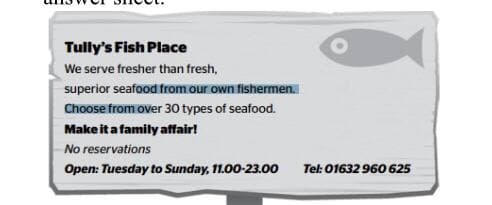
1. [A, B, C]
A. This place offers the best frozen seafood in the area.
B. You can’t book a table.
C. Tully’s Fish Place is open every day
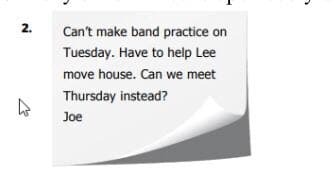
2. [A, B, C]
A. Joe is moving house.
B. Joe can’t make band practice this week.
C. Joe wants to change the band practice to a different day.
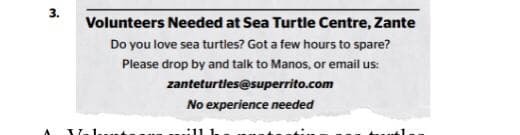
3. [A, B, C]
A. Volunteers will be protecting sea turtles.
B. Volunteers will have to work all day.
C. Manos will email the volunteers.
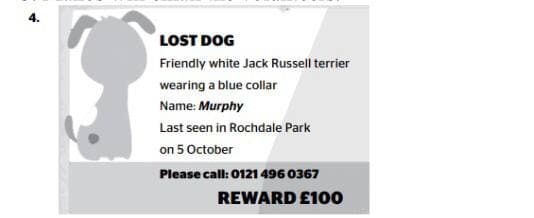
4. The person who placed this ad [A, B, C]
A. will pay £100 to buy a terrier.
B. was lost in Rochdale Park.
C. is looking for their pet.

5. [A, B, C]
A. You mustn’t leave children alone in the pool.
B. You must take a shower after swimming in the pool.
C. You can dive into the pool if you are over 12.

6. Why has Lucy written this postcard? [A, B, C]
A. to ask how Fiona is
B. to invite Fiona to join her and Martin
C. to tell Fiona how she’s spending her time away

Doctor, doctor...
Did you know that we forget about 80% of the medical information a doctor might give us? This interesting finding came to light as a result of a study carried out by Utrecht University. What is even more interesting is that almost half of what we think we remember is wrong. Why do you think this happens? Well, going to the doctor can make most people nervous, and when we are stressed we are more likely to concentrate on the diagnosis rather than on the treatment. Therefore, we know what is wrong with us but have no idea what to do about it. Here are some good tips to keep in mind when seeing a doctor. Always bring along a notepad to write down important pieces of information, such as how to take prescribed medication or how to prepare for any medical tests you might need.
What would be even better is if your doctor agreed to let you record him. In this way, you could replay his advice at home, where you are more likely to be able to understand it. If you believe the situation is serious or you’re really worried, get a family member or a close friend to come with you to listen in. Regardless of what you choose to do, there is one golden rule which you need to take into account. To communicate effectively, you need to ask the right questions. The Partnership for Clear Health Communication (PCHC) recommends you ask three questions every time you talk to a medical professional: ‘What is my main problem?’, ‘What do I need to do?’ and ‘Why is it important for me to do this?’ These will help you identify the problem and deal with it in a rational way.
7. Patients remember most of the medical information a doctor gives them. [A, B]
8. If patients feel nervous, it is likely they will forget the diagnosis. [A, B]
9. Patients should give the doctor a notepad so he can note down what he says. [A, B]
10. It may be easier for patients to make sense of a doctor’s advice if they listen to it at home. [A, B]
11. Friends or relatives should always accompany patients to the doctor. [A, B]
12. The PCHC suggests asking specific questions when visiting a doctor. [A, B]
14
12 з 168 балів
Listening
Watch a video about South Korean teenagers who are sent to digital detox boot camps. For questions 1 to 6, choose the correct option.
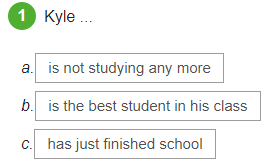 [a, b, c]
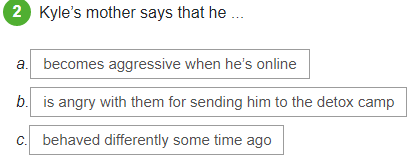 [a, b, c]
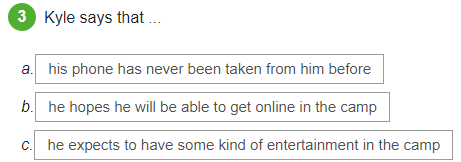 [a, b, c]
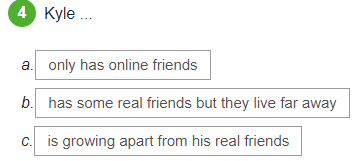 [a, b, c]
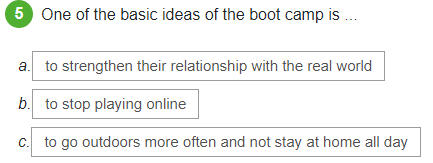 [a, b, c]
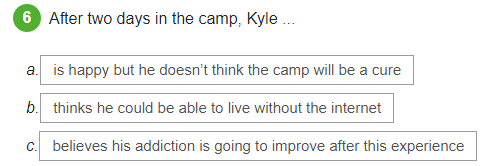 [a, b, c]
Watch an interview to a literary translator. For questions 1 to 7, decide if the statements are true or false.
 [True, False]
 [True, False]
 [True, False]
 [True, False]
 [True, False]
 [True, False]
 [True, False]
Рефлексія від 14 учнів
Сподобався:
0
Так: 12
Ні: 2
Зрозумілий:
0
Так: 11
Ні: 3
Потрібні роз'яснення:
0
Ні: 11
Так: 3