- Всеосвіта›
- Бібліотека тестів›
- Англійська мова›
- HS1 2021 act 5 p18

Тест:
HS1 2021 act 5 p18

17.09.2021

Вміст тесту:
1
2
3
4
5
6
7
8
9
10
11
12
1
12 з 142 балів
Match the words with the translation.
Words
Translation
1
to be fluent in
А
семестр
2
requirements
Б
завуч
3
in short
В
призначати
4
a class teacher
Г
скаржитись на
5
to assign
Ґ
вільно володіти чимось
6
a principal/a headmaster
Д
прогульщик
7
to allow
Е
вимоги
8
to complain about
Є
коротко
9
to fall behind
Ж
переглядати щось
10
to browse smth
З
предмети на вибір
11
optional subjects
И
довзоляти
12
a truant
І
відставати
13
a term
К
наймати репетитора
14
a head teacher
Л
класний керівник
15
to hire a tutor
М
директор
2
12 з 142 балів
Complete the words and phrases with the necessary letter or preposition.
1. short
2. a t m
3. to a n
4. re ments
5. to br e smth
6. a t t
7. to co about
8. to fall
9. to a tutor
10. a h teacher
11. to a
12. a pr
3
12 з 142 балів
Connect the beginnings and the ends of the phrases.
Beginnings
Ends
1
to set
А
a fire
2
to catch
Б
general cleaning
3
to make
В
a nap
4
to sort
Г
at one's leisure
5
to do smth
Ґ
up on housework
6
to have
Д
the country
7
to go to
Е
a picnic
8
to do
Є
out and do the laundry
9
to have/go for
Ж
up a tent
4
12 з 142 балів
Write the correspondent phrases to the pictures.
1.
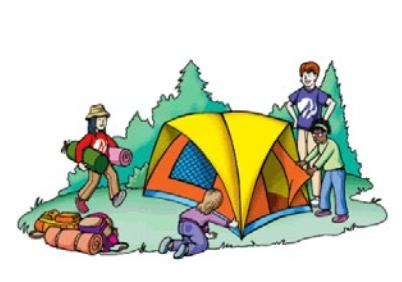
2.
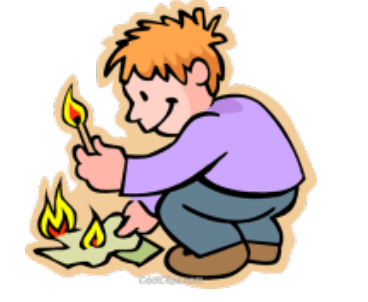
3.
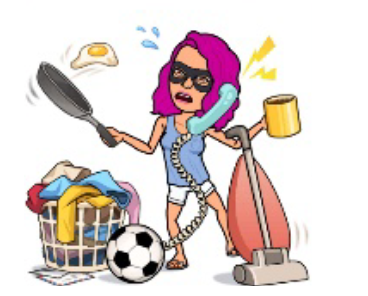
4.
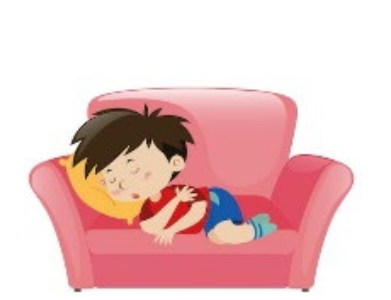
5.
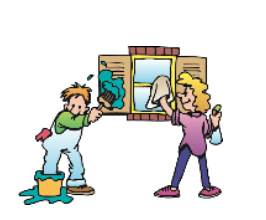
6.
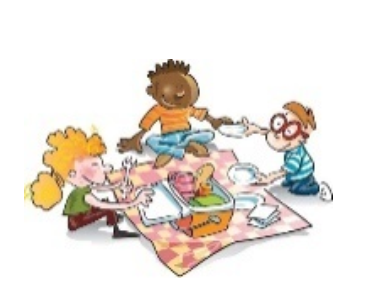
5
12 з 142 балів
Choose the correct forms to complete the sentences below.
1. What music [did you used, did you use, used you] to like when you were a child?
2. I [usedn't to, didn't use to, didn't used to] listen to music when I was a child.
3. We [use to go, don't use to go, usually go]usually go to the cinema at weekends.
4. They [use to live, used to living, used to live] in the country, but now they live in the city.
5. I [loved, didn't use to love, used to love] the cake you made me last week.
6. [Used you to, Did you use to, Did you used to] long hair when you were younger?
7. She [used not to be, didn't used to be, didn't use to be] very tall when she was in school.
8. I [normally go, don't use to go, use to go]to bed very late on Fridays and Saturdays.
9. Robert [use to play, used to play, used to playing] in a band.
10. I [use to break, broke, used to break] my right arm in a skiing accident when I was 21.
6
12 з 142 балів
Look at Frank's routine and complete the sentences with the correct form of "used to" and The Present Simple.
IN THE PAST | AT PRESENT |
1. Not use a computer | Be a computer designer |
2. Walk everywhere | Not walk |
3. Eat only meat | Like meat, fish, and chicken |
4. Write postcards to friends | Never write |
5. Play pop music | Play the guitar in a rock band |
6. Not go to the cinema | Go to the cinema at weekend |
7. Play football | Not do sports |
1. In the past Frank a computer, but at present he a computer designer.
2. In the past Frank everywhere, but at present he .
3. In the past Frank only meat, but at present he meat, fish and chicken.
4. In the past Frank postcards to friends, but at present he never .
5. In the past Frank pop music, but at present he the guitar in rock band.
6. In the past Frank to the cinema, but at present he to the cinema at weekends
7. In the past Frank football but, at present he sports.
7
12 з 142 балів
Choose “used to” or “be used to” construction.
1. It was difficult when I first started a university course because I [wasn’t used to having, didn't use to have, wasn’t used] a hectic schedule.
2. There [used to be, was used to be, is used to be] a bakery in the village in those days.
3. She lives in Los Angeles and she [used to going, is used to going, didn't use to going] to Disney Land.
4. Mrs Wilson [used to read, is used to reading, used to reading]four hours a day when she was young.
5. Don't worry about him, he [is used to getting up, used to getting up, used to get up]early every day .
6. I [didn' t use to smoking, wasn't used to smoke, didn' t use to smoke] when I was young.
7. When I was a child , I [was used to collect, used to collect, was used to collecting]used to collect (to collect) stamps.
8. He is nervous because he [doesn't use to speak, is not used to speaking, didn't use to speak] English .
8
12 з 142 балів
Open the brackets.
1. As soon as he (to return) from school, he (сконцентруватися) his studies.
2. Our uncle (підбирати) me after school next time.
3. Where have you been today, Ann? Why (you, прогулювати) the lessons?
4. I (не подобатися) having dinner with my parents. I (зависати з однолітками) instead.
5. While we (їсти не вдома), he (to change) his hectic timetable.
6. Her cousin used (пропускати уроки) in junior school, but now he (to prepare) for very important exams.
7. Why (you, дрімати)? It’s so late and you (робити) so much work already.
8. Spring is over. I (згадувати) on my time in spring camp with great pleasure.
9. Last Friday Nick (вирішувати) to pick up his brother because he (запізнюватись) for the Modern Art lesson.
10. My granny (бути) very busy last week and she (підганяти) on housework.
9
12 з 142 балів
1. Your idea is different [of, from, between, over] mine.
2. She’s quite good [at, in, of, about] English.
3. H’s proud [for, about, with, of]his students.
4. He’s really interested [about, in, of, over] it.
5. I have just [put, putted, putting, puting]it on the desk.
6. If he misses many classes, he will fall [after, apart, off, behind] .
7. Don’t worry! I believe [your , at you, mine, you] .
8. I [did , made, dream, sleep] well in the test.
9. Choose the correct sentence.
[Look! They return., Look! They are coming back., Look! They sing well!, Look! What time now?]
10. I [didn’t see, am not see, haven’t seen, hasn’t seen] you for ages.
11. They work in [a, the, -, an]extremely difficult conditions.
12. You shouldn’t [to promise, promising, will promise, promise]him anything.
13. This is a very expensive holiday which involves a trip [through, along, about, around] the world.
14. She hasn’t come home [still, already, yet, till] .
15. I … [saw, looked, viewed, watched] TV yesterday evening.
16. The teacher asked her students to do their [housework, homework, home duty, house job] .
17. The police officer told the children always to tell the [true, facts, information, truth] .
18. I’m terribly sorry but I [wasn’t listen to, wasn’t hearing, didn’t hear, didn’t heard] what you said just now and I wonder if you could repeat it.
19. Can you [listening, hearing, listen, hear] me all right over there because you are rather a long way away.
20. I [listen, am listening, hear, am hearing] to the concert every Monday on the radio and imagine I am there listening to it in person.
21. What is the name of that picture which you [look at, is looking at, are looking at, looked at] on the wall.
22. [Do you go, Is you going, Are you going, Did you go] to see that film that is on at the cinema next week?
23. Does anyone honestly [discover, think, believe, consider] what a politician says nowadays?
24. I’m sure you’re quite [write, right, all right, serious] but many people disagree with you.
25. This summer we went [on, off, in, by] holiday to Greece.
26. I believe it is [politic, polite, political, politeness] to hold a door open for a lady.
27. What exercise do you like doing [next, best, after, before] of all?
28. That’s a good question but I need [time, space, length, width] to think about it.
29. Don’t worry there’s no need to answer [firstly, fairly, immediately, easily] I’m not in a hurry.
30. I often read short articles [for, at, about, between] pets in my favourite magazines.
31. You will probably agree [with, for, in, on] me.
32. For the whole of next week we are planning to sell our new dictionaries at a special [price, prize, prise, praise] .
33. Can you remember the last time you [have, having, had, will have]such an exciting time?
34. You must be joking. Have you forgotten how terrible I felt the last time we went somewhere [in, with, by, on] plane?
35. Do you drink a [much, many, huge, lot]of tea with sugar?
36. [Which, Who, How, What] are you going to get home from work?
37. [Was, Were, Did, Had] you do much sightseeing when you were on vacation in Madrid?
38. Mr. Lam usually organizes many trips for teachers during the summer holidays. He is [a travel agent, an editor, a taxi driver, an actor].
39. Two girls talked to [each other, to another, with other, with each] [each other, to another, with other, with each] in the room last night.
40. There is so much smoke in the air that it is [enjoyable, pleasant, healthy, unhealthy] to live in many of the world’s cities.
41. The man explained to us [how, how can, how we can, how can we] to get to the airport.
42. He is [a, an, the, -] honest worker.
43. A few students complained [of, on, for, about] the schedule.
44. She is an excellent travel agent, she is very [goodly, goodest, good, gooder]with people, so all the customers like her.
45. The contrast [over, about, between, from] rich and poor is great.
10
12 з 142 балів
TASK 1. For questions 31-42, read the text below and decide which answer А-D best fits each gap.
SHOPPING MALLS
Victor Gruen, an American architect, revolutionised shopping in the 1950s by creating the type of shopping centre that we now call a shopping mall.
Gruen's (31)
[A, B, C, D] was to provide a pleasant, quiet and spacious shopping environment with large car parks, which usually (32)
[A, B, C, D] building in the suburbs. He also wanted people to be able to shop in all kinds of weather. He (33)
[A, B, C, D] on using building designs that he knew people would feel (34)
[A, B, C, D]with, but placed them in landscaped 'streets' that were entirely enclosed and often covered with a curved glass roof. This was done to (35)
[A, B, C, D] some of the older shopping arcades of city centres, but while these housed only small speciality shops, Gruen's shopping malls were on a much grander (36)
[A, B, C, D]
Access to the whole shopping mall was gained by using the main doors, which (37)
[A, B, C, D] the shopping 'streets' from the parking (38)
[A, B, C, D] outside. As there was no need to (39)
[A, B, C, D]out bad weather, shops no longer needed windows and doors, and people could wander (40)
[A, B, C, D] from shop to shop. In many cities, shopping malls now (41)
[A, B, C, D] much more than just shops; cinemas, restaurants and other forms of entertainment are also (42)
[A, B, C, D]in popularity.
31 | A direction | B aim | C search | D view |
32 | A resulted | B sought | C intended | D meant |
33 | A insisted | B demanded | C requested | D emphasised |
34 | A favourable | B agreeable | C comfortable | D enviable |
35 | A model | B imitate | C repeat | D shadow |
36 | A measure | B height | C size | D scale |
37 | A disconnected | B withdrew | C separated | D parted |
38 | A strips | B lines | C areas | D plots |
39 | A hold | B get | C stay | D keep |
40 | A freely | B loosely | C simply | D entirely |
41 | A contain | B concern | C consist | D compose |
42 | A becoming | B growing | C raising | D advancing |
TASK 2. You are going to read an extract from a short story.
For questions 1-8, choose the answer А-D which you think fits best according to the text.
We always went to Ireland in June. Ever since the four of us began to go on holidays together we had spent the first fortnight of the month at Glencorn Lodge in County Antrim. It's a large house by the sea, not far from the village of Ardbeag. The English couple who bought the house, the Malseeds, have had to add to the building, but everything has been done most discreetly.
It was Strafe who found Glencorn for us. He'd come across an advertisement in the days when the Malseeds still felt the need to advertise. 'How about this?' he said one evening and read out the details. We had gone away together the summer before, to a hotel that had been recommended by friends, but it hadn't been a success because the food was so appalling.
The four of us have been playing cards together for ages, Dekko, Strafe, Cynthia, and myself. They call me Milly, though strictly speaking my name is Dorothy Milson. Dekko picked up his nickname at school, Dekko Deacon sounding rather good, I suppose. He and Strafe were at school together, which must be why we call Strafe by his surname as the teachers used to. We're all about the same age and live quite close to the town where the Malseeds were before they decided to make the change from England to Ireland. Quite a coincidence, we always think.
'How very nice,' Mrs Malseed said, smiling her welcome again this year. Some instinct seems to teU her when guests are about to arrive, for she's rarely not waiting in the large, low-ceilinged hall that always smells of flowers. 'Arthur, take the luggage up,' she commanded the old porter. 'Rose, Tulip, Lily and Geranium.' She referred to the names of the rooms reserved for us. Mrs Malseed herself painted flowers on the doors of the hotel instead of putting numbers. In winter, when no one much comes to Glencorn Lodge, she sees to little details like that; her husband sees to redecoration and repairs.
'Well, well, well,' Mr Malseed said, now entering the hall through the door that leads to the kitchen. 'A hundred thousand welcomes,' he greeted us in the Irish manner. He was smiling broadly with his dark brown eyes twinkling, making us think we were rather more than just another group of hotel guests. Everyone smiled, and I could feel the others thinking that our holiday had truly begun. Nothing had changed at Glencorn, all was well. Kitty from the dining room came out to greet us. 'You look younger every year, all four of you,' she said, causing everyone in the hall to laugh again. Arthur led the way to the rooms, carrying as much of our luggage as he could manage and returning for the remainder.
After dinner, we played cards for a while but not going on for as long as we might because we were still quite tired after the journey. In the lounge, there was a man on his own and a French couple. There had been other people at dinner, of course, because in June Glencorn Lodge is always full: from where we sat in the window we could see some of them strolling about the lawns, others taking the cliff path down to the seashore. In the morning we'd do the same: we'd walk along the sands to Ardbeag and have coffee in the hotel there, back in time for lunch. In the afternoon we'd drive somewhere.
I knew all that because over the years this kind of pattern had developed. Since first we came here, we'd all fallen hopelessly in love with every variation of its remarkable landscape.
1 Why did the Malseeds no longer advertise Glencorn Lodge? [A, B, C, D]
A | It was too expensive. |
B | It was not necessary. |
C | It was too complicated. |
D | It was not effective. |
2 What did Dekko and the writer have in common?
[A, B, C, D]
A | They did not like their names. |
B | People used their surnames when speaking to them. |
C | They chose their own nicknames. |
D | People did not call them by their real names. |
3 The coincidence referred to in paragraph three is that the four friends and the Malseeds
[A, B, C, D]
A | came from the same area. |
B | preferred Ireland to England. |
C | lived close to one another. |
D | were all about the same age. |
4 What was special about the rooms at Glencorn Lodge?
[A, B, C, D]
A | They had been painted by Mrs Malseed herself. |
B | There was no paint on the doors. |
C | They did not have numbers. |
D | There were different flowers in all of them. |
5 What did the writer particularly like about Mr Malseed?
[A, B, C, D]
A | He had nice brown eyes. |
B | Не always came to welcome them. |
C | Не made guests feel like friends. |
D | He spoke in the Irish way. |
6 Why did the writer feel contented after Mr Malseed had spoken?
[A, B, C, D]
A | Everything was as it had always been. |
B | The holiday would start at any moment. |
C | A few things had improved at Glencorn. |
D | Her friends had enjoyed the holiday. |
7 What did Kitty do which made the friends laugh?
[A, B, C, D]
A | She told them a joke. |
B | She pretended to insult them. |
C | She laughed when she saw them. |
D | She paid them a compliment. |
8 The next day the friends would walk to Ardbeag because
[A, B, C, D]
A | they would be able to walk on the sands. |
B | this was what they always did. |
C | they wanted to do the same as other people. |
D | it was quite a short walk for them. |
11
12 з 142 балів
TASK 1.
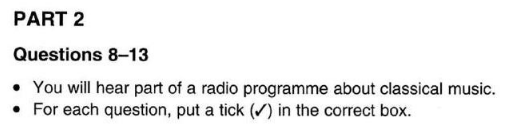
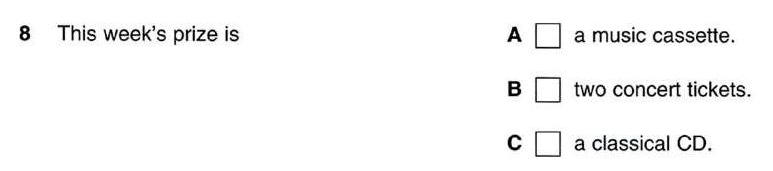
8 - [A, B, C]
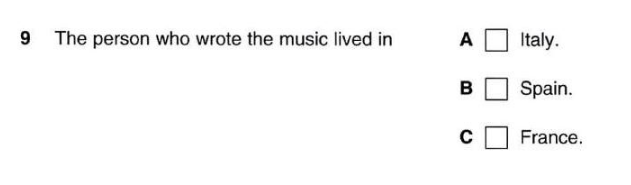
9 - [A, B, C]
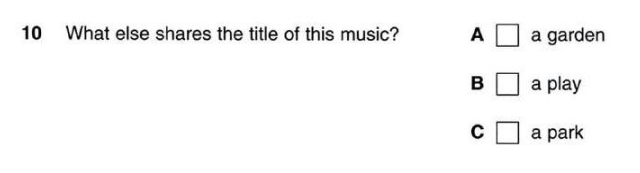
10 -
[A, B, C]
11 -
[A, B, C]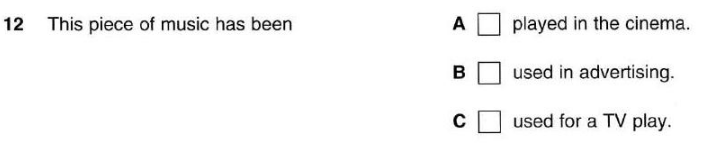
12 - [A, B, C]
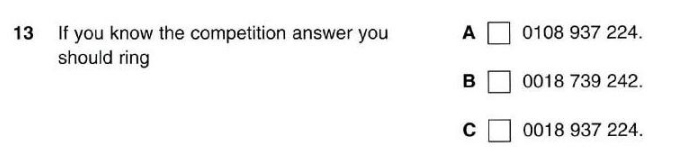
13 - [A, B, C]
12
10 з 142 балів
Listen to the recording and fill in the gaps.
Anyone who does love chocolate is mad. I don’t think I know anyone . Some of my friends say they hate white chocolate or dark chocolate, but then other kind. I think chocolate is one of the best inventions ever. of life’s true pleasures. There’s nothing better than having your whole chocolate and letting it melt. I love pushing the chocolate the roof of my mouth and then moving . Yum. I eat chocolate every day. I know it’s bad for our teeth and , but I don’t care. I prefer to think about the of chocolate. I’ve read many articles that say chocolate is .
Рефлексія від 3 учнів
Сподобався:
0
Так: 2
Ні: 1
Зрозумілий:
0
Так: 2
Ні: 1
Потрібні роз'яснення:
0
Ні: 2
Так: 1