- Всеосвіта›
- Бібліотека тестів›
- Англійська мова›
- HS1 2019 unit6 p110 act12

Тест:
HS1 2019 unit6 p110 act12

17.09.2021

Вміст тесту:
1
2
3
4
5
6
7
8
9
Тест містить питання скопійовані з: HS1 2018 unit6 p66 act11.
1
12 з 108 балів
Sign the pictures. Mind the articles!
|
|
|
|
|
|
|
|
|
|
|
|
|
|
|
|
|
|
|
|
|
|
|
|

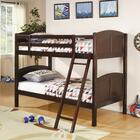

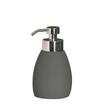








2
12 з 108 балів
Define the family pattern in which these people live. Mind the articles!
1. This is Tom and his dream is to get acquainted with his father who left their family after he had been born. So now he is brought up only by his motherand his grandparents often help them.
2. We don’t have any money to buy our own flat, that’s why we live with my husband’s mother in her apartment. But one the other hand it’s not bad because she always helps us with our child as she has already been retired.
3. - I know this boy to be a successful student.
- Yes, I agree to you. Do you know his parent?
- Yes, his mother is a teacher at our local school. And I heard that his father died in the car accident, so his mother got married for the second time. And this man has cool relationships with her son.
4.My sister and I have a friendly family which lives in the mansion. Our mother is a layer in a big company. Our father is a surgeon in the hospital. But for pity we don’t have other relatives, even grandparents.
5.This couple couldn’t have their own children, that’s why they took a child from the orphan house (orphanage). And they seems to be happy.
6.- Do you know that family which lives next to you?
- Not so much really. But my mother has told me recently that a lot of people live in that house.
- What do you mean?
- I know that there is a husband and a wife who have twins; also the wife’s sister lives with them. And the husband’s father who was single and lived far from them sold his flat and moved to their place, too.
3
12 з 108 балів
Choose either PAST PERFECT or PAST PERFECT CONTINUOUS | |||
Before we parked our car we [had collected, had been collecting] the ticket. | |||
I arrived on Sunday. I [hadn't been, hadn't been being] at home for two days. | |||
The roads were blocked in the morning. It [had snowed, had been snowing] all night. | |||
They got to the beach after they [had walked, had been walking] for hours. | |||
She called the police when she [had seen, had been seeing] the light in the hall. | |||
His English was perfect. He [had studied, had been studying] it since he started school. | |||
She didn't go to work. She [had caught, had been catching] a cold. | |||
When we moved to Park Street, the Johnsons [had lived, had been living] there for ages. | |||
We [had signed, had been signing] the contract before the meeting ended. | |||
Ben was so sweaty because he [had gone jogging, had been jogging] . | |||
4
12 з 108 балів
Match the formula and the tense!
1
S + had + not + been + Ving+SPS.
А
Present Perfect Continuous (Affirmative)
2
Have / Has + S + been + Ving?
Б
Future Continuous (Interrogative)
3
Will + S + have VIII + TI+…
В
Future Perfect (Affirmative)
4
S + had + not + VIII + …
Г
Past Perfect Continuous (Negative)
5
Shall/will + S + be V-ing?
Ґ
Past Perfect (Affirmative)
6
S + have/has + VIII + SPS.
Д
Future Perfect (Interrogative)
7
S + will (shall) + not + V + SPS.
Е
Present Simple (Affirmative)
8
S + have been / has been + Ving
Є
Present Perfect (Affirmative)
9
Did + S + V + SPS?
Ж
Present Perfect Continuous (Interrogative)
10
S + will have + VIII + TI +…
З
Future Simple (Negative)
11
S + V (-s/-es) + SPS
И
Past Simple (Interrogative)
12
To be + S + Ving + SPS?
І
Past Perfect (Negative)
13
S + had + VIII + …
К
Past Continuous (Affirmative)
14
S + to be (past) + Ving + SPS.
Л
Present Continuous (Interrogative)
5
12 з 108 балів
Fill in the correct form of the verb in ().
How long driving? - I for over five years . (YOU DRIVE, DRIVE)
When I school I my hair and it short ever since. (LEAVE, CUT, WEAR)
When I through your books I noticed that you have a copy of Murder in the Cathedral. (LOOK)
The plane that you now off for Paris (LOOK, JUST TAKE)
Tom and James a conversation. Please , don't disturb them !(HAVE)
He the flowers when it to rain (WATER, START).
here? - Yes, I my holidays here last year. Did you have a nice time? - No , it all the time. (YOU EVER BE, SPEND, RAIN)
Jack his job last year and out of work since then (LOSE, BE)
What between 9 and 12 yesterday? I the house. (YOU DO, CLEAN)
Housewives to work very hard (HAVE).
In the evenings I often chess with my next door neighbour. I chess with him ever since I to live here ten years ago. He has been here all his life. He this house from his father, another great chess player (PLAY, PLAY, COME, INHERIT)
If I a ghost I would try to frighten people (BE).
I hope it when we leave church (NOT RAIN).
Since you gave me your number I you four times. (PHONE)
6
12 з 108 балів
HS 1 – UNIT 6 - General TEST 3
1. The inspector stopped and asked us where [a, b, c, d] .
a) we are going
b) were we going
c) are we going
d) we were going
2. John slipped on a piece of orange [a, b, c, d] broke his leg.
a) peel b) shell c) layer d) coat
3. Her sister works at a well-known hospital. She’s [a, b, c, d] .
a) a nurse b) the nurse c) nurse d) an nurse
4. He said he didn’t derive [a, b, c, d] from working.
a) any joy b) some joys
c) joys d) no joy
5. Where [a, b, c, d]? – In Vietnam.
a) did you born
b) have you been born
c) were you born
d) are you born
6. Parents should be [a, b, c, d] for teaching their children the difference between right and wrong.
a) responsibly b) responsible
c) responsibility d) responsive
7. What’s the name of the man [a, b, c, d] ?
a) his car you borrowed
b) whose car you borrowed
c) which car you borrowed
d) you borrowed his car
8. Two of these books are mine, [a, b, c, d] are John’s.
a) others b) the others c) another d) rest
9. [a, b, c, d] fairy stories, stepmothers are always unkind … their stepchildren.
a) in/to b) on/for c) on/to d) in/for
10. When the time came to [a, b, c, d] the bill at the hotel she found her purse had been stolen.
a) pay for b) pay up c) pay out d) pay
11. We missed the ferry. It [a, b, c, d] by the time we arrived at the pier.
a) went b) was going c) has gone d) had gone
12. How [a, b, c, d] now? Better than before?
a) you feel b) you are feeling c) are you feeling
d) do you feel
13. [a, b, c, d] amount of money can buy love and liberty.
a) No b) Never c) Not only d) None
14. She works eight hours [a, b, c, d] day.
a) for b) a c) in d) the
15. The firemen brought several long [a, b, c, d] to save some people on the roof.
a) stairs b) steps c) staircases d) ladders
16. She’s so lazy that she never does [a, b, c, d] work.
a) some b) any c) none d) no
17. She isn’t [a, b, c, d] well with the new manager.
a) taking on b) going on
c) keeping on d) getting on
18. Do you think it’s going to rain heavily? - [a, b, c, d] .
a) I won’t hope so
b) I don’t hope
c) I don’t hope so
d) I hope not
19. I would like to invite [a, b, c, d] to my party if they want.
a) theirs b) their c) they d) them
20. I [a, b, c, d] to find a well-paid job but I had no luck.
a) hardly tried b) tried hard
c) tried hardly d) hard tried
21. He has a … [a, b, c, d] cut on his face.
a) horrible b) afraid
c) logical d) ill-prepared
22. Colin has been married for a long time. She got married [a, b, c, d] she was 29 years old.
a) since b) while c) as d) when
23. [a, b, c, d]nor animals can survive without oxygen.
a) Neither can plants
b) Plants neither
c) Neither plants
d) Plants can neither
24. What a boring weekend! [a, b, c, d] anything!
a) I don’t b) I didn’t c) I didn’t do d) I don’t do
25. Our flat is [a, b, c, d] the third floor of the building.
a) in b) on c) above d) at
26. You don’t know why Angela is absent today, [a, b, c, d] ?
a) do you b) don’t you c) is she d) does she
27. [a, b, c, d] he went to the party last night is still a mystery to me.
a) How b) Since c) While d) Although
28. Be careful! Don’t [a, b, c, d] your drink on the floor.
a) spread b) flood c) spill d) flow
29. Where’s the book I gave you? What [a, b, c, d] with it?
a) have you done
b) have you been doing
c) were you doing
d) are you doing
30. We’re late. The film [a, b, c, d] by the time we get to the cinema.
a) will already start
b) will be already started
c) will already have started
d) will be starting
31. He was always very quick [a, b, c, d] learning languages.
a) on b) in c) at d) about
32. Why do you say we are fond of luxuries? – The streets of Bangkok are full of private cars, [a, b, c, d] are expensive.
a) most of what b) most they
c) most of which d) all those
33. How long [a, b, c, d] here? – Exactly four years today. I’m thinking of changing my job next year.
a) did you work
b) do you work
c) are you working
d) have you worked
34. Don’t worry [a, b, c, d] late tonight.
a) if I’ll be b) when I’ll be
c) if I am d) when I am
35. I [a, b, c, d] my hand when I was cooking the lunch.
a) have burnt b) was burning
c) had burnt d) burnt
36. As [a, b, c, d] as I know, we have not received a bill for this new printer.
a) soon b) far c) much d) long
37. They’re close friends. They [a, b, c, d] each other for a long time.
a) have been knowing
b) know
c) have known
d) knew
38. This child [a, b, c, d] his soup all over the tablecloth.
a) spilt b) scattered c) stained d) set
39. What was wrong with you? Why [a, b, c, d] see the doctor?
a) had you to b) did you have to
c) must you d) will you
40. She may be old but she’s still [a, b, c, d] control of all that is happening.
a) with b) under c) in d) over
41. What time did they [a, b, c, d] the hotel?
a) get to b) both a and c are correct
c) arrive at d) arrive in
42. Karen has been working here [a, b, c, d] .
a) since six months
b) for six months
c) for six monthes
d) six months ago
43. I’ll be in London next week. I hope to see Tom [a, b, c, d] there.
a) while I will be
b) during my visit
c) while I am
d) both b and c are correct
44. She wondered [a, b, c, d] her uncle looked like now, after so many years she hadn’t met him.
a) that b) what c) whose d) how
45. Let’s get a taxi. It’s [a, b, c, d] to walk.
a) a quite long way
b) rather a long way
c) quite a long way
d) both b and c are correct
7
12 з 108 балів
Part 1
Questions 1-5
There is one question for each conversation.
For questions 1-5, put a tick (ü) under the right answer.
Example:What time will they meet?
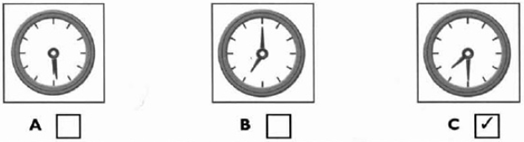
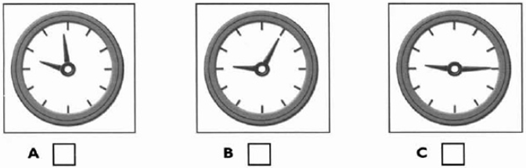
1. What time does the bus leave? [A, B, C]
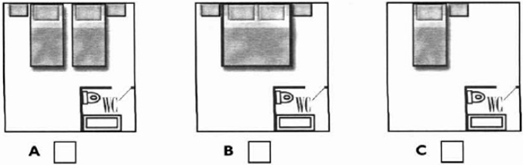
2. Which room does the man want? [A, B, C]
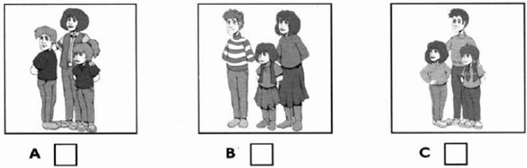
3. Which is Abigail’s family? [A, B, C]
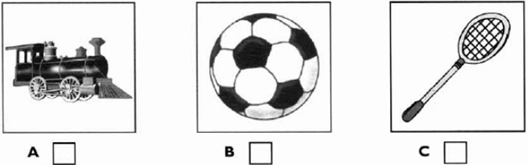
4. Which toy is Cerys going to buy? [A, B, C]
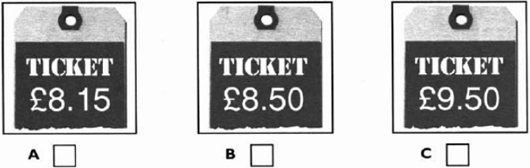
5. How much does the ticket cost? [A, B, C]
Part 3
Questions 11-15
Listen to Patrick making a phone call.
For questions 11-15, choose A, B or C.
You will hear the conversation twice.
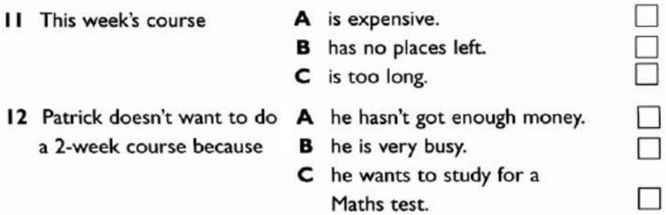
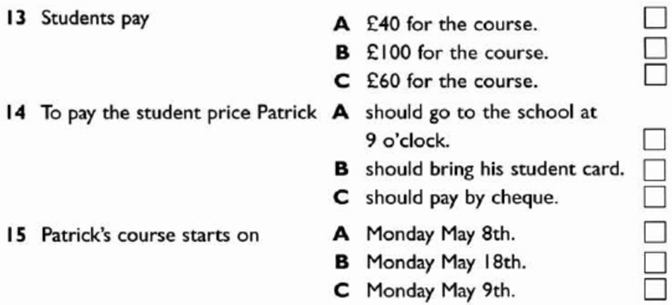
11. [A, B, C]
12. [A, B, C]
13. [A, B, C]
14. [A, B, C]
15. [A, B, C]
8
12 з 108 балів
Part 2
Questions 6-10
Listen to Isobel talking to a friend about her birthday. What did she do on each day? For questions 6-10, write a letter A – H next to each day.
You will hear the conversation twice.
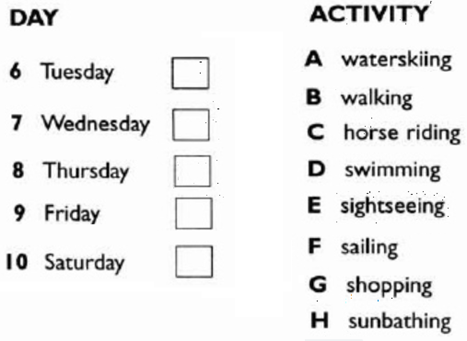
1
Tuesday
А
waterskiing
2
Wednesday
Б
walking
3
Thursday
В
horse riding
4
Friday
Г
swimming
5
Saturday
Ґ
sightseeing
Д
sailing
Е
shopping
Є
husband
9
12 з 108 балів
Reading. Task1. Read the text and match choices (A-H) to (1-5). There are three choices you don’t need to use.
How to Have Good Relationship with Your Parents.
1) [a, b, c, d, e, f, g, h] Without mutual respect, any relationship will be an unhappy one. People who respect each other: 1) value each other’s opinions, 2) listen to each other, 3) disagree without screaming or insults. And remember, your parents have lived longer then you – don’t discount their experience and knowledge.
2) [a, b, c, d, e, f, g, h] This is your key to freedom. The way to build trust is through honesty and responsibility. Honesty means you don’t lie or manipulate. Responsibility means you are reliable and can be counted on to use good judgment. When your parents trust you, it’s a lot easier for them to say “yes”.
3) [a, b, c, d, e, f, g, h] Your parents want to know what’s going on in your life. If you keep them in the dark, they won’t know when you need their help or whether they can trust you. Tell them what you’re up to, share your thought and feelings with them, and seek their advice for your problems (you don’t have to take it). Communication builds closeness.
4) [a, b, c, d, e, f, g, h] If you’re always honest, a parent will be likely to believe what you say. If you sometimes hide the truth or add too much drama, parents will have a harder time believing what you tell them. If you tell stories, they’ll find it hard to trust you.
5) [a, b, c, d, e, f, g, h] Using a tone that’s friendly and polite makes it more likely that parents will listen and take what you say seriously. It also makes it more likely that they’ll talk to you in the same way. Of course, this is hard for any of us (adults included) when we’re feeling heated about something. If you think your emotions might get the better of you, do something to blow off steam before talking: go for a run. Cry. Hit your pillow. Do whatever it takes to sound calm when you need to.
These guidelines work both ways. Is, on occasions, your parents violate any of the guidelines, talk to them about it. Pick a time when you are both calm and feeling god toward each other (never when you’re angry). Then, explain to them what they did, yow it makes you feel, and what you’d like them to do instead.
a. Win Your Parents’ Confidence
b. Try Not to Argue or Whine
c. Speak Respectfully
d. Never Lie
e. Try to Understand Their Point of View
f. Respect Each other
g. Communicate
h. Give Details that Can Help Parents to Understand Your Situation.
Task 2
Read the text below. For questions (6—10) choose the correct answer (А, В, C, or D).
HOW DO WE KNOW THAT ELEPHANTS NEVER FORGET?
Elephants would be excellent in the business world. Working elephants in Myanmar have been shown to remember verbal commands, other animals, and people. Considering the way they store memories of their interactions, elephants appear biologically disposed to networking. An elephant never draws a blank, leading to the famous saying: "An elephant never forgets." Studies have revealed that as an elephant ages, its memor y improves. When approached by an outsider, a matriarch often signals to the rest of the herd whether the stranger is a friend or a foe. She rises her personal experiences, as well as her sense of smell and contact cues, to protect her brood from rogue and possibly violent Dull elephants. The matriarch passes her knowledge on to other members of her herd. (This was determined from a study of twenty-one elephant families during a seven-year period in Kenya.)
The same survival instinct comes into play when an elephant smells a member of a familiar group that is known to kill elephants. When an elephant catches a whiff of one of these hunters, it will race for safety. If the elephant smells a member of a group that is known not to kill elephants, it will continue grazing in the area. The elephant remembers scents, and it can differentiate between one that means danger and one that doesn't.
The saying itself is likely an alteration of an old Greek proverb: "A camel never forgets an injury." Camels were swapped out for elephants early in the twentieth century after intelligence and an impressive capacity for recall were observed in the latter. It has become common to say someone has an "elephantine" memory — which is much more acceptable than saying that someone has an elephantine body.
6. Which of the following is NOT stated about a matriarch in paragraph 1? [A, B, C, D]
A She recognizes enemies.
В She teaches other elephants.
C She has perfect sense of smell.
D She fights with bull elephants.
7. Wha t is described in paragraph 2? [A, B, C, D]
A How an elephant kills its enemies.
В How an elephant lives in the herd.
C How an elephant feels danger.
D How an elephant hunts.
8. The studies about elephants' intelligence date back to [A, B, C, D]
A. the matriarch epoch
В. the 20 t h century
C. the Greek time
D. this century
9. Why was the word "camel" exchanged in the saying? [A, B, C, D]
A. Studies showed camels weren't able to remember injury.
В. Elephants were excellent in business world.
C. Studies proved that elephants were clever.
D. Camels became fewer in number.
10. What does "elephantine" memory mean? [A, B, C, D]
A. You memorize all details.
В. You have a bad memory.
C. You forget injustice.
D. You have big brain.
Рефлексія від 10 учнів
Сподобався:
0
Так: 6
Ні: 4
Зрозумілий:
0
Так: 5
Ні: 5
Потрібні роз'яснення:
0
Ні: 8
Так: 2