- Всеосвіта›
- Бібліотека тестів›
- Англійська мова›
- HS1 2019 U6 act12 p114

Тест:
HS1 2019 U6 act12 p114

23.09.2021


Вміст тесту:
1
2
3
4
5
6
7
8
9
10
11
Тест містить питання скопійовані з: HS1 Unit6 GeneralTest4.
1
12 з 132 балів
Match the picture and the word.
1

А
gardening
2

Б
knitting
3

В
sailing
4

Г
hang gliding
5

Ґ
pottery
6

Д
yoga
7

Е
bowling
8

Є
sewing
9

Ж
canoeing
10

З
parachuting
11

И
jogging
12

І
weight lifting
13

К
skiing
14

Л
juggling
2
12 з 132 балів
Translate the words and phrases. Mind articles and particle to.
1) метушитися -
2) хитатися -
3) поводитися зріло -
4) поділяти схожі інтереси -
5) довіряти -
6) наполягати -
7) бути викраденим -
8) попередня домовленість -
3
12 з 132 балів
Read the following text and decide which word (a, b or c) is missing in items 1–10.
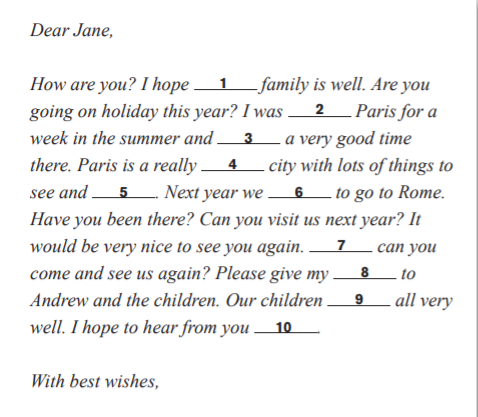
1. [a) you, b) your, c) yours]
2. [a) at, b) in, c) to]
3. [a) had, b) has, c) have]
4. [a) interest, b) interested, c) interesting]
5. [a) do, b) make, c) take]
6. [a) like, b) want, c) wish]
7. [a) when, b) which, c) why]
8. [a) greetings, b) love, c) wishes]
9. [a) are, b) have, c) is]
10. [a) good, b) near, c) soon]
4
12 з 132 балів
Choose the correct hobby for every case.
I developed an interest in [reading, rock climbing, painting] after my father gave me rock equipment.
Mary loves plants and flowers, so [fishing, dancing, gardening] is the ideal hobby for her.
If I had a good camera, my favourite hobby would be [cinema, photography, cooking].
Tim decided to take up [pottery, camping, fishing] as a hobby because he loves working with clay.
My father gave me a magnifying glass last Christmas. Since then I started collecting [stamps, autographs, cinema].
One of the most popular activities at the seaside to watch it from height is [parachuting, bowling, canoeing].
When all my family go to the picnic, after barbecue we divide into two teams and play [hang gliding, billiards, football].
My hobby is [sailing, sewing, yoga]. It helps to relax and to train my body at the same time.
His hobby is [painting, knitting, table tennis]. It helps him to develop concentration. He also likes it very much because it is a team kind of sportand he can converse with his friends.
Their uncle is a clown. He has taught them to perform magic tricks but most of all they like [skiing, sewing, juggling].
5
12 з 132 балів
Translate the words or phrases in the brackets. Mind the form of the predicate.
1) My siblings (мають погані відносини) with their (хрещеною) and that’s why they don’t show a nice (зразок сім'ї) to their children.
2) Her great-grandparents (мали близнюків) who were divorced in 20 years after (одруження). They were (самотніми) for many years. But they (нещодавно одружилися) again and bring up nice children.
3) Their (невістка) (була заручена) and now she is married and (вагітна).
4) Our friend (була сиротою) for 10 years by the time she got (прийомні батьки).
5) My relatives-in-law (щойно придбали) a high-rise building, but they must make (центральне опалення) and (водопровід).
6) My father has a birthday today, that’s why I (готувала) different dishes and (прибирала) for 4 hours till all the relatives came.
7) This week I (орендувала) a flat. Most of all I liked a bathroom, because it was (найзручніша) and there were many things: (умивальник), a tap, (фен), (дозатор мила), a bath tub, (дзеркало у повний зріст), (вішалка для рушника) and others.
8) Their son-in-law (займався) hang gliding and parachuting for 5 years by the time he started to go in for (важкою атлетикою).
6
12 з 132 балів
Define the tense form.
1) As she was bright and ambitious, she became a manager in no time. [Past Perfect, Past Simple, Present Simple]
2) Even though he's thoroughly trained, he still makes a lot of mistakes. [Present Simple, Present Perfect, Present Continuous]
3) Tom had been traveling around the world since the month of December. [Past Perfect, Present Perfect Continuous, Past Perfect Continuous]
4) The lyricist has been writing realistic songs since the beginning of his career. [Present Perfect Continuous, Past Perfect Continuous, Present Perfect]
5) Will you have gone to the concert of the realistic songs before I come? [Future Simple, Future Perfect, Future Conttinuous]
6) I will be arranging all the necessary materials for the program. [Future Perfect, Future Simple, Future Continuous]
7) We had been enjoying the program thoroughly for three hours. [Past Perfect, Past Perfect Continuous, Present Perfect Continuous]
8) Have you been preparing the assignment for two hours? [Present Perfect, Past Perfect Continuous, Present Perfect Continuous]
9) They will play hockey in that field on Thursday. [Future Perfect, Future Simple, Future Continuous]
10) I had been shopping with my elder brother at the fair since morning. [Present Perfect Continuous, Past Perfect Continuous, Past Perfect]
7
12 з 132 балів
Correct the mistakes. Write only the correct variant in the blank.
1) You had not been wait there for more than two hours when she finally arrived.
2) They’ve got blisters on their feet because they’ve been walking by 9 a.m.
3) What have they doing? – They’ve been playing computer games.
4) He'll staying with his parents for several months while his father is in recovery.
5) I won't have written all the reports at next week.
6) She had been to the cinema twice this week.
7) There have been many earthquakes on California.
8) We will not have eaten breakfast before we will get to the airport tomorrow morning.
9) I wasn't say anything until she had finished talking.
8
12 з 132 балів
General Test 4
1. They say they’ve been to [a, b, c, d] restaurant in town.
a) every b) most c) many d) all
2. Mary hasn’t written to me [a, b, c, d] .
a) already b) never c) any longer d) yet
3. I don’t get tired [a, b, c, d] watching TV every night.
a) of b) with c) at d) by
4. When we first came here, they [a, b, c, d] this bridge yet.
a) hadn’t built
b) haven’t built
c) had built
d) have built
5. My manager is very busy at the moment so it may take a [a, b, c, d] time to answer your letters.
a) some b) small c) little d) few
6. I’ve known Tom [a, b, c, d]I left college.
a) until b) during c) since d) when
7. The exam was quiet easy; [a, b, c, d] we expected.
a) more easy than
b) easier than
c) easier as
d) more easy that
8. They like to [a, b, c, d] the crossword puzzle in the newspaper every day.
a) answer b) do c) make d) fill
9. My parents visited [a, b, c, d] .
a) Canada and United States
b) the Canada and United States
c) the Canada and the United States
d) Canada and the United States
10. Are you looking forward [a, b, c, d] your old teacher again?
a) to being seen b) to seeing
c) seeing d) to see
11. [a, b, c, d] Mary three hours to do her homework.
a) It must b) It takes
c) To take to it d) Taking it
12. He’s a wonderful cook, he can make a delicious [a, b, c, d] out of almost anything.
a) meal b) food c) flavour d) plate
13. The red curtains began to [a, b, c, d] after they had been hanging in the sun for two months.
a) disappear b) die c) melt d) fade
14. They have lived near the railway for so long now that they’ve become [a, b, c, d] to the noise of the trains.
a) unconscious b) aware
c) familiar d) accustomed
15. It was impossible for Susan to tell the truth so she had to [a, b, c, d] a story.
a) combine b) invent c) manage d) lie
16. The accident was my fault, so I had to pay for the damage [a, b, c, d] the other car.
a) on b) for c) to d) of
17. It’s late. It’s time [a, b, c, d] home.
a) to go b) going c) for going d) to going
18. The show was very long, but there were two [a, b, c, d] .
a) intervals b) gaps
c) tests d) interruptions
19. Papermaking began in China and from there it [a, b, c, d]North Africa and Europe.
a) spilled b) sprang c) carried d) spread
20. The nurse [a, b, c, d] a rare disease when she was working in the hospital.
a) took b) suffered c) infected d) caught
21. The story was really boring. It was [a, b, c, d]I’ve ever read.
a) the story more boring
b) the more boring story
c) the most boring story
d) most boring story
22. The traffic lights [a, b, c, d] to red, and the pedestrians crossed the street.
a) removed b) turned c) exchanged
d) shone
23. I’m thinking [a, b, c, d]a house. Do you think that’s a good idea?
a) of to buy b) about buy c) to buy d) of buying
24. When we heard his joke, we burst into loud [a, b, c, d] .
a) laughter b) enjoyment
c) smiles d) amusement
25. It is a good idea to be [a, b, c, d] dressed when we go for an interview.
a) clearly b) boldly c) finely d) smartly
26. It took me quite a long time to get there. It was [a, b, c, d] journey.
a) three hours b) a three-hours
c) a three-hour d) three hour
27. Smoking is a very bad habit but many people find difficult to [a, b, c, d] it.
a) break b) cough c) breathe d) beat
28. He is not very good [a, b, c, d] translating documents.
a) for b) at c) in d) about
29. The boy sitting next to me on the plane was nervous because he [a, b, c, d] before.
a) hasn’t flown b) wasn’t flying
c) didn’t fly d) hadn’t flown
30. Since his mother died, his aunt [a, b, c, d] him.
a) brought after b) brought up
c) brought in d) brought on
31. My close friend phoned [a, b, c, d] me for a fare-well party.
a) for inviting b) for to invite
c) for invite d) to invite
32. I fail to understand this sentence. Can you [a, b, c, d] ?
a) explain this word me
b) explain to me this word
c) explain this word to me
d) explain me this word
33. Could you tell me where [a, b, c, d] is?
a) the office of the manager’s
b) the office of the manager
c) the manager office
d) the manager’s office
34. I object … being kept waiting. Why can’t you be … time? [a, b, c, d]
a) of / on b) for / on c) to / on d) to / upon
35. Have you any objections [a, b, c, d] this plan?
a) to b) with c) at d) for
36. [a, b, c, d] a villa when they were living in London?
a) Had they b) Have they had
c) Were they having d) Did they have
37. Many people in the world died [a, b, c, d] AIDS.
a) from b) about c) for d) of
38. [a, b, c, d] a long time for the train.
a) We have always to wait
b) We have to wait always
c) Always we have to wait
d) We always have to wait
39. The path was so icy that we walked very carefully. We were afraid [a, b, c, d] .
a) of falling b) to falling
c) to fall d) from falling
40. The job was more difficult than I [a, b, c, d] expected it to be.
a) have b) would c) might d) had
41. Scientists have discovered a close [a, b, c, d] between smoking and lung cancer.
a) combination b) action c) connection
d) union
42. The burglar [a, b, c, d] to open a store’s window.
a) forced b) discovered c) succeeded
d) managed
43. Thomas doesn’t speak very clearly. [a, b, c, d] .
a) He is difficult to understand him.
b) He is difficult to understand.
c) It is difficult to understand him.
d) Both a and b
44. If you’re worried about the problem, you should do something [a, b, c, d] it.
a) against b) with c) about d) for
45. I [a, b, c, d] to music a lot but I don’t do any more.
a) used to listen b) was used to listening
c) was used to listen d) was listening
9
12 з 132 балів
Listening
Fill in the gaps while listening.
“Home is where the heart is.” That’s (1) . I’ve lived in many different houses during my life (2) them have been home. When you are growing up, home is where your family lives. I left home (3) 18 and slowly my childhood home (4) . Now it’s my parents’ house and not my home. I (5) around a lot and only spent (6) in most places I lived. They never (7) felt like home. A home is somewhere you (8) relaxed and want to (9) . The expression “Home Sweet Home” is also true. You have to have nice feelings about it (10) home. Home doesn’t have to be in your (11) . I’ve lived in several countries and have had a home (12) .
10
12 з 132 балів
Listening
You will hear people talking in eight different situations. You will hear each situation twice. Choose the correct answer.
1.Listen to this couple talking about a film they've just watched. What sort of film was it? [A a comdey, B a horror film, C a romance]
2. Listen to this advertisement. How much will a dietary and fitness assesmenet cost you? [A 20, B 30, C 33]
3. You have returned home and smell gas as you enter the house. You call the Gas Hotline and hear this message. Which number should you dial? [A 5, B 3, C 4]
4. Listen to this news item. What was James Reeves arrested by the police for? [A a firearms office, B breaking into a car, C stealing a radio]
5. Sally has just returned from her holiday. How was the holiday? [A good, B bad, C terrible]
6. Listen to this lecture. In which century were tartans first produced? [A the twelfth century, B the fifteenth century, C It is not known]
7. You will hear a conversation in which one man is giving directions to another. Where is the first speaker trying to get to? [A the leisure centre, B the clubhouse, C the community centre]
8. Listen to this conversation. How many sandwiches does the speaker order? [A three, B two, C six]
11
12 з 132 балів
Reading
Read and match choices (A-H) to (1-5). There are three choices you do not need to use.
Ways to Volunteer with Your Kids
Everyone wants their children to learn and know about the world around them, and a great hands-on practice is volunteer work. Is there a better way to learn than getting out there and doing something that benefits others?
1. [A, B, C, D, E, F, G, H] Unfortunately, every community has residents without homes who need shelter, food or clothing. Volunteer to make or serve food at pantries or shelters that serve these people in your community. Take it a step further, and organize your own food drive to collect and deliver much-needed food to these organizations.
2. [A, B, C, D, E, F, G, H] One of the biggest impacts on the environment is discarded trash. Take your children to a location like the beach or a park, and pick up trash. Also, check with local organizations to see if they are hosting annual cleanup days. Many groups hold events each year to clean up rivers, highways and other public lands.
3. [A, B, C, D, E, F, G, H] Most children love animals, so volunteering at a local animal shelter or rescue operation is a great way to get them involved. Visit the animal shelters, and walk the creatures that are waiting in cages to find homes. Kids also can help out by collecting pet food and other supplies that are in constant demand at animal shelters.
4. [A, B, C, D, E, F, G, H] Most families have more clothes than they really need. Clean out your wardrobes, and gather your gently used belongings and take them to a nearby shelter. Use this activity as a teaching opportunity for your children, explaining how we can use what we have to help others. Take it a step further, and help them organize their own community clothing drive for local organizations.
5. [A, B, C, D, E, F, G, H] Volunteering with your children provides a great way to show your kids other life lessons as well. Take your kids to the grocery store, and give them a dollar. Have them pick out the most cost-effective food – which becomes a maths lesson for your kids, too – and then take it to a shelter or food drive. Another example is having your children read to seniors in the hospital, which helps improve the kids’ skills.
A Celebrate the holidays.
B Go to the dogs.
C Clean your closets.
D Go on litter closets.
E Teach your kids.
F Do it for the kids.
G Help the homeless.
H Go to the local children’s hospital.
Рефлексія від 4 учнів
Сподобався:
0
Так: 3
Ні: 1
Зрозумілий:
0
Так: 2
Ні: 2
Потрібні роз'яснення:
0
Ні: 3
Так: 1