https://deepai.org/machine-learning-model/text2img
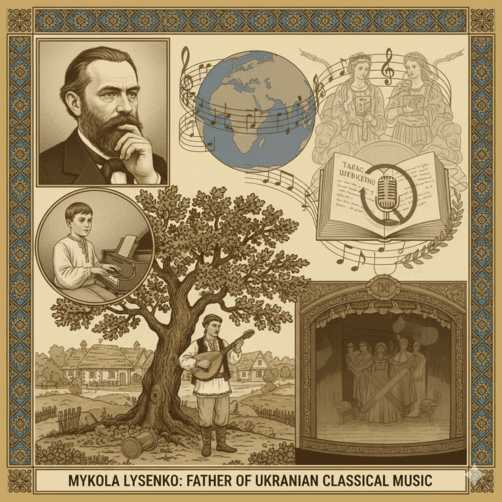
картинка створена за допомогою Gemini
- Всеосвіта›
- Бібліотека тестів›
- Англійська мова›
- Full Blast 8 Unit 4 (ГР3 )

Тест:
Full Blast 8 Unit 4 (ГР3 )

02.12.2025
Вміст тесту:
1
2
3
4
5
6
7
8
9
10
11
12
13
14
15
1
1 з 19 балів
Read the text and mark «True» or «False»
Mykola Lysenko: The Father of Ukrainian Classical Music
The composer, conductor and pianist Mykola Lysenko was born in the Poltava region in 1842. His mother was his first piano teacher, but he learnt so fast that he was sent to a boarding school in Kyiv to continue his piano studies when he was just nine years old.
Later he studied physics and mathematics at the University of Kyiv. It was not until after he got his degree that he turned to music full-time and his career as a musician really began. He went to Leipzig, Germany, where he worked with some of the most famous composers of his day.
As a young man, he became interested in Ukrainian traditional music – especially the songs that people sang in the villages of his home region. And this is exactly what made his music so special: In his operas, piano pieces and songs, he mixed Ukrainian folk tradition with classical styles. He travelled around the country collecting folk songs and studying the music, lyrics and instruments of traditional singers or Kobzars. He also composed music for works by Taras Shevchenko and other famous Ukrainian poets.
Lysenko wanted to celebrate Ukrainian culture and share it with the world. This was not easy at that time! In fact, performances in the Ukrainian language were banned in 1876. Lysenko's most famous opera, Taras Bulba, was never performed during his lifetime, because the lyrics were in Ukrainian. But despite the difficulties, he kept composing, performing and encouraging young talent till the end of his life in 1912. Lysenko was such an important composer that he is known as the father of Ukrainian classical music. His music continues to be enjoyed around the world.
Mykola Lysenko was born in Kyiv in 1842.
2
1 з 19 балів
Read the text and mark «True» or «False»
Mykola Lysenko: The Father of Ukrainian Classical Music
The composer, conductor and pianist Mykola Lysenko was born in the Poltava region in 1842. His mother was his first piano teacher, but he learnt so fast that he was sent to a boarding school in Kyiv to continue his piano studies when he was just nine years old.
Later he studied physics and mathematics at the University of Kyiv. It was not until after he got his degree that he turned to music full-time and his career as a musician really began. He went to Leipzig, Germany, where he worked with some of the most famous composers of his day.
As a young man, he became interested in Ukrainian traditional music – especially the songs that people sang in the villages of his home region. And this is exactly what made his music so special: In his operas, piano pieces and songs, he mixed Ukrainian folk tradition with classical styles. He travelled around the country collecting folk songs and studying the music, lyrics and instruments of traditional singers or Kobzars. He also composed music for works by Taras Shevchenko and other famous Ukrainian poets.
Lysenko wanted to celebrate Ukrainian culture and share it with the world. This was not easy at that time! In fact, performances in the Ukrainian language were banned in 1876. Lysenko's most famous opera, Taras Bulba, was never performed during his lifetime, because the lyrics were in Ukrainian. But despite the difficulties, he kept composing, performing and encouraging young talent till the end of his life in 1912. Lysenko was such an important composer that he is known as the father of Ukrainian classical music. His music continues to be enjoyed around the world.
Lysenko studied only music at the University of Kyiv.
3
1 з 19 балів
Read the text and mark «True» or «False»
Mykola Lysenko: The Father of Ukrainian Classical Music
The composer, conductor and pianist Mykola Lysenko was born in the Poltava region in 1842. His mother was his first piano teacher, but he learnt so fast that he was sent to a boarding school in Kyiv to continue his piano studies when he was just nine years old.
Later he studied physics and mathematics at the University of Kyiv. It was not until after he got his degree that he turned to music full-time and his career as a musician really began. He went to Leipzig, Germany, where he worked with some of the most famous composers of his day.
As a young man, he became interested in Ukrainian traditional music – especially the songs that people sang in the villages of his home region. And this is exactly what made his music so special: In his operas, piano pieces and songs, he mixed Ukrainian folk tradition with classical styles. He travelled around the country collecting folk songs and studying the music, lyrics and instruments of traditional singers or Kobzars. He also composed music for works by Taras Shevchenko and other famous Ukrainian poets.
Lysenko wanted to celebrate Ukrainian culture and share it with the world. This was not easy at that time! In fact, performances in the Ukrainian language were banned in 1876. Lysenko's most famous opera, Taras Bulba, was never performed during his lifetime, because the lyrics were in Ukrainian. But despite the difficulties, he kept composing, performing and encouraging young talent till the end of his life in 1912. Lysenko was such an important composer that he is known as the father of Ukrainian classical music. His music continues to be enjoyed around the world.
His music is unique because it combines Ukrainian folk music with classical music.
Запитання №4 Вікторина (правда/неправда)
Запитання №5 Вікторина (правда/неправда)
Запитання №6 З однією правильною відповіддю
Запитання №7 З однією правильною відповіддю
Запитання №8 З однією правильною відповіддю
Запитання №9 З однією правильною відповіддю
Запитання №10 З однією правильною відповіддю
Запитання №11 На послідовність
Запитання №12 Впорядкувати слова
Запитання №13 Впорядкувати слова
Запитання №14 Впорядкувати слова
Запитання №15 Впорядкувати слова
Опис, який учні побачать після проходження тестування

Рефлексія від 80 учнів
Сподобався:
0
Так: 72
Ні: 8
Зрозумілий:
0
Так: 68
Ні: 12
Потрібні роз'яснення:
0
Ні: 73
Так: 7