Тестові завдання на закріплення лексичного матеріалу, вживання фразових дієслів та тренування навичок читання коротких текстів для учнів 10 класу, підручник О. Карпюк
- Всеосвіта›
- Бібліотека тестів›
- Англійська мова›
- Communication technologies, 10 form (copy)

Тест:
Communication technologies, 10 form (copy)
26.01.2024
Опис тесту (учням цей опис не показується):
Вміст тесту:
1
2
3
4
5
6
7
8
9
10
11
12
13
14
15
16
17
Тест містить питання скопійовані з: Communication technologies, 10 form.
1
1 з 32 балів
You will hear an interview about technological inventions in medical treatment. Choose the correct answer according to what you hear.
1. In the introduction, we learn that Daniel Brooks
2
1 з 32 балів
You will hear an interview about technological inventions in medical treatment. Choose the correct answer according to what you hear.
2.The questions Daniel received were
3
1 з 32 балів
You will hear an interview about technological inventions in medical treatment. Choose the correct answer according to what you hear.
3.The devices Daniel refer to
4
1 з 32 балів
You will hear an interview about technological inventions in medical treatment. Choose the correct answer according to what you hear.
4.Daniel believes that
5
1 з 32 балів
You will hear an interview about technological inventions in medical treatment. Choose the correct answer according to what you hear.
5.Which point is NOT discussed in the interview?
6
4 з 32 балів
Match
1
to create a file
А
to relocate the file to some other place of the hard drive
2
to save a file
Б
to make the same file again
3
to rename a file
В
to remove smth from the computer memory
4
to move a file
Г
to make a file available to work
5
to delete a file
Ґ
to make an electronic document
6
to copy a file
Д
to store information on a computer
7
to close a file
Е
to end your work with a file
8
to open a file
Є
to give the new name to an existing file
7
10 з 32 балів
Complete the text with the correct words A-D.
Radio Waves
Today, many of our most important electronic appliances work by using electromagnetic waves, including radio and TV receivers and wireless Internet devices. The technological advances which led to the creation of these devices started with 1) _______ [discovery, confirmation, invention, evidence] of radio waves. Radio waves are used for the transmission of electronic pulses that 2) ___ [illustrate, picture, reflect, represent] sounds, information and pictures. Scottish physicist James Maxwell first 3) _____ [predicted, judged, valued, reckoned] the existence of radio waves in the 1860s. World famous Italian inventor Guglielmo Marconi later proved that radio communication was a real 4) ______ [capacity, possibility, probability, certainly]when he transmitted the world's first wireless radio signal in 1895. At a 5) ____ [coming, following, successive, later] date, the letter S in Morse code was broadcast over 2,100 miles across the Atlantic from the USA to England in 1901. It was the first 6) ______ [lucky, profitable, successful, fortunate] wireless radio signal to cross between continents. Marconi's company became 7) _______ [well-said, well-known, well-done, well-made] as a provider of wireless equipment and operators for shipping. It most 8) ______ [officially, publicly, famously, remarkably] supplied equipment to the Titanic. The company's wireless transmissions helped save many lives, as SOS messages were sent out from the 9) ______ [dropping, sinking, falling, collapsing] ship to other ships nearby. Marconi had been invited to sail on the ship's first 10) ______ [voyage, travel, cruise, expedition] but had not been able to make it. It was only after the event that he must have realized how lucky he had been!
8
0.5 з 32 балів
Write ... the directions so you don't forget them.
9
0.5 з 32 балів
If you are an existing user log ... using the form below.
10
0.5 з 32 балів
We heard the news as soon as we switched ... the car radio.
11
0.5 з 32 балів
You can even zoom ... to selected areas of the screen for a better view.
12
0.5 з 32 балів
It is a small picture or symbol.
13
0.5 з 32 балів
Copying information from a website to you own computer.
14
0.5 з 32 балів
A global computer network providing a variety of information and communication facilities.
15
0.5 з 32 балів
___ the net for information is so exciting.
16
4 з 32 балів
Input devices, as the name suggests, are used 1) [to put on, to put in], or enter, data. Input devices are the pieces of 2) [hardware, software] which allow us to enter information into the computer. The most common are the 3) [keyboard, keypad] and the mouse.
A mouse allows you to (4) [control , command]the cursor and move around the screen very quickly. Making the same 5) [movements, action]with the arrow keys on the keyboard would take much longer. As you (6) [move , remove]the mouse on your desk, the pointer on the screen moves in the same direction.
Users can type in text using the keyboard, or can 7) [enter, go] keyboard commands .
Like the 8) [mouse, monitor], the keyboard is a means of interacting with your computer. You really only need 9) [to use, to apply]the keyboard when you're typing text.
Another device which can be used to input data is 10) [a scanner, a monitor]. This electronic device is used to transfer an image such as text, or 11) [pictures, cartoons], into the computer. It is possible to scan in any image, store it and view it on the 12) [ screen, camera].
17
5 з 32 балів
Reads the text and choose the correct answer A-D.
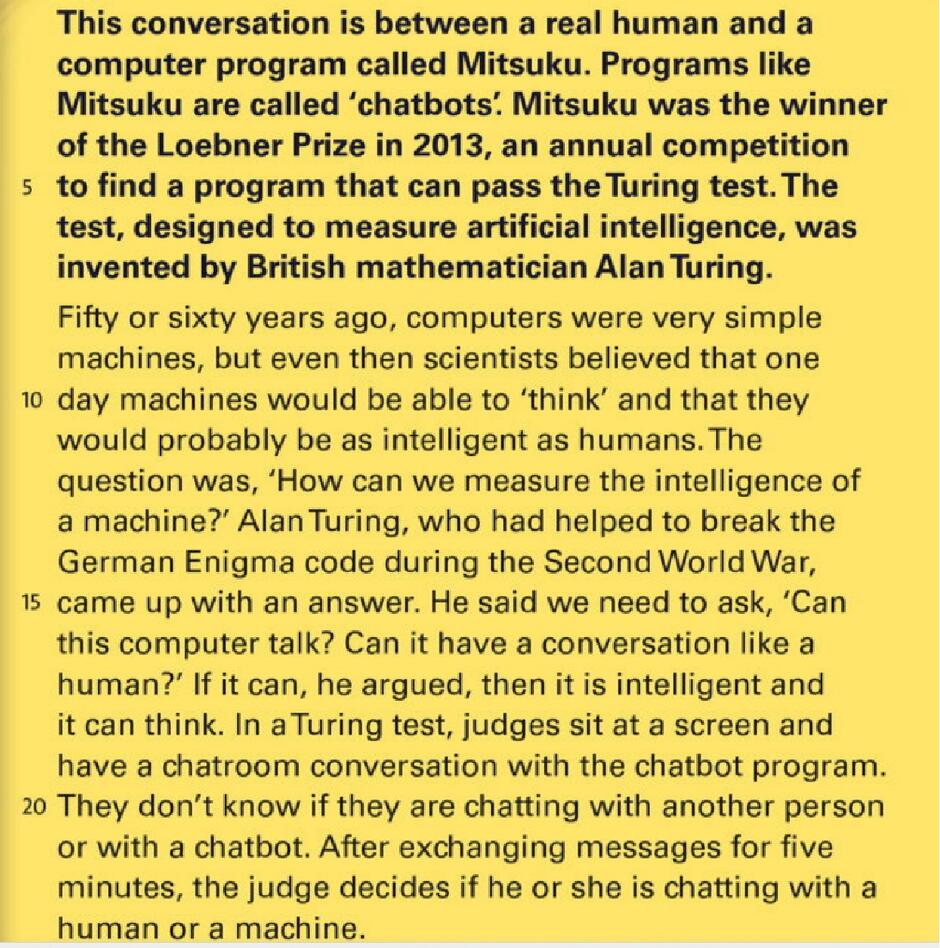
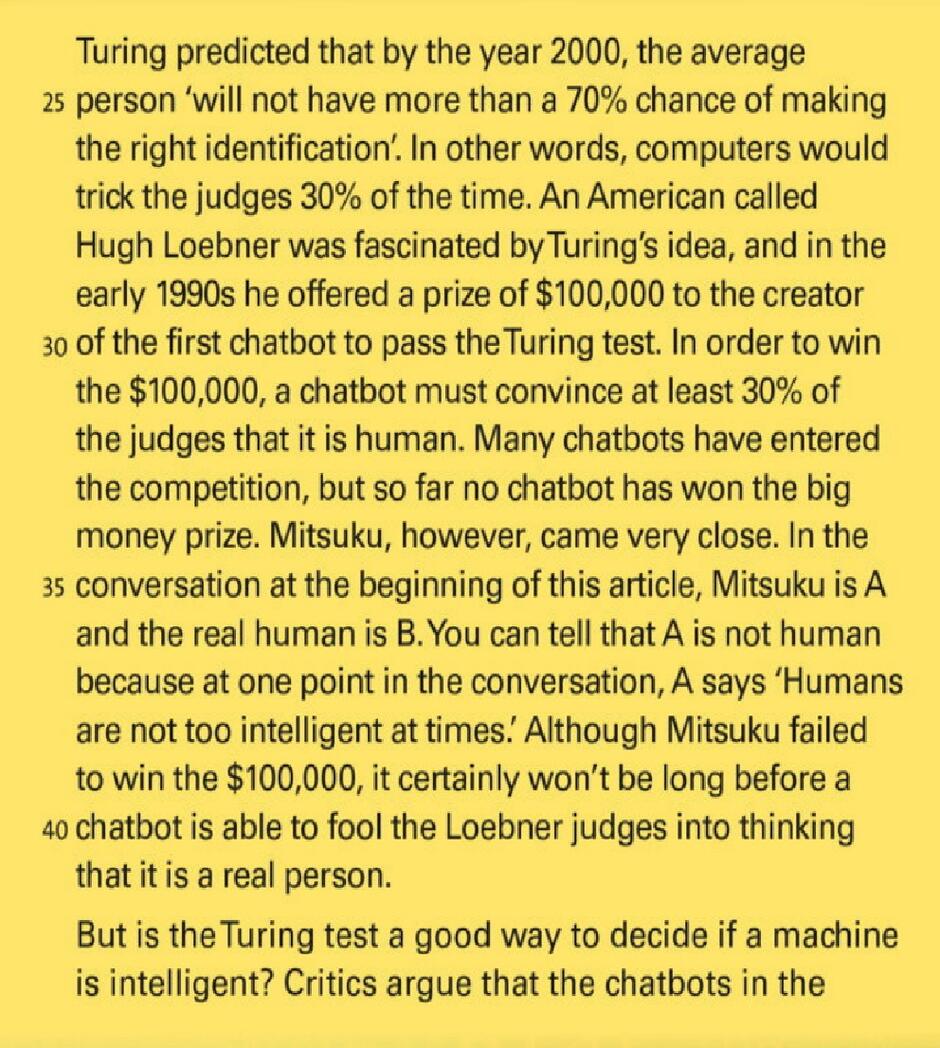
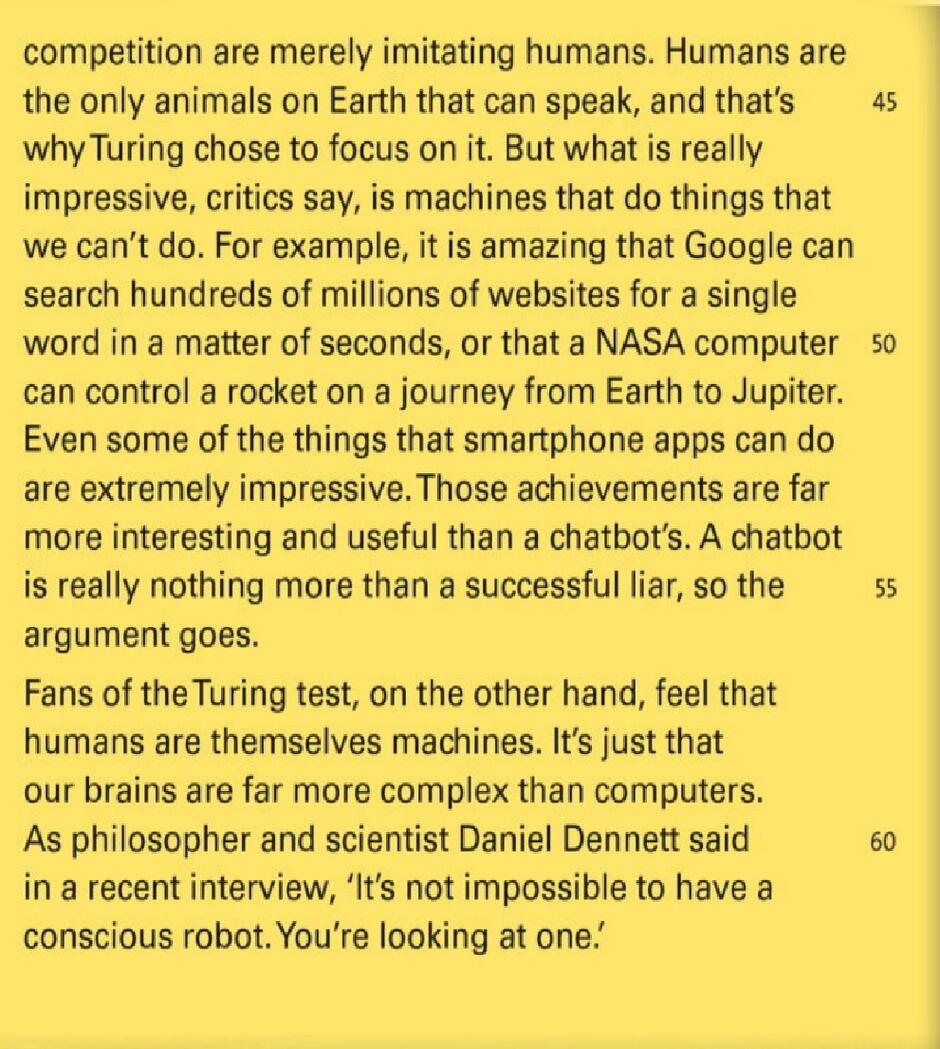 1. Around the middle of the last century, scientists
a tried to build computers that were as intelligent as humans.
b built a machine that could have a conversation with a human.
c thought that computers could never be as intelligent as humans.
d thought that in the future computers and people might be equally clever. [A, B, C, D]
2. According to the Turing test, a computer that could think would be able to
a break the Enigma code.
b talk to people like an ordinary person does.
c chat with another computer.
d have a chatroom conversation for a minimum of five minutes. [A, B, C, D]
3. Chatbots that enter the Loebner competition
a have a 30% chance of winning.
b share prize money of $100,000.
c need to appear human to about a third of the judges.
d will never win the big money prize. [A, B, C, D]
4. The main criticism of the Turing test is that
a Turing focused on the wrong type of intelligence.
b the winner simply has to copy human behaviour.
c Google and NASA computers can also achieve amazing things with the help of chatbots. [A, B, C, D]
d chatbots are designed to do things that we can't do.
5. The writer of the text a agrees
a agrees with the critics of the Turing test.
b is more impressed with search engines than chatbots.
c does not express a personal opinion on the validity of the Turing test.
d believes that people are just very complex robots [A, B, C, D]
Рефлексія від 8 учнів
Сподобався:
0
Так: 5
Ні: 3
Зрозумілий:
0
Так: 5
Ні: 3
Потрібні роз'яснення:
0
Ні: 4
Так: 4