- Всеосвіта›
- Бібліотека тестів›
- Англійська мова›
- 7.4 Television • collocations • phrases related to reading • word building

Тест:
7.4 Television • collocations • phrases related to reading • word building

15.09.2022
Опис тесту (учням цей опис не показується):
Вміст тесту:
1
2
3
4
5
1
4 з 42 балів
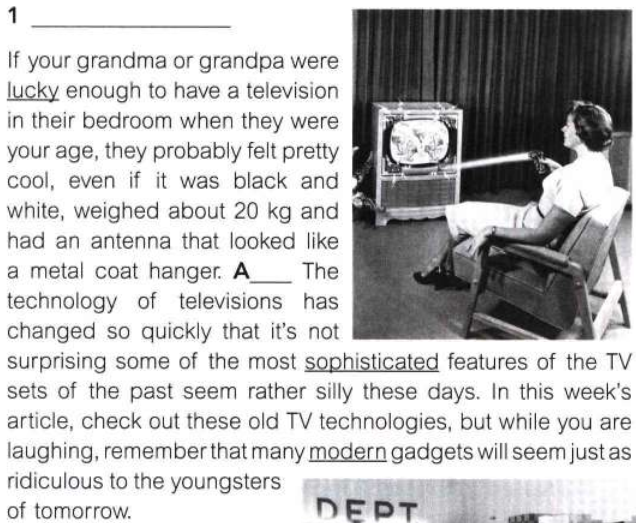
If your grandma or grandpa were lucky enough to have a television in their bedroom when they were your age, they probably felt pretty cool, even if it was black and white, weighed about 20 kg and had an antenna that looked like a metal coat hanger. The technology of televisions has changed so quickly that it’s not surprising some of the most sophisticated features of the TV sets of the past seem rather silly these days. In this week’s article, check out these old TV technologies, but while you are laughing, remember that many modern gadgets will seem just as ridiculous to the youngsters of tomorrow.
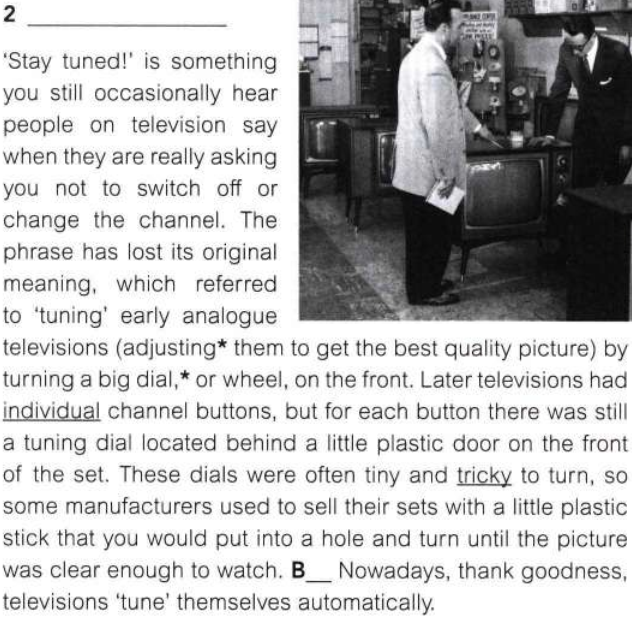
‘Stay tuned!’ is something you still occasionally hear people on television say when they are really asking you not to switch off or change the channel. The phrase has lost its original meaning, which referred to ’tuning’ early analogue televisions (adjusting* them to get the best quality picture) by turning a big dial,* or wheel, on the front. Later televisions had individual channel buttons, but for each button there was still a tuning dial located behind a little plastic door on the front of the set. These dials were often tiny and tricky to turn, so some manufacturers used to sell their sets with a little plastic stick that you would put into a hole and turn until the picture was clear enough to watch. Nowadays, thank goodness, televisions ‘tune’ themselves automatically.
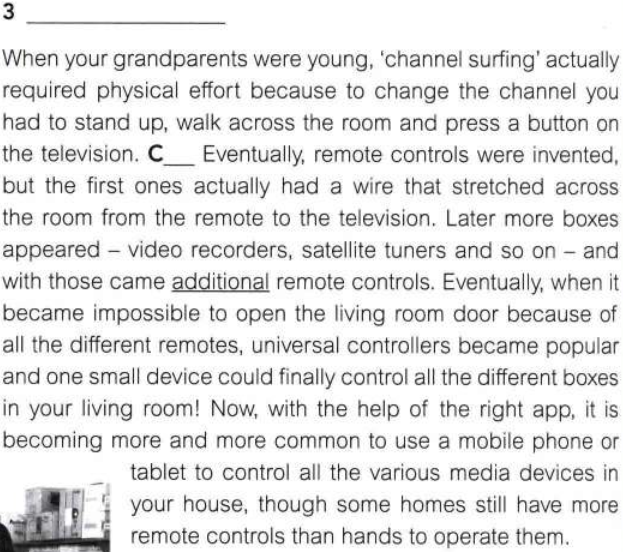
When your grandparents were young, 'channel surfing’ actually required physical effort because to change the channel you had to stand up, walk across the room and press a button on the television. Eventually, remote controls were invented, but the first ones actually had a wire that stretched across the room from the remote to the television. Later more boxes appeared - video recorders, satellite tuners and so on - and with those came additional remote controls. Eventually, when it became impossible to open the living room door because of all the different remotes, universal controllers became popular and one small device could finally control all the different boxes in your living room! Now, with the help of the right app, it is becoming more and more common to use a mobile phone or tablet to control all the various media devices in your house, though some homes still have more remote controls than hands to operate them.
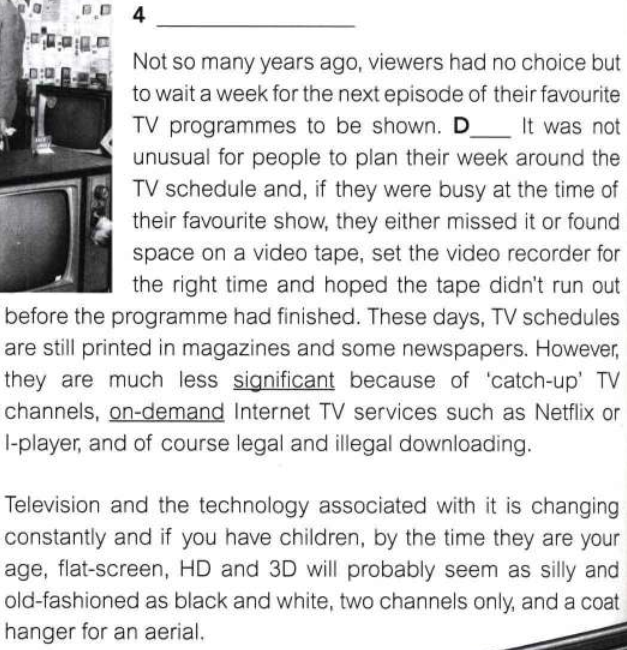
Not so many years ago, viewers had no choice but to wait a week for the next episode of their favourite TV programmes to be shown. It was not unusual for people to plan their week around the TV schedule and, if they were busy at the time of their favourite show, they either missed it or found space on a video tape, set the video recorder for the right time and hoped the tape didn’t run out before the programme had finished. These days, TV schedules are still printed in magazines and some newspapers. However, they are much less significant because of ’catch-up’ TV channels, on-demand Internet TV services such as Netflix or l-player, and of course legal and illegal downloading.
Television and the technology associated with it is changing constantly and if you have children, by the time they are your age, flat-screen, HD and 3D will probably seem as silly and old-fashioned as black and white, two channels only, and a coat hanger for an aerial.
Read the text again and complete gaps with the number (1,2 or 3) of missing sentences below. There is one extra sentence.
1 If you lost this little tool, the entire set became useless.
2 These first colour television sets were extremely expensive.
3 People would check the weekly TV schedule in a magazine or newspaper and highlight the shows they really wanted to watch.
4 Now, just a few decades later most of us carry small, powerful, high-definition, full-colour, multi-media devices in our bags and pockets.
5 Actually, this wasn't such a big problem, because for a long time there were only two or three channels to choose from.
2
4 з 42 балів
Read the text and match headings with parts 1-4. There are two extra headings.
1
А

2
Б

3
В

4
Г

Ґ

Д

3
8 з 42 балів
Match the underlined adjectives in the text with synonyms below. Use a dictionary if necessary.
1
fortunate
А
lucky
2
important
Б
significant
3
advanced
В
sophisticated
4
more
Г
additional
5
single
Ґ
individual
6
instant
Д
on-demand
7
contemporary
Е
modern
8
difficult
Є
tricky
Запитання №4 Із заповненням пропусків у тексті
Запитання №5 Із заповненням пропусків у тексті
Рефлексія від 9 учнів
Сподобався:
0
Так: 7
Ні: 2
Зрозумілий:
0
Так: 7
Ні: 2
Потрібні роз'яснення:
0
Ні: 7
Так: 2