- Всеосвіта›
- Бібліотека тестів›
- Англійська мова›
- 27.05 - 3a (HS1 2021 unit1 summary test)

Тест:
27.05 - 3a (HS1 2021 unit1 summary test)

26.05.2022


Вміст тесту:
1
2
3
4
5
6
7
8
9
10
11
Тест містить питання скопійовані з: HS1 2021 unit1 summary test.
1
12 з 130 балів
Match the words with the translation.
Words
Translation
1
to do the laundry
А
семестр
2
To combine
Б
прогулювати уроки
3
to be angry
В
брати участь
4
to be short of money
Г
покинути
5
to skip lessons
Ґ
відкласти
6
to tell the mistakes
Д
відвідувати
7
to sleep in
Е
працювати над
8
to put aside
Є
розповідати про помилки
9
to sit through
Ж
поєднувати
10
To attend
З
проспати
11
to work on
И
сердитися
12
to participate
І
прати білизну
13
a term
К
шукати
14
to search for
Л
не мати грошей
15
To give up
М
просидіти
2
12 з 130 балів
Complete the table.
derivative | part of speech | translation | |
To participate | |||
| noun | участь | |
| adj | той, що приймає участь | |
| noun | учасник | |
To entertain |
| adj | розважальний |
| noun | розвага | |
| noun | конферансьє, артист |
To decide |
| noun | рішення |
| adj | вирішений, остаточний | |
| adverb | рішуче, безсумнівно | |
| noun | рішучий, вирішальний | |
To attend |
| noun | відвідуваність |
| adj | присутній |
3
12 з 130 балів
Translate the following words and sentences. Mind the usage of the article and the particle "to".
1. спочатку
2. робити щось на дозвіллі
3. подрімати
4. розводити багаття
5. працювати над
6. п’ятихвилинна прогулянка/п’ять хвилин пішки
7. проспати
8. просидіти, витримати до кінця
9. пропускати уроки
10. піти на пікнік
11. покинути, здаватися
12. брати участь
4
12 з 130 балів
Match the verb to look with the prepositions according to the translation.
1
шукати у словнику - to look
А
forward to
2
дивитись на - to look
Б
for
3
доглядати - to look
В
sth up
4
зневажати - to look
Г
back on
5
згадувати - to look
Ґ
through
6
чекати з нетерпінням - to look
Д
after
7
шукати - to look
Е
over sth
8
спостерігати - to look
Є
on
9
проглядати - to look
Ж
down on
10
повторно оглядати - to look
З
at
5
12 з 130 балів
Choose “used to” or “be used to” construction.
1. It was difficult when I first started a university course because I [wasn’t used to having, didn't use to have, wasn’t used] a hectic schedule.
2. There [used to be, was used to be, is used to be] a bakery in the village in those days.
3. She lives in Los Angeles and she [used to going, is used to going, didn't use to going] to Disney Land.
4. Mrs Wilson [used to read, is used to reading, used to reading]four hours a day when she was young.
5. Don't worry about him, he [is used to getting up, used to getting up, used to get up]early every day .
6. I [didn' t use to smoking, wasn't used to smoke, didn' t use to smoke] when I was young.
7. When I was a child , I [was used to collect, used to collect, was used to collecting]used to collect (to collect) stamps.
8. He is nervous because he [doesn't use to speak, is not used to speaking, didn't use to speak] English .
6
12 з 130 балів
Open the brackets.
1. As soon as he (to return) from school, he (сконцентруватися) his studies.
2. Our uncle (підбирати) me after school next time.
3. Where have you been today, Ann? Why (you, прогулювати) the lessons?
4. I (не подобатися) having dinner with my parents. I (зависати з однолітками) instead.
5. While we (їсти не вдома), he (to change) his hectic timetable.
6. Her cousin used (пропускати уроки) in junior school, but now he (to prepare) for very important exams.
7. Why (you, дрімати)? It’s so late and you (робити) so much work already.
8. Spring is over. I (згадувати) on my time in spring camp with great pleasure.
9. Last Friday Nick (вирішувати) to pick up his brother because he (запізнюватись) for the Modern Art lesson.
10. My granny (бути) very busy last week and she (підганяти) on housework.
7
12 з 130 балів
1. When my brother (to be) a pupil he (used to/to be used to) go in for figure skating.
2. Nancy is interested in aerobics and yoga. She (to change) her hectic schedule because she plans to have some spare time for attending the gym.
3. The school years (to end) on the 31th of May.
4. As soon as he (to return) from the concert, he fully (to concentrate on) his studies.
5. It’s the second time I (to go for) a picnic this month.
6. More and more people (to go) to the country.
7. Jane (used to/to be used to) go for two-hour walks after the general cleaning last year.
8. Our aunt (to pick up) me after school next time.
She just (to sort out) and (to do) her laundry, that’s why she (to go out) to the café now.
9. Mark (do like) to skip lessons and hang out with peers for a couple of hours.
Now he (to be fond of / keen on) weight lifting and he (used to/to be used to) participating in the contests.
10. Her nephew (to combine) studies and work. As far as I remember, he (used to/to be used to) overloaded working days and one day-off.
11. My classmates always (to put) aside their preparation for every test.
8
12 з 130 балів
1. Your idea is different [of, from, between, over] mine.
2. She’s quite good [at, in, of, about] English.
3. H’s proud [for, about, with, of]his students.
4. He’s really interested [about, in, of, over] it.
5. I have just [put, putted, putting, puting]it on the desk.
6. If he misses many classes, he will fall [after, apart, off, behind] .
7. Don’t worry! I believe [your , at you, mine, you] .
8. I [did , made, dream, sleep] well in the test.
9. Choose the correct sentence.
[Look! They return., Look! They are coming back., Look! They sing well!, Look! What time now?]
10. I [didn’t see, am not see, haven’t seen, hasn’t seen] you for ages.
11. They work in [a, the, -, an]extremely difficult conditions.
12. You shouldn’t [to promise, promising, will promise, promise]him anything.
13. This is a very expensive holiday which involves a trip [through, along, about, around] the world.
14. She hasn’t come home [still, already, yet, till] .
15. I … [saw, looked, viewed, watched] TV yesterday evening.
16. The teacher asked her students to do their [housework, homework, home duty, house job] .
17. The police officer told the children always to tell the [true, facts, information, truth] .
18. I’m terribly sorry but I [wasn’t listen to, wasn’t hearing, didn’t hear, didn’t heard] what you said just now and I wonder if you could repeat it.
19. Can you [listening, hearing, listen, hear] me all right over there because you are rather a long way away.
20. I [listen, am listening, hear, am hearing] to the concert every Monday on the radio and imagine I am there listening to it in person.
21. What is the name of that picture which you [look at, is looking at, are looking at, looked at] on the wall.
22. [Do you go, Is you going, Are you going, Did you go] to see that film that is on at the cinema next week?
23. Does anyone honestly [discover, think, believe, consider] what a politician says nowadays?
24. I’m sure you’re quite [write, right, all right, serious] but many people disagree with you.
25. This summer we went [on, off, in, by] holiday to Greece.
26. I believe it is [politic, polite, political, politeness] to hold a door open for a lady.
27. What exercise do you like doing [next, best, after, before] of all?
28. That’s a good question but I need [time, space, length, width] to think about it.
29. Don’t worry there’s no need to answer [firstly, fairly, immediately, easily] I’m not in a hurry.
30. I often read short articles [for, at, about, between] pets in my favourite magazines.
31. You will probably agree [with, for, in, on] me.
32. For the whole of next week we are planning to sell our new dictionaries at a special [price, prize, prise, praise] .
33. Can you remember the last time you [have, having, had, will have]such an exciting time?
34. You must be joking. Have you forgotten how terrible I felt the last time we went somewhere [in, with, by, on] plane?
35. Do you drink a [much, many, huge, lot]of tea with sugar?
36. [Which, Who, How, What] are you going to get home from work?
37. [Was, Were, Did, Had] you do much sightseeing when you were on vacation in Madrid?
38. Mr. Lam usually organizes many trips for teachers during the summer holidays. He is [a travel agent, an editor, a taxi driver, an actor].
39. Two girls talked to [each other, to another, with other, with each] [each other, to another, with other, with each] in the room last night.
40. There is so much smoke in the air that it is [enjoyable, pleasant, healthy, unhealthy] to live in many of the world’s cities.
41. The man explained to us [how, how can, how we can, how can we] to get to the airport.
42. He is [a, an, the, -] honest worker.
43. A few students complained [of, on, for, about] the schedule.
44. She is an excellent travel agent, she is very [goodly, goodest, good, gooder]with people, so all the customers like her.
45. The contrast [over, about, between, from] rich and poor is great.
9
12 з 130 балів
TASK 1. For questions 31-42, read the text below and decide which answer А-D best fits each gap.
to revolutionise - революціонізувати
to provide - забезпечувати
environment - середовище
landscaped - озеленений
enclosed - закритий, обгороджений
grand - грандіозний
to gain - здобути
SHOPPING MALLS
Victor Gruen, an American architect, revolutionised shopping in the 1950s by creating the type of shopping centre that we now call a shopping mall.
Gruen's (31)
[A, B, C, D] was to provide a pleasant, quiet and spacious shopping environment with large car parks, which usually (32)
[A, B, C, D] building in the suburbs. He also wanted people to be able to shop in all kinds of weather. He (33)
[A, B, C, D] on using building designs that he knew people would feel (34)
[A, B, C, D]with, but placed them in landscaped 'streets' that were entirely enclosed and often covered with a curved glass roof. This was done to (35)
[A, B, C, D] some of the older shopping arcades of city centres, but while these housed only small speciality shops, Gruen's shopping malls were on a much grander (36)
[A, B, C, D]
Access to the whole shopping mall was gained by using the main doors, which (37)
[A, B, C, D] the shopping 'streets' from the parking (38)
[A, B, C, D] outside. As there was no need to (39)
[A, B, C, D]out bad weather, shops no longer needed windows and doors, and people could wander (40)
[A, B, C, D] from shop to shop. In many cities, shopping malls now (41)
[A, B, C, D] much more than just shops; cinemas, restaurants and other forms of entertainment are also (42)
[A, B, C, D]in popularity.
31 | A direction | B aim | C search | D view |
32 | A resulted | B sought | C intended | D meant |
33 | A insisted | B demanded | C requested | D emphasised |
34 | A favourable | B agreeable | C comfortable | D enviable |
35 | A model | B imitate | C repeat | D shadow |
36 | A measure | B height | C size | D scale |
37 | A disconnected | B withdrew | C separated | D parted |
38 | A strips | B lines | C areas | D plots |
39 | A hold | B get | C stay | D keep |
40 | A freely | B loosely | C simply | D entirely |
41 | A contain | B concern | C consist | D compose |
42 | A becoming | B growing | C raising | D advancing |
TASK 2
Read the text about new books and then choose the correct answer to the questions.
The Long Journey
This book by Simon Cameron is his first book. Simon became a writer after teaching English for several years. Sheila is a nurse in northern Australia, where she works in a small hospital. One day a baby is so ill that Sheila has to drive all night to get here to the nearest big city. They have a lot of problems getting there.
Hard Job
This exciting story is Liz Brown's tenth. Hard Job is about Jojo who works with his father, a carpenter, in Thailand. They work long, hard hours, making tables and chairs, but they do not have any money. Then one day a man dressed in black buys the most beautiful table in the shop.
Hospital or Cinema?
Melanie Smith, who studies English in Manchester, wrote this story earlier this year. Elena is a young Russian woman whose dream is to be a doctor. She goes to London to study English and medicine, but one day she meets a man who asks her to go to the USA with him to become a film star. What will Elena do?
1. Which book is about somebody who works with doctors? [The Long Journey, Hard Job, Hospital or Cinema]
2. Which book is by somebody who has written a lot of books?
[The Long Journey, Hard Job, Hospital or Cinema]
3. Which book is about somebody who is very poor?
[The Long Journey, Hard Job, Hospital or Cinema]
4. Which book is about somebody who would like to work in a hospital?
[The Long Journey, Hard Job, Hospital or Cinema]
5. Which book is by somebody who worked in a school?
[The Long Journey, Hard Job, Hospital or Cinema]
6. Which book is about a man and his son?
[The Long Journey, Hard Job, Hospital or Cinema]
7. Which book is by a student?
[The Long Journey, Hard Job, Hospital or Cinema]
10
12 з 130 балів
TASK 1.
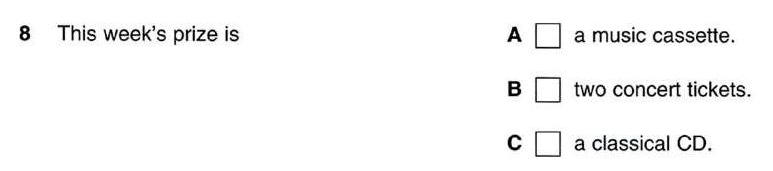
8 - [A, B, C]
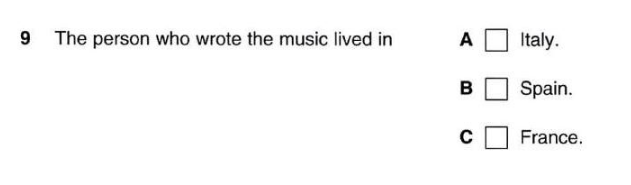
9 - [A, B, C]
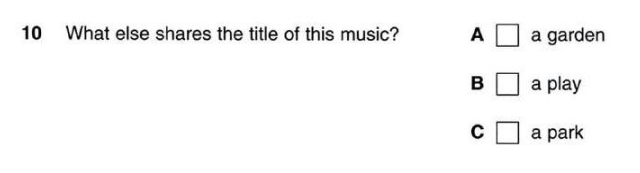
10 -
[A, B, C]
11 -
[A, B, C]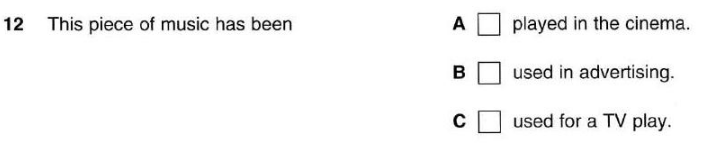
12 - [A, B, C]
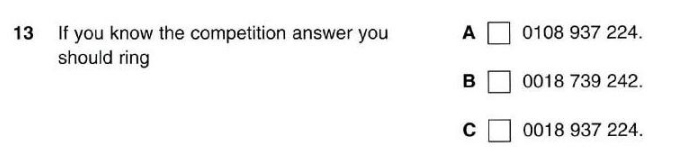
13 - [A, B, C]
11
10 з 130 балів
Listen to the recording and fill in the gaps.
Anyone who does love chocolate is mad. I don’t think I know anyone . Some of my friends say they hate white chocolate or dark chocolate, but then other kind. I think chocolate is one of the best inventions ever. of life’s true pleasures. There’s nothing better than having your whole chocolate and letting it melt. I love pushing the chocolate the roof of my mouth and then moving . Yum. I eat chocolate every day. I know it’s bad for our teeth and , but I don’t care. I prefer to think about the of chocolate. I’ve read many articles that say chocolate is .
Рефлексія від 17 учнів
Сподобався:
0
Так: 16
Ні: 1
Зрозумілий:
0
Так: 13
Ні: 4
Потрібні роз'яснення:
0
Ні: 13
Так: 4