Урок з відвідуванням літературно - меморіального музею Тараса Шевченка. Інтегрованість заходу полягає у залученні іноземної мови до вивчення культурної спадщини України.
Конструктор уроків
- Всеосвіта›
- Бібліотека уроків›
- English›
- Урок - екскурсія «High Spot of Pryorka»

Урок:
Урок - екскурсія «High Spot of Pryorka»
08.02.2026
Опис уроку (учням цей опис не показується):
Вміст уроку:
1
2
3
4
5
6
7
8
1
1 з 28 балів
Morning, folks. At our today’s lesson we are going on an educational excursion. Pretty sure you’ll take an active part in exploring a significant historical and cultural site closely connected with Taras Shevchenko - his house in Priorka, Kyiv. By the end of the lesson, you will be capable of describing this place and explaining its cultural authenticity in fluent English.
2
2 з 28 балів
Look around and take turns telling me:
What makes a place historically important?
Why do writers' houses often become museums?
How can places influence a writer's creative work?
3
5 з 28 балів
I’d like to you to revise a few key words to be able to grasp the information easily:
cultural heritage
literary legacy residence
historical site
creative period
commemorate
preserve
Students are asked to match the words with their definitions and use three of them in their own sentences.
.png)
4
5 з 28 балів
T.: Listen carefully and practise asking questions:
Guide 1:
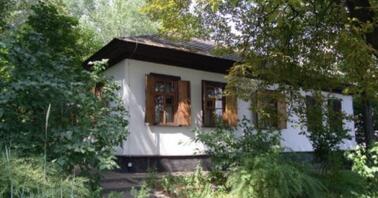
Driving along Vyshhorodska Street from the Kurenivka side, you can see a white Ukrainian house surrounded by a wooden fence. This is the Taras Shevchenko Literary and Memorial Museum. We sometimes drive by here, mostly during working hours, so we never managed to get here. This time it was a day off, and I decided to visit the museum.
Guide 2:
In August 1859, Taras Shevchenko arrived in Kyiv on business before leaving for St.
Petersburg. Once he was walking from Podol, he wanted to rent a house on the outskirts of the city, and he reached Priorka.
Guide 3:
At that time, this area was a place with ordinary huts. Almost every hut had a room for boarders. In general, the poet could have stayed in any of them, but seeing children's clothes hanging in the yard, he decided to stay in this particular hut. He loved children very much.
Guide 4:
At that time, Taras Shevchenko was a famous person for every Ukrainian, but few people knew him by sight. When renting a room, the poet did not introduce himself.
However, over time, he was still recognized.
Varvara Pashkovska, the owner of this house, was proud all her life that Taras Shevchenko had stayed at her house. Then, decades later, when the area was being rebuilt, all the surrounding houses were demolished, but this one was preserved because of its special history.
Guide 5:
There is information that the hut originally stood until 1989 (maybe longer). And later, after it was dismantled, this museum was built in its place, which was an exact copy of that hut.
The museum is located in the territory of the Birch Grove Park. It is fenced off from it by a wooden fence.
Guide 6:
The museum grounds reveal a completely different atmosphere — the area is more well-groomed and somewhat stylized as a residential courtyard of that era. The trees are whitewashed, there are haystacks, and there is a well.
Guide 7
The house has two rooms - two expositions. On the right side is the room Where Taras Shevchenko lived. On the left is an exposition that shows the culture and life of people of that era.
Guide 8:
As soon as you enter the room, your gaze is drawn to a large portrait of Taras Shevchenko.
And it is no coincidence that this portrait hangs here. It was taken in Kyiv during the poet's visit. From this photo you can see what the poet looked like then. In this photo he is 45 years old, but he looks much older.
This is the result of a hard life - hard work, exlle.
You can also see how he was dressed. It's a white shirt and light pants. (The black jacket was given to him by the photographer for the portrait).
Next to the portrait in the corner is a chair with clothes on it, so you can get an idea of what he was wearing. A white shirt, pants, and a hat. The poet also walked with a cane at the time.
Guide 9:
The room is decorated with photographs of Kyiv at that time, as well as portraits of people who were associated with Taras Shevchenko during his visit. On the table are newspaper publications related to the poet's visit to Kyiv.
Please note that the left window is smaller than the right one. The fact is that originally there were two rooms, where the large windows were Taras Shevchenko's room,
and where the smaller ones were the kitchen. It's just that now, to make more space in the museum, they made one large room.
The room contains things that could have been in the poet's room, such as a desk, a bookshelf, etc. Of course, these are not the real things, but simply visual exhibits.
5
5 з 28 балів
Roles:
Museum Guide
Cultural Historian
Visitor
Task:
Each group delivers a short guided speech (2-3 minutes) describing the house, its historical background and cultural value. Students are encouraged to use advanced vocabulary and complex sentence structures.
6
3 з 28 балів
Discussion questions:
Why is Shevchenko's house in Priorka still relevant today?
How does preserving such places contribute to national identity?
Should cultural heritage be integrated into language learning? Why?
7
2 з 28 балів
Students complete the sentence:
One fact that impressed me the most today was...
This excursion helped me understand that...
8
5 з 28 балів
Write a 150-180 word essay:
"Taras Shevchenko's House in Priorka as a Cultural Landmark in the Capital of Ukraine🇺🇦."
Рефлексія від 1 учня
Сподобався:
0
Так: 1
Ні: 0
Зрозумілий:
0
Так: 1
Ні: 0
Потрібні роз'яснення:
0
Ні: 1
Так: 0