Мета уроку: розвивати навички читання, виконання тестових завдань, виховувати зацікавленість здобувачів освіти у розширенні своїх знань.
Конструктор уроків
- Всеосвіта›
- Бібліотека уроків›
- Англійська мова›
- Education in Ukraine

Урок:
Education in Ukraine
14.05.2025
Опис уроку (учням цей опис не показується):
Вміст уроку:
1
2
3
1
Warm Up
Watch the video-joke about importance of learning English properly. Can you explain what the problem was?
Watch one more video and answer the questions which aim to enhance vocabulary related to education, stimulate critical thinking, and encourage you to reflect on your own experiences.
A-level questions:
Where does Mr. Bean take the exam?
(In a big exam hall / At a school.)What does Mr. Bean bring with him to the exam?
(A pencil case, pens, and paper.)What problem does Mr. Bean have during the exam?
(He studied the wrong subject.)Does Mr. Bean try to copy from another student?
(Yes, he tries to cheat.)What does Mr. Bean do when he gets nervous?
(He panics and acts strangely.)What does the other student do during the exam?
(He writes quietly and ignores Mr. Bean.)Does Mr. Bean finish his exam?
(No, he doesn’t.)What can we learn from Mr. Bean’s experience?
(It’s important to study the right topic and be prepared.)
B-1 -level questions:
Why is it important to read exam instructions carefully?
(Because misunderstanding them can lead to serious mistakes, like answering the wrong questions.)How does Mr. Bean's behavior affect other students during the exam?
(It distracts and possibly annoys them.)What does this video suggest about relying on cheating in exams?
(That it’s ineffective and usually leads to failure.)What skill does Mr. Bean lack that causes him problems in the exam?
(He lacks good preparation and time management.)How does the video use humor to comment on exam stress?
(It exaggerates the situation to show how stressful exams can feel.)What could Mr. Bean have done differently to succeed?
(He could have studied the right subject and stayed calm.)How does the lack of dialogue help or hurt the storytelling in the video?
(It helps by making the situation universally understandable.)What message about education does this clip send to students?
(That being prepared and honest is the best way to succeed.)
B 2-level questions:
What subject did Mr. Bean prepare for, and what subject was the actual exam about?
How did this mismatch affect him?What strategies did Mr. Bean use to try and cheat during the exam?
Were any of them successful?How did Mr. Bean react when he realized he had studied the wrong material?
What emotions did he display?What was the significance of the two different colored exam papers?
How did this detail impact the outcome?Why did Mr. Bean struggle to write when he finally found the correct exam paper?
What solution did he attempt?How did the invigilator respond to Mr. Bean's actions during the exam?
Was the response appropriate?What lessons can students learn from Mr. Bean's experience in this clip?
Discuss the importance of preparation and honesty.Have you ever faced a similar situation where you were unprepared for a test?
How did you handle it?Do you think humor is an effective way to address serious educational topics like cheating and exam pressure?
Why or why not?
2
Vocabulary:
education- освіта;
a state/private school - державна/ приватна школа;
a сlassmate - однокласник;
spacious - просторий;
compulsory - обов'язковий;
comprehensive secondary education - загальна середня освіта;
primary education - початкова освіта;
higher education - вища освіта;
library - бібліотека;
саnteen - їдальня;
gym - спортивна зала;
assembly hall - актова зала;
swimming pool - басейн;
to graduate from institute - закінчити інститут/ випуститися з інституту;
graduate - випускник (коледжу, ВНЗ);
school-leaver - випускник школи;
entrance exams - вступні екзамени;
It is common practice - так заведено, загально прийнято;
scholarship - стипендія;
the Bachelor’s Degree - ступінь бакалавра
comprise - містити в собі, охоплювати
curriculum - курс навчання, навчальна програма
EIT (External Independent Testing) - ЗНО
at the expense of - за чийсь рахунок
average mark - середня оцінка
senior school - старша школа
according to - відповідно до
1 Watch the video and do the tasks pausing it where it is suggested.
https://www.youtube.com/watch?v=C2qsE8551KI
2 Read the text and do the task below:
EDUCATION IN UKRAINE
The education system in Ukraine is changing. Now a child has to study in school for 12 years, like a lot of pupils in Europe. Also, more and more schools are following the New Ukrainian School programme that promotes innovation, creativity, and cooperation between teachers, parents, and their children. We asked two pupils from a state school and a private school to share what they like about their schools and what other changes at their schools they want to see.
 Lina I study in a state school. I like my school, my classmates, and the teachers. Everyone is friendly to each other; the teachers are very kind and helpful, they explain the material in an interesting way and make it easy to understand.
However, there are a few things I would happily change in my school. Firstly, the start time of the first lessons why do we have to wake up so early? Secondly, I would make classes smaller - there are around 30 children in every form, and it often becomes too noisy during lessons. I would also, make our classrooms more modern and add more technology like interactive whiteboards, tablets, and computers. Besides, I would prefer to study only the subjects we need for the future, like in most European schools.
 Mark My parents chose a really great private school for me. The school building is quite spacious and modern. All the classrooms have interactive whiteboards, computers, tablets that everyone can use freely. We also have a swimming pool and the gym, and I enjoy our lessons there. But the most amazing place is our library, there are not only paper books and magazines; pupils can also surf the Internet and watch different educational films there. Is there anything l would like to change? The compulsory school uniform. I would like to wear something more casual like jeans and pullovers instead of jackets and trousers. Oh, and one more thing, the lessons should start a little later because I would like to stay in bed for longer in the morning.
Choose: Mark or Lina?
Mark/Lina studies in a private school that has modern classrooms and lots of technology.
Mark/Lina would like to start lessons later in the morning.
Mark/Lina enjoys doing sports in the swimming pool and gym at school.
Mark/Lina thinks there are too many students in his/her class, and it gets noisy.
Mark/Lina doesn’t like wearing a school uniform and prefers casual clothes.
Mark/Lina says his/her teachers are kind and explain the material clearly.
Mark/Lina likes spending time in the school library with books, the Internet, and educational films.
Mark/Lina wants to study only the subjects that are important for the future.
Mark's//Lina's school has tablets and computers that students can use anytime.
Mark/Lina would like to modernize the classrooms in the school.
GRAMMAR
Adverbs of manner and modifiers
А Read the sentences with the adverbs in bold in the text and choose the correct alternative.
Adverbs such as quite, very, really, too modify adjectives/ verbs.
Adverbs such as happily and freely modify adjectives /verbs.
В Read the following sentences and fill in the gaps with the adverbs below.
loudly / safely / nicely / very /fully / too / slowly
1 All pupils should know traffic rules to travel to school ...
2 Walk along the school corridors ...
3 When the teacher asks you a question, answer it ...
4 English is ... important for university education.
5 Spending ... much time playing computer games can harm your eyes.
6 We mustn't speak ... in the school library.
7 Our English teacher always talks to us ... .
3 Read the text below. For questions (1—6) choose the correct answer (A, B, C or D).

The Ukrainian educational system is organised into four levels: primary, secondary, higher and postgraduate education.
Younger school comprises grades 1 to 4. Grades 5—9 are usually referred to as «middle school», while 10—12 are «senior school». Despite the names, students usually study in the same school building throughout their primary and secondary education.
Primary schooling lasts 4 years and middle school — 5. The middle school curriculum varies slightly between schools. There are then 3 profile years.
During grades 9 and 11, students take various exams. The current examination system is undergoing change. At the 9th grades students take GTC (Governmental Total Certification) and the students of the 11th grades need to pass both GTC and EIT (External Independent Testing) that allow to define their university entrance eligibility. From 2008, entrance exams were replaced by the EIT. The results of the testing will have the same status as entrance examinations to institutions of higher education.
Higher education is either state-funded or private. It is common practice that university candidates are not required to pass an entrance examination if they are willing to pay for their education. Students that study at state expense receive a standard scholarship if their average mark at the end-of-term exams and differentiated test is at least 4; this rule may be different in some universities. In the case all grades are 5, the scholarship is increased by 25 %. There are two degrees conferred by Ukrainian universities: the Bachelor’s Degree (4 years) and the Master’s Degree (5—6 years). These degrees are introduced in accordance with Bologna process, in which Ukraine is taking part.
1) Grades 10—12 are usually referred to as ...
A postgraduates. C «middle school».
B «senior school». D bachelors.
2) What exams allow twelfth (currently eleventh) graders to enter university without taking separate entrance exams?
A External Independent Tests.
B Entrance Tests.
C Ability Tests.
D School-Leaving Examinations.
3) University candidates are not required to pass an entrance examination if ...
A they have good academic results.
B they are willing to pay for their education.
C they enter state-funded universities.
D they successfully passed more than three Government Tests.
4) Students that study at state expense receive a standard scholarship if their average mark at the end-of-term exams and differentiated test is ...
A no less than 4. C at least 5.
B at least 9. D 5 on average.
5) What are the two degrees conferred by Ukrainian universities?
A The Doctor Degree and the Master’s Degree.
B The Bachelor’s Degree and the Master’s Degree.
C The Bachelor’s Degree and the Doctor of Philosophy.
D The Bologna Degree and the Master’s Degree.
4 Read the text. Choose from (a—h) the one which best fits each space (1—7). One choice is extra.
Every year, thousands of international students consider studying abroad 1) __ , with the hope of better educational and work opportunities in the future. However, no matter whether you are looking for online associate degrees, an MBA, or language courses, obtaining a university education requires 2) __ to make sure the experience is right for you.
Looking to improve your language skills, but you don’t have the time to go overseas to attend a school? More and more universities around the world are offering opportunities for students to obtain degrees online (distance education) from the comfort of their own homes, and many of these institutions are accredited, meaning 3) __ .
If you decide to take language courses online (or any subject for that matter), be sure to evaluate the benefits of studying online 4) __ . The advantages of studying online are that the costs are usually lower, you can study at your own pace, and you have access to the materials 24-hours-a-day 5) ___ in the world. However, you won’t get the human interaction of meeting people face to face like you would if you were physically attending a school overseas.
On the other hand, the advantages of going overseas may include day-to-day opportunities to learn a new culture, meet new friends 6) __ , and chances to see different parts of the world. However, there may be a number of disadvantages for some including expense, time away from one’s school, family, or work life, and the challenge of adapting to a new culture and way of life.
Whatever you do, consider a distance education programme 7) __ , whether it is within your budget, and equally important, whether it provides you with opportunities to grow beyond the classroom through cultural and educational activities.
A that meets your educational needs
B reviewed and evaluated
C versus going abroad
D with whom you can use and practise the language
E from almost any computer
F careful planning and research
G to pursue a university degree
H that they have met certain standards of excellence
3
5 Read the text. Choose from (a—h) the one which best fits each space (1—7). One choice is extra.
Every year, thousands of international students consider studying abroad 1) __ , with the hope of better educational and work opportunities in the future. However, no matter whether you are looking for online associate degrees, an MBA, or language courses, obtaining a university education requires 2) __ to make sure the experience is right for you.
Looking to improve your language skills, but you don’t have the time to go overseas to attend a school? More and more universities around the world are offering opportunities for students to obtain degrees online (distance education) from the comfort of their own homes, and many of these institutions are accredited, meaning 3) __ .
If you decide to take language courses online (or any subject for that matter), be sure to evaluate the benefits of studying online 4) __ . The advantages of studying online are that the costs are usually lower, you can study at your own pace, and you have access to the materials 24-hours-a-day 5) ___ in the world. However, you won’t get the human interaction of meeting people face to face like you would if you were physically attending a school overseas.
On the other hand, the advantages of going overseas may include day-to-day opportunities to learn a new culture, meet new friends 6) __ , and chances to see different parts of the world. However, there may be a number of disadvantages for some including expense, time away from one’s school, family, or work life, and the challenge of adapting to a new culture and way of life.
Whatever you do, consider a distance education programme 7) __ , whether it is within your budget, and equally important, whether it provides you with opportunities to grow beyond the classroom through cultural and educational activities.
A that meets your educational needs
B reviewed and evaluated
C versus going abroad
D with whom you can use and practise the language
E from almost any computer
F careful planning and research
G to pursue a university degree
H that they have met certain standards of excellence
6 Read the magazine article.
Primary and Secondary Education in Ukraine
In Ukraine children start going to school at the age of six or seven. There are also kindergartens in Ukraine, where children study from three-four years old. Primary and secondary education is compulsory. There is a state sector and a private one in the system of education. Schoolchildren attend state schools for free, but private schools are fee-paying.
Primary and secondary education in Ukraine is divided into:
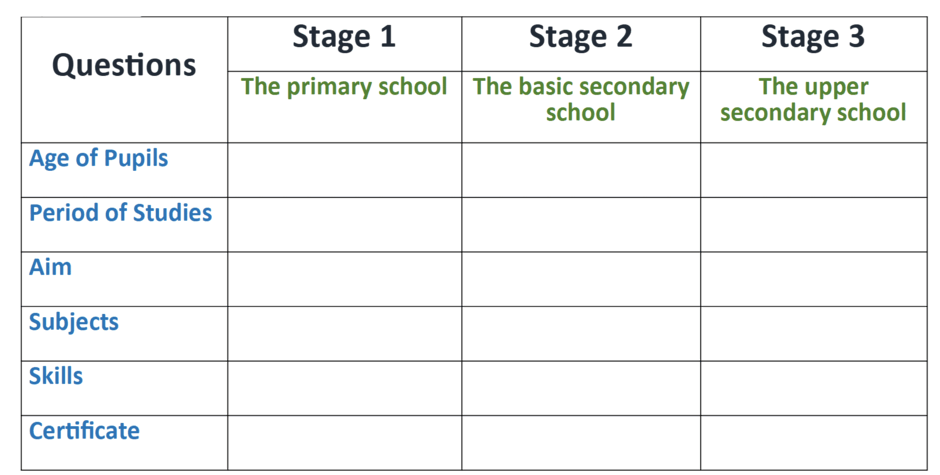
Stage 1: the primary school – four years of studies. Children get basic knowledge and skills in mathematics, languages and nature study.
Stage 2: the basic secondary school – five years of studies. Pupils get knowledge and skills in science and humanities, mother tongue and foreign languages. The basic school certificate gives 14–15 year olds the right to continue schooling both at the upper secondary school and colleges or vocational schools.
Stage 3: the upper secondary school lasts two years. Pupils can either continue their education in a secondary school or can change schools and begin to and study more detailed mathematics and physics, biology, history, or get computer skills and a trade education. After finishing the 11th form of the upper secondary school, a lyceum or a gymnasium, one must take standard assessment tests and go into higher education. All applicants become students on a competitive basis according to their test results.
kindergarten - дитячий садочок
compulsory - обов'язковий
the primary school - початкова школа
the basic secondary school - середня школа
the upper secondary school - старша школа
applicant - абітурієнт
7 Complete the table.
Рефлексія від 14 учнів
Сподобався:
0
Так: 13
Ні: 1
Зрозумілий:
0
Так: 13
Ні: 1
Потрібні роз'яснення:
0
Ні: 13
Так: 1