
Quick Summary
The SAP SuccessFactors Onboarding certification rewards a clear view of how onboarding processes, system configuration, permissions, data collection, and integrations connect. This guide walks through seven topic areas from the official course, a five-stage study plan, and the current assessment details to confirm with SAP before you book.
Introduction: What to Know Before You Start Studying
Preparing for SAP SuccessFactors Onboarding certification means understanding how employee onboarding processes, system configuration, permissions, data collection, and integrations work together. A structured plan helps candidates organize these topics and build the practical knowledge that consultant-oriented assessment scenarios call for.
The C_THR97 certification belongs to SAP SuccessFactors Onboarding. SAP recommends reviewing its official certification information and the Configuring SAP SuccessFactors Onboarding course before the assessment. Candidates can start with this SAP SuccessFactors Onboarding Study Guide to organize preparation around the certification's major subject areas.
What the study guide covers
SAP SuccessFactors Onboarding supports employee transitions through preboarding, onboarding, internal hiring, rehire, and offboarding. The platform helps organizations coordinate information collection, assigned tasks, documentation, and employee lifecycle processes.
The SAP SuccessFactors Onboarding Academy course includes 20 units on core configuration and related functionality, which gives your preparation a ready-made structure.
A strong plan ties each topic to its business purpose. Knowing why a configuration exists, who uses it, and how it interacts with another process builds a more complete picture of the platform.
Key topics to study for SAP SuccessFactors Onboarding
Onboarding fundamentals and system configuration
Begin with the purpose, structure, and core functions of SAP SuccessFactors Onboarding. See how onboarding activities support the transition from candidate to employee and how different participants contribute along the way.
Next, review the configuration concepts from the official course, including enabling and configuring Onboarding in Provisioning and the settings that core functionality depends on.
Link system configuration to business requirements. A single configuration decision can change how an onboarding program operates, how tasks are assigned, and how employees experience the process.
Role-based permissions and participant responsibilities
Permission management is a central part of Onboarding administration. Administrators, hiring managers, recruiters, new hires, and other participants each need access that matches their responsibilities.
Study the role-based permission model with attention to permission roles, assigned users, target populations, and available permissions. Together these concepts show how organizations control access and keep the onboarding process consistent. Tie each permission concept to its operational purpose so access control fits into the broader configuration model.
New-hire processing and onboarding programs
New-hire processing connects recruitment activity with onboarding tasks. The official course covers initiating the new-hire process and configuring programs that coordinate the activities each employee situation requires.
Study how onboarding can begin through SAP SuccessFactors Recruiting and through other supported processes. Review task assignments, responsible groups, and business rules. Programs organize activities to match organizational requirements, and business rules decide how particular conditions affect program selection and task assignment.
Understand the chain from triggering event to employee information, program configuration, assigned responsibilities, and task completion.
Onboarding data models and additional data collection
Organizations need accurate employee information to support administrative and operational processes, which makes data collection central to onboarding.
The SAP course covers defining the Onboarding data model and creating custom MDF objects for additional data collection. Study what these components do and how they support requirements beyond standard fields. Key concepts include the structure of collected information, custom fields, and the relationship between onboarding information and connected SAP SuccessFactors processes.
Data models also give context for document generation, employee records, reporting, and integrations. Consider how information moves through the employee lifecycle, and link the configuration components together as you go.
Compliance forms, documents, and electronic signatures
SAP's Onboarding Academy covers activating compliance forms, creating document templates, and using electronic-signature tools.
Review how compliance forms collect required information and how document templates produce consistent documentation. The curriculum also includes e-signature functionality and integrations with tools such as DocuSign.
Email services belong here too. Study standard and custom email templates, notification status, and custom tokens. Together these features help organizations manage documentation, communicate required actions, and track activity.
Rehires, internal hires, and process variants
Employee transitions differ with employment history and organizational circumstances, so the official course includes managing rehires, using the internal-hire process, and customizing onboarding through Process Variant Manager.
Learn how rehire-related checks support the process and how internal hiring differs from a standard new-hire workflow. Review the purpose of process variants and how business requirements shape onboarding configuration.
The curriculum also covers cancelling onboarding processes and triggering no-show events, which show how the system handles changes to an employee's onboarding status.
Offboarding, integrations, and reporting
Preparation extends past the initial onboarding process. SAP's course includes offboarding and employee termination, onboarding integrations, and report creation.
For offboarding, review programs, permissions, business rules, and the alumni experience, and consider how employee lifecycle requirements influence their design.
Integration topics cover connections between Onboarding and other systems, including Recruiting, Employee Central, Learning, and external platforms. Understand the purpose of each connection and the role of data exchange in coordinated HR processes.
The course also covers creating Story Reports from Onboarding data. Reporting concepts connect day-to-day activity with monitoring and analysis needs.
How to build an effective study plan
A structured schedule makes the syllabus easier to manage. Group related subjects into stages and study them together.
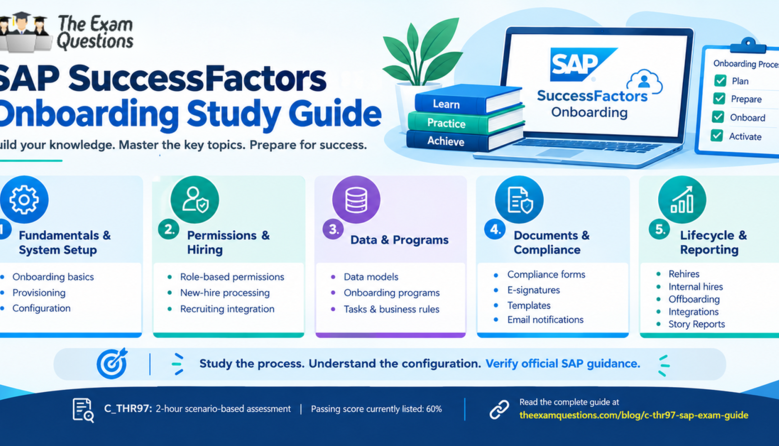
The first stage covers fundamentals: the Onboarding process, system configuration, and role-based permissions. Build a clear view of the platform's purpose and core structure.
The second stage covers configuration and data: new-hire processing, onboarding programs, business rules, data models, and additional data collection, each linked to its business use.
The third stage covers documentation and employee scenarios: compliance forms, templates, electronic signatures, email services, rehires, internal hires, and process variants.
The fourth stage widens the view to offboarding, integrations, reporting, and the relationships between onboarding and other HR processes.
The fifth stage consolidates your knowledge. Revisit difficult concepts, summarize configuration relationships in your own words, and review current SAP guidance. Use authorized training environments when available to build familiarity with the workflows.
This approach builds conceptual understanding and keeps preparation aligned with the published course structure.
Verify the official certification requirements
The SAP official certification page lists C_THR97 as a scenario-based assessment lasting two hours, with a 60% passing score. SAP identifies the certification as intended for SAP partner consultants who implement the solution.
Certification and provisioning access are separate matters. SAP states that provisioning rights go exclusively to registered SAP partner consultants after certification, so passing the exam leaves customers and independent consultants without those rights.
Certification arrangements and assessment details can change, so review the SAP page before scheduling. The Onboarding Academy course supplies the detailed topic sequence for technical preparation.
Conclusion
A well-organized SAP SuccessFactors Onboarding Study Guide moves you from individual product concepts to a broader understanding of onboarding configuration and employee lifecycle processes.
Focus on system setup, permissions, new-hire processing, data models, onboarding programs, compliance, documents, integrations, and reporting. Tie every subject to its business purpose, and review the current official SAP information before the assessment.
For further certification guidance, visit The Exam Questions and use the C_THR97 exam guide alongside SAP's official certification details to support a structured preparation plan.