
Quick Summary
Preparing for the SAP Business AI Platform Administrator certification calls for an understanding of SAP BTP account management, security, connectivity, runtime environments, and platform operations. This four-week plan gives you a structured way to review technical concepts, practise administrative tasks, and build confidence before the practical assessment.
Introduction to a four-week preparation schedule
Cloud technology has changed how organisations develop, manage, and operate enterprise applications. Platforms such as SAP Business Technology Platform (SAP BTP) let businesses connect applications, manage services, and support different enterprise workloads through a common cloud environment.
Managing such an environment takes more than general cloud knowledge. Administrators understand account structures, user permissions, service configurations, connectivity, and operational monitoring.
The SAP Business AI Platform Administrator Study Plan helps IT professionals, technical students, and educators organise their preparation around these responsibilities. It combines topic-based revision with practical exercises, so candidates understand what each platform component does and how it is administered.
A four-week schedule breaks the preparation into manageable stages and gives you time to build technical understanding and review important administrative activities.
Understanding the SAP Business AI Platform Administrator certification
SAP currently offers the certification SAP Certified – SAP Business AI Platform Administrator, identified by the code C_ADBTP.
The assessment evaluates a candidate's ability to manage and administer SAP BTP environments. According to the SAP official certification page, the assessment uses one system-based activity, runs for two hours, and requires a 100% passing score.
This practical format makes familiarity with the SAP environment especially valuable. Candidates should know how to configure settings, manage permissions, investigate technical issues, and verify administrative operations.
SAP's Operating SAP Business AI Platform course contains nine units covering the major administrative responsibilities. These units provide a useful foundation for building your syllabus review and preparing for the certification.
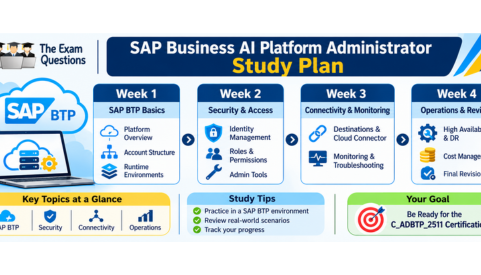
The four-week study schedule
The schedule below is a suggested preparation framework and sits alongside SAP's own materials. Adjust the timing according to your previous experience and familiarity with cloud administration.
Week one: understand SAP BTP fundamentals
The first week focuses on the platform and how its components are organised.
Main topics:
Overview of SAP BTP and administrator responsibilities.
Global accounts, directories, and subaccounts.
Service entitlements and quotas.
Cloud Foundry and Kyma environments.
Basic runtime administration.
Start by understanding how an SAP BTP global account is structured. Learn how directories and subaccounts organise services and environments.
Next, examine the difference between service entitlements and quotas. Entitlements determine which services are available for allocation, and quotas define the allocated capacity.
Spend some time comparing Cloud Foundry and Kyma. Understand their purposes, how they support different workloads, and which administration tools go with each environment.
Practical activity: explore the SAP BTP cockpit, identify account-level settings, and examine available service configurations. Draw a simple diagram showing the relationship between the global account, directories, and subaccounts.
By the end of the week, you can explain the basic platform structure in your own words.
Week two: identity management and configuration tools
The second week focuses on platform security and the tools used to manage SAP BTP environments.
Main topics:
Identity providers and user administration.
Authentication and authorisation.
Role templates, roles, and role collections.
SAP Automation Pilot.
Command-line interfaces and kubectl.
Terraform fundamentals.
Identity and access management deserves particular attention because it shapes how users and applications interact with platform services.
Understand why authentication and authorisation differ. Authentication verifies who a user is, and authorisation determines which operations that user can perform. Study how role collections are assigned and how administrators investigate permission-related problems.
Also become familiar with administrative tools: SAP Automation Pilot, command-line interfaces, kubectl for Kyma administration, and Terraform for infrastructure automation.
Practical activity: work through a user-access scenario. Identify the user, examine the assigned permissions, and determine which changes would provide appropriate access. Explain why each configuration step is required, so the work goes beyond following instructions.
Week three: connectivity and platform monitoring
The third week connects platform administration with everyday operational responsibilities.
Main topics:
SAP BTP destinations.
SAP Cloud Connector.
Cloud-to-on-premise connectivity.
Application monitoring and logs.
Alerts and observability.
Troubleshooting common configuration issues.
Applications frequently communicate with other enterprise systems. Administrators understand how destinations define connection details and how SAP Cloud Connector supports secure communication with on-premise environments.
Monitoring matters just as much. Application logs, alerts, and operational information help identify problems before they affect business processes.
Practical activity: consider an SAP BTP application that cannot communicate with an internal enterprise system. Create a troubleshooting checklist covering destination settings, Cloud Connector status, and backend connectivity. Then consider an application that becomes unavailable, and identify which operational indicators could reveal the cause.
By the end of this week, you can approach common connectivity and monitoring problems systematically.
Week four: availability, cost management, and final revision
The final week brings the previous topics together and focuses on operational decision-making.
Main topics:
High availability.
Disaster recovery.
Observability and monitoring review.
Service consumption and cost management.
Entitlement and quota management.
Practical task revision.
Understand how high availability reduces service disruption and how disaster recovery supports restoration after major incidents.
Review service consumption and the relationship between allocated capacity and actual usage. Administrators monitor these areas to limit unnecessary costs and spot capacity-related problems.
During the remaining days, revisit account configuration, access management, connectivity, and runtime environments.
Practical activity: complete a mixed administration exercise. Start with an account configuration scenario, examine user permissions, check service availability, and investigate a connectivity issue. Finish by reviewing the relevant consumption information. Complete each activity independently and verify the result.
How to make your preparation more effective
A timetable delivers value when it leads to consistent progress. Combine concept revision with practical exercises in every session.
Use three simple methods to evaluate your understanding:
Maintain a mistake record: write down the task, the error encountered, its likely cause, and the correction. This keeps revision focused.
Repeat administrative operations: complete important tasks more than once, and try performing them from memory.
Explain technical decisions: after configuring a service or assigning a role, explain why the change was necessary and how you verified the result.
These methods build practical understanding that serves you well beyond the certification itself.
Common preparation mistakes to avoid
Connect terminology to behaviour: knowing what a subaccount is helps most when you also understand service allocation and administration.
Give identity and access management enough time: a successful login confirms identity, and the assigned permissions decide which operations a user can perform.
Practise connectivity and troubleshooting scenarios: administrators often investigate problems involving multiple components.
Judge readiness by task completion: the important question is whether you can complete the required administrative task accurately and independently, whatever your practice scores show.
Frequently asked questions about SAP BTP administrator preparation
How long should I follow this schedule?
The suggested schedule covers four weeks. Candidates with previous SAP BTP experience may need less time, and beginners may benefit from additional practice.
What is the assessment format?
SAP currently lists C_ADBTP as a system-based assessment with one activity and a two-hour duration. The published passing score is 100%. Verify the latest conditions in your certification account.
Which topic deserves the most attention?
Identity and access management deserves particular attention, alongside account structure, runtime environments, configuration tools, and connectivity. SAP's official course outline provides nine units covering these responsibilities.
Is practical experience important for SAP BTP administration?
Yes. Practical familiarity helps candidates understand how settings affect platform operations. It also makes troubleshooting and configuration tasks easier to approach.
Can beginners follow this plan?
Yes. Beginners can follow the schedule by first understanding basic SAP BTP concepts and gradually moving toward administrative exercises. Some familiarity with cloud platforms makes preparation easier.
Conclusion
A structured plan makes certification preparation easier to organise and evaluate. Dividing the work into four weeks gives candidates time to understand platform fundamentals, practise identity management, explore connectivity, and review operational responsibilities.
The key objective is the ability to perform administrative tasks accurately, with technical definitions as supporting knowledge. Consistent practice, careful troubleshooting, and regular revision also build useful professional skills for managing enterprise cloud environments.
Continue your C_ADBTP exam preparation
Use the four-week schedule as a starting point, review your weaker topics, and practise administrative tasks regularly. For additional exam-focused preparation, visit The Exam Questions and explore C_ADBTP practice material alongside your technical preparation.